
39 Essential Questions to Promote Teacher Inquiry and Reflection


When Hollywood Director Gregory Ratoff said, “Let me ask you a question, for your own information”, a lot of people raised a doubtful eyebrow and wondered what he meant.
The phrase even made its way into the hilarious book called “776 stupidest things ever said” alongside classics like “I totally agree with everything I just said” and “A verbal contract isn’t worth the paper it is written on”. 😀
However, as inquiry educators, we now realize that what Gregory gave us was actually an absolute gem. Because we understand that the right questions have the power to guide our attention towards crucial information, help us reflect more deeply, and gain better insight into various subjects as well as our own selves.
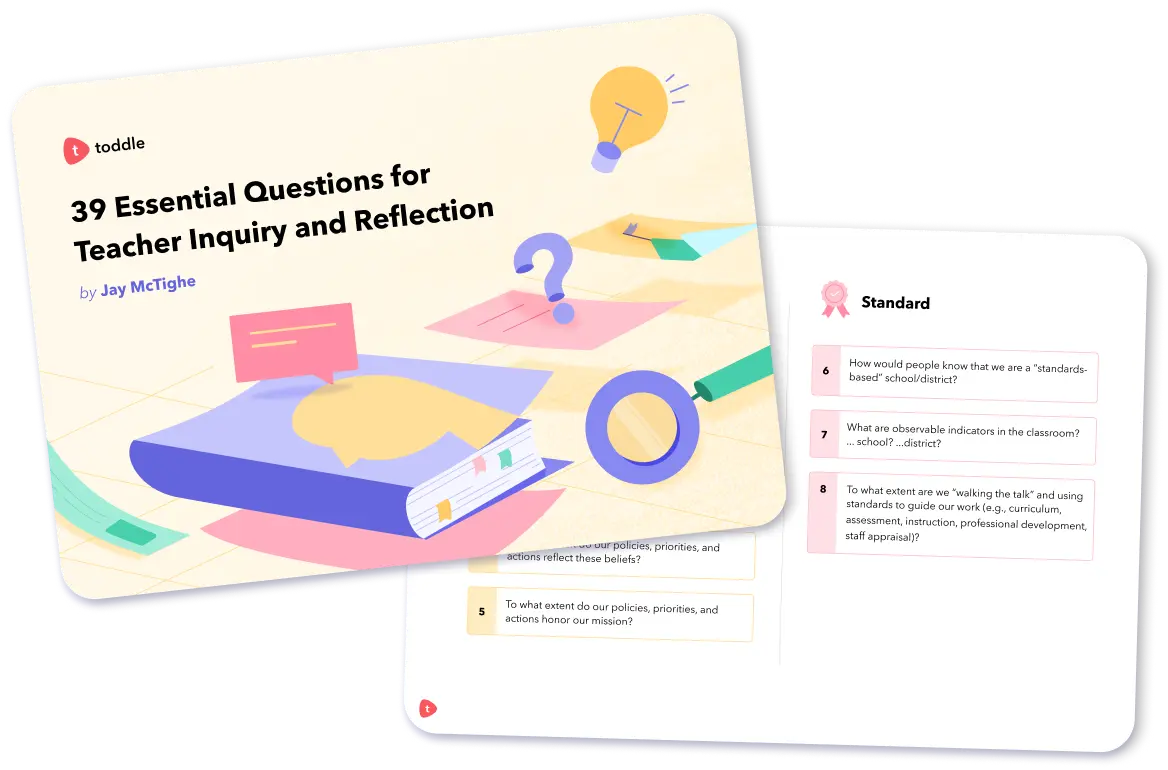
In this resource, Jay McTighe skillfully guides us through 39 such thought-provoking self reflection questions for teachers. From curriculum planning to professional development, these questions span all the key aspects of your work as a UbD educator.
These questions, when used effectively, will help you:
- Foster a shared understanding of how teaching and learning should happen at your school.
- Zoom out of everyday teaching and learning and think more intentionally about the larger goals of your school
- Inspire your team to formulate their own reflection questions
So, grab your trusty pen and paper and start answering the questions right below. You’re sure to uncover a wealth of information about yourself and your teachers, and ultimately emerge as a more skilled and empowered UbD team!
Download 39 reflection prompts for teacher inquiry and reflection



1. Missions and beliefs
- To what extent does our (team, school, district, community) share a common mission?
- What educational beliefs about teaching and learning do we hold?
- What assumptions about learning guide our instructional and assessment practices?
- To what extent do our policies, priorities, and actions reflect these beliefs?
- To what extent do our policies, priorities, and actions honor our mission?
2. Standards
- How would people know that we are a “standards-based” school/district?
- What are observable indicators in the classroom? … school? …district?
- To what extent are we “walking the talk” and using standards to guide our work (e.g., curriculum, assessment, instruction, professional development, staff appraisal)?
3. Curriculum planning
- Why should the curriculum be planned “backward”?
- To what extent is our curriculum coherent and aligned?
- Does our curriculum highlight enduring knowledge and authentic performance?
- What content should we “cover” and what needs to be “uncovered?”
- To what extent do textbooks function as the syllabus (rather than a resource)?
4. Assessments
- How are we doing? What evidence is needed to answer this question?
- How will we know that students really understand the “big” ideas?
- Are we assessing everything we value (or only those things that are most easily tested and graded)?
- Is anything important “falling through the cracks” because we are not assessing it?
- How might our assessments promote learning, not simply measure it?
5. Classroom instruction
- To what extent is our instruction engaging and effective?
- To what extent does our instruction reflect research and best practices?
- To what extent are we engaging students in “doing” the subject?
- Are we effectively teaching ALL students?
6. Professional development
- To what extent do our professional development practices reflect the research on adult learning?
- How does our staff view professional development?
- To what extent are our professional development practices “results” oriented?
- Is our professional development appropriately differentiated?
7. Change process
- What do we believe about educational change? To what extent are these shared beliefs?
- To what extent are various initiatives seen as connected and coherent (as opposed to being seen as separate things or “add ons”)?
- How might we “work smarter” and more effectively?
8. Policy, structure, and culture
- To what extent do our policies, structures, and culture reflect our beliefs about learning?
- How might we restructure to enhance learning?
- What is the best use of our time when teachers are not with students?
- What messages do our policies send?
- Is our staff appraisal process working?
- To what extent do we have a culture of continuous improvement?
- What existing factors support this reform? What factors resist change?
- How do our leaders receive the honest feedback they need to improve?
Now that you’ve skimmed through these questions, we know it can be tempting to move on with the demands of your bustling day. But trust us, the real magic happens when you take the time to engage with these questions genuinely and even create your own.
So find a good day that works for your team, gather around with your favorite beverages, and let these questions guide you towards becoming a more skilled and confident UbD team!
How to use this resource:
- At the beginning of every academic year, as you begin planning your curriculum
- During onboarding sessions with your new teachers
- At end-of-year review meetings, in your discussions and evaluations with the leadership team
- Whenever you find the opportunity to bring your leadership team and teachers in one place!