



When I arrived in April 2024, we had a brand new campus and a blank sheet. We are small, just 65 children, based on an Air Force base in the middle of the Saudi desert, around three hours north of Riyadh.
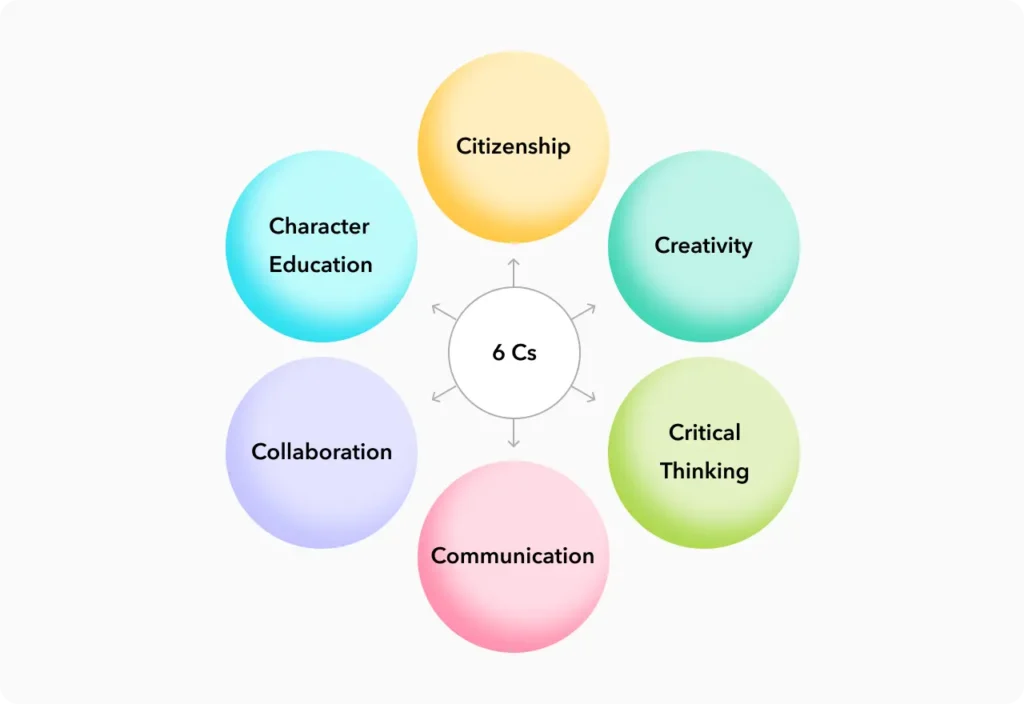
Pretty early on, I realised academic excellence alone wasn’t enough. I’ve seen competencies and learner profiles become posters on a wall. We wanted a shared language of learning that our children could actually use, so they could say, “Today I’m working on my collaboration ,” and know what that means. That led to a clear decision: we adopted Michael Fullan’s Deep Learning framework, the 6Cs (Character, Citizenship, Collaboration, Communication, Creativity, and Critical Thinking), as our learner profile.
Building the 6Cs competency coach
That is where technology could bridge the gap. Using Toddle’s AI Tutor, we built what we call our 6Cs Competency Coach. It is not a standard chatbot. Instead of giving definitions, it holds a coaching conversation. It meets children where they are, adapts its language from Foundation to Year 6 and helps them connect moments from their day to one or two of the 6Cs, with a practical next step to try.
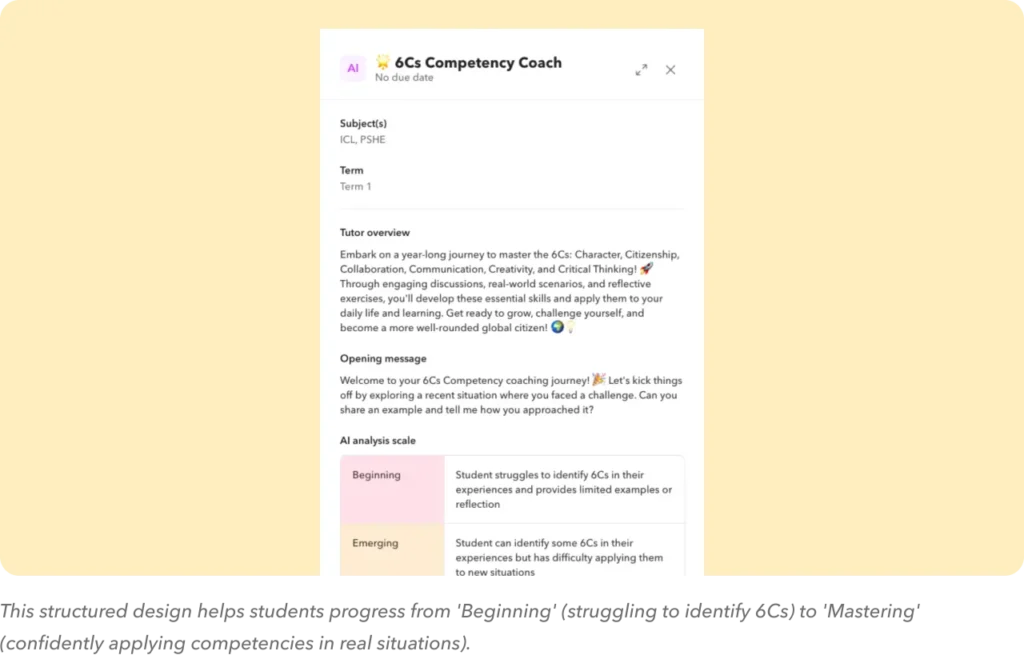
I configured Toddle’s AI tutors with specific instructions:
- Role: a learning coach focused on the 6Cs (not a teacher marking work, and not a general chatbot).
- Age range: adapt language and question length for ages 4–11; offer simpler wording when asked.
- Coaching style: ask one question at a time; use examples from the child’s real life (playground, home, hobbies).
- 6C mapping: help the child name which “C” they used and what it looked like in that moment.
- Reflection loop: What happened? → Which C? → What could you try next time?
- Tone: warm, encouraging, low-pressure; never shame or “tell them off
- Guidance rules: if a child shares something worrying, encourage them to speak to a trusted adult.
Now we have a coach in every child’s hands
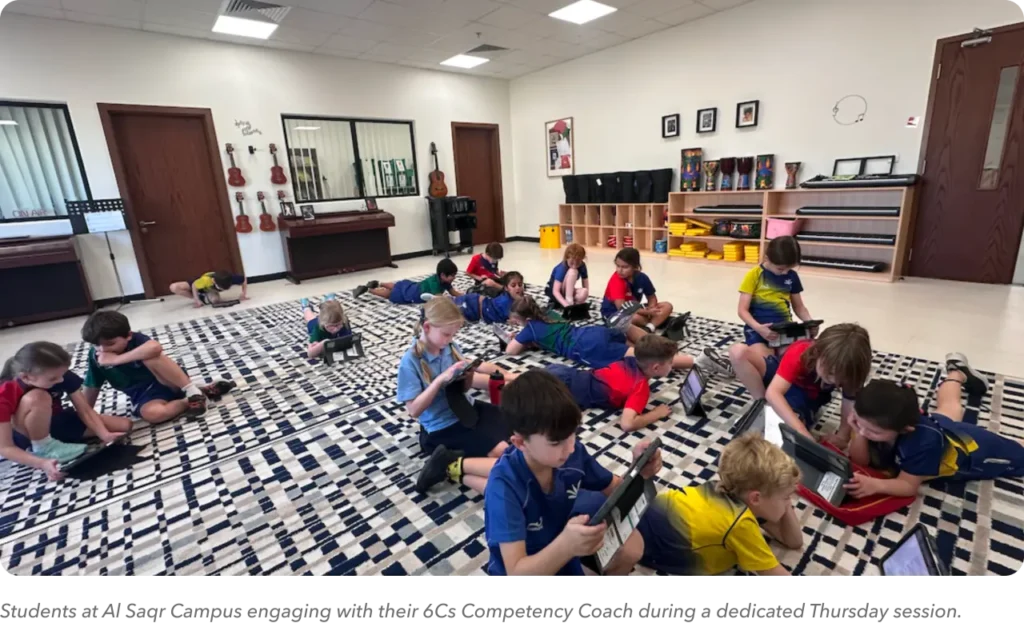
This is how it plays out in practice. Every Thursday afternoon, something special happens in our school. All 65 children settle in and open Toddle’s AI Tutors. The room fills with low, thoughtful voices as each child meets with their Competency Coach. There are no games or distractions, just conversations.
Because the Coach is built to connect learning to real life, children don’t treat it like a place to “look up” the 6Cs. They bring something that actually happened, and the Coach does what we simply cannot do at scale every week: it turns that moment into a short, structured coaching conversation. In a few prompts, it helps a child name the competency, give evidence from their own experience, and choose a next step they can try.
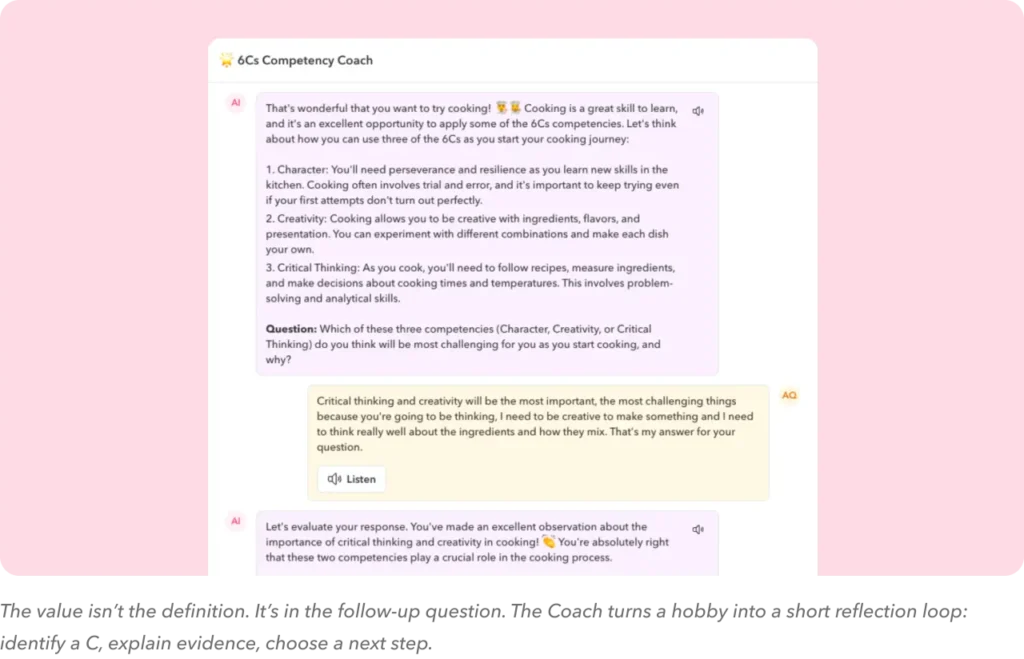
For example, one student used cooking to explore the 6Cs. The Coach helped them map the experience to Character (sticking with it when something goes wrong), Creativity (trying new combinations), and Critical Thinking (measuring and following steps), then pushed the learning forward with a simple “which one will be hardest, and why?”
The student identified critical thinking and creativity as the biggest challenge because you have to be precise with ingredients while also inventing something of your own.
Three transformations we’re seeing
Since introducing the Competency Coach, three changes stand out in the day-to-day life of our school:
A. Transfer beyond the classroom
The real test came when our students left our campus entirely. Recently, they attended a camp with children from other BISR schools. During a problem-solving activity, a facilitator asked the mixed group, “What skills might we need here?”
Our students didn’t hesitate. They immediately responded, “We need Critical Thinking to analyze the puzzle,” and “We need Collaboration to listen to everyone’s ideas.” This was an authentic transfer – students applying competency language spontaneously in a completely new environment.
B. Genuine student agency and choice
Because the AI Coach is always available, students drive the process entirely. They choose their focus, initiate conversations, and determine their own learning pace.
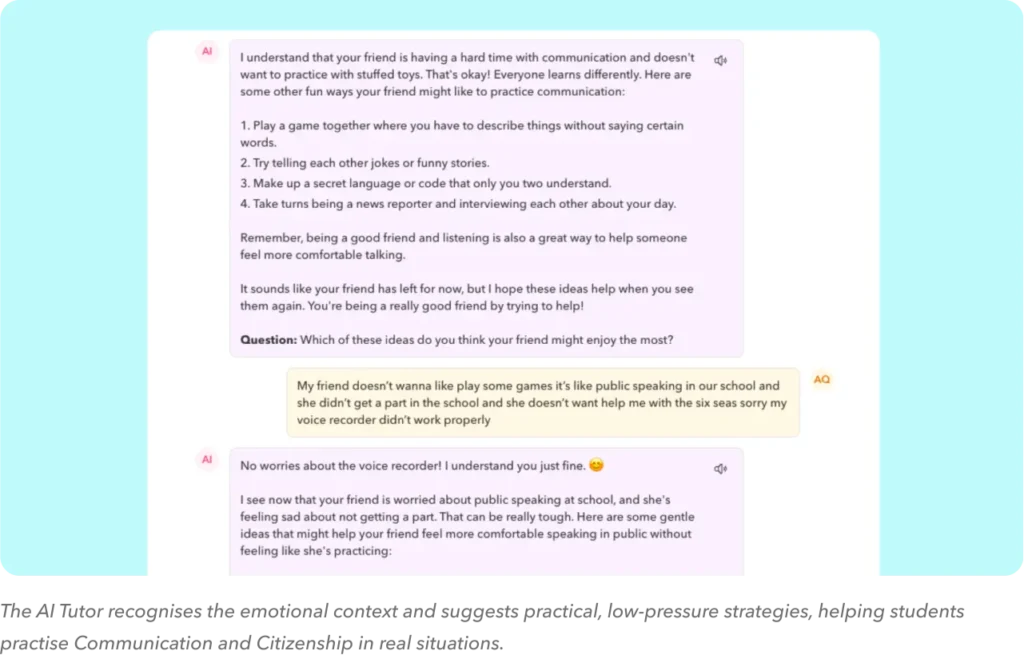
Sometimes this agency shows up as empathy. In one conversation, a student came to the Coach not for themselves, but for a friend who was upset about not getting a part in a school activity and was avoiding speaking practice. The Coach acknowledged what the friend might be feeling and suggested a few low-pressure ways to rebuild confidence and practise communication without turning it into a performance. That is student agency in its simplest form: a child noticing a need in their community and taking action on their own values.
C. Integration across the learning experience
This works for us because Toddle is woven into everyday school life. Every student has six folders in their portfolio, one for each “C”. When they upload evidence, whether that is a photo, a video, or a voice note, they tag it to the competency it shows.
That really comes to life during our Student-Led Conferences. Parents come in, and students use their iPads to filter their portfolios and talk through what they are proud of: “Here is my evidence for Character,” “Here is my evidence for Critical Thinking.” The Coach helps them build the understanding, and the portfolio helps them hold onto the evidence.
Aminah, one of our students, recently chose a science video about circuits and explained the competencies she had used. When her parent asked, “Why Character?” she said, “Because in our first video we actually got a lot of things wrong and we couldn’t give up.” Moments like that are what we are aiming for: children naming their learning in a way that feels real, because it is grounded in something they have actually done.
Aminah demonstrates student ownership by confidently guiding her parents through her 6Cs portfolio.
Measuring what matters
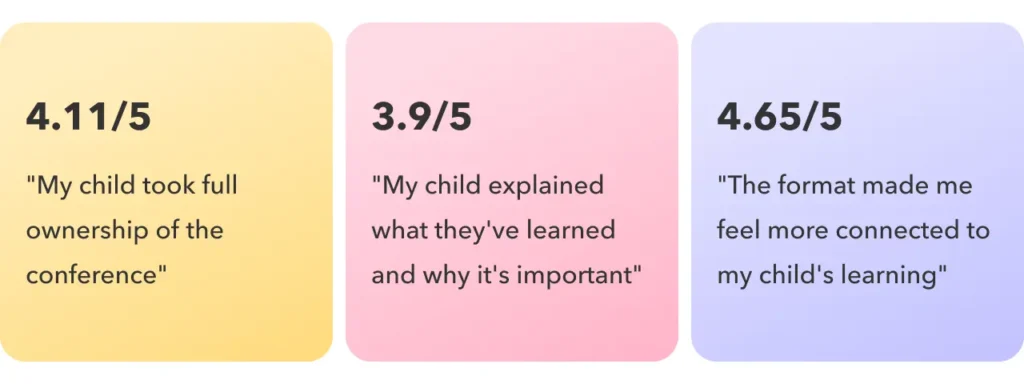
Following our Student-Led Conferences, we surveyed our parents. With only 65 children, we heard from a large proportion of our families, and one message came through clearly: parents felt genuinely connected to their child’s learning journey.
We began with a simple constraint: a small school, limited one-to-one time, and a desire for every child to truly own their learning.
Toddle’s AI Tutors changed what was possible. They ensured that reflective coaching was no longer a privilege reserved for confident speakers or the children adults naturally reach first.
Every student now has a consistent space to be heard, to make sense of their experiences, and to practise the language of learning. That equity, more than any feature, is what has shifted our culture.