
When we adopted Toddle AI last year, planning was the obvious place to start.
It’s time consuming and deeply creative work. And in our context, our staff brought vastly different experiences which made consistency a real challenge.
Newer teachers were still building their understanding of the PYP. Learning how its different elements connect. Experienced educators had developed strong practices over the years, but they’d settled into familiar rhythms.
Toddle AI met each teacher where they were. For newer teachers, it became an experienced PYP mentor of sorts that helped them weave ATLs in more authentic and see how their activities connected to the central idea. For experienced educators, it became their creative companion. It opened up fresh possibilities for provocations. Brought new energy to units they’d planned many times before.
Overall, Toddle AI became the teammate everyone wanted to work with. And the bigger win? It helped every teacher plan to a higher standard, at every stage. No matter the background. No matter the experience level.
Here’s how Toddle AI helped our teachers at different stages of planning:
Co-planning authentic inquiries
Planning a high quality learning experience used to take our teachers 2-3 hours. With Toddle AI, the same work takes less than half that time.
Take our Grade 2 How We Organize Ourselves unit. We wanted students to explore community systems through a Chinese lens on citizenship.
One of our more experienced teachers explored the idea with Toddle AI, and it helped shape a clear plan: students split into three groups, each modelling a different community system. They’d take on roles, present to each other, and then reflect on what they learned.
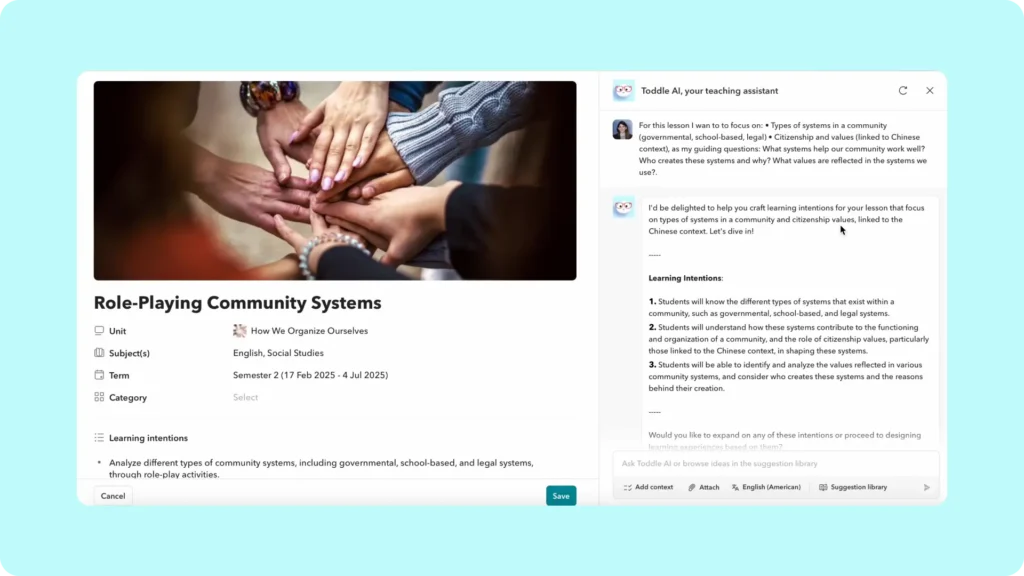
It aligned so naturally with the PYP principles! Student agency through role assignment, collaborative learning, and metacognition built right into the reflection step. With a few tweaks to the groups and roles, she turned it into a full learning experience in about twenty minutes.
For me, this is what co-planning with AI looks like. The teacher steers the work, sets the priorities for their learners, while Toddle AI helps bring their vision to life faster than they ever could alone.
Localising inquiry for the Chinese context
Planning in China always comes with an extra layer of thought. We’re particularly careful about examples, sources, and resources. It’s important that everything fits our local guidelines and still feels authentic for students.
When you add local context on Toddle AI – for us, China – it automatically localises the resources and examples it suggests. Sensitive content is replaced with suitable alternatives, and every link aligns with education bureau expectations.
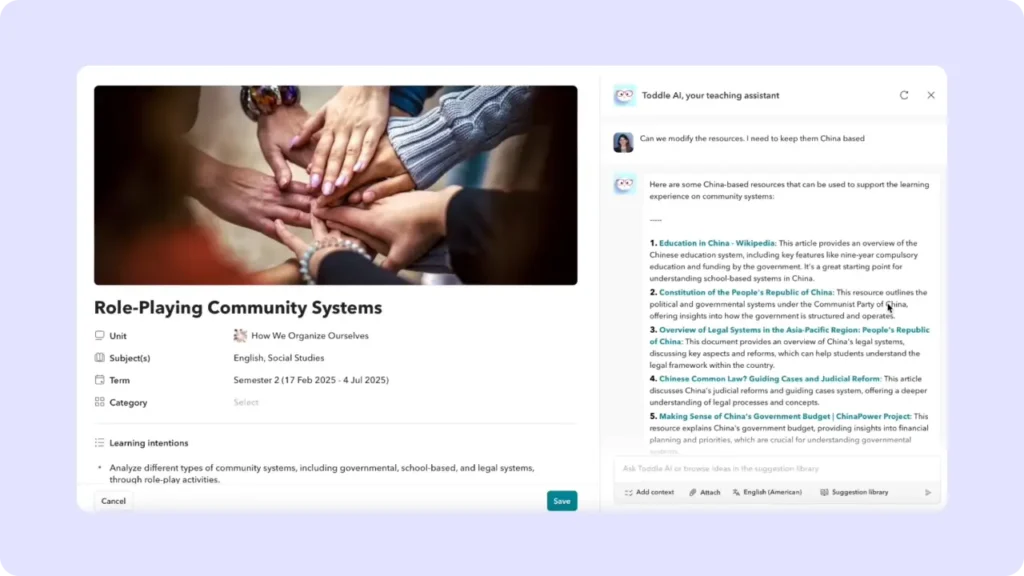
It saves hours of vetting and translation. But more importantly, it helps especially our newer teachers plan confidently – knowing their resources are relevant and appropriate to the setting.
Differentiation built in more intentionally
Differentiation sits at the heart of good teaching, but it’s also the part most squeezed by time. Too often scaffolds and extensions are bolted on after the core activity, which means they don’t always match the conceptual focus or learning goals.
In our Grade 4 Migration unit, one of our teachers used Toddle AI to plan those supports alongside the main task. After designing the core learning experience, she simply prompted the AI to ‘add scaffolding instructions.’ Within seconds, it produced sentence starters, visual supports, and extension ideas. All tied to the larger concepts and standards.
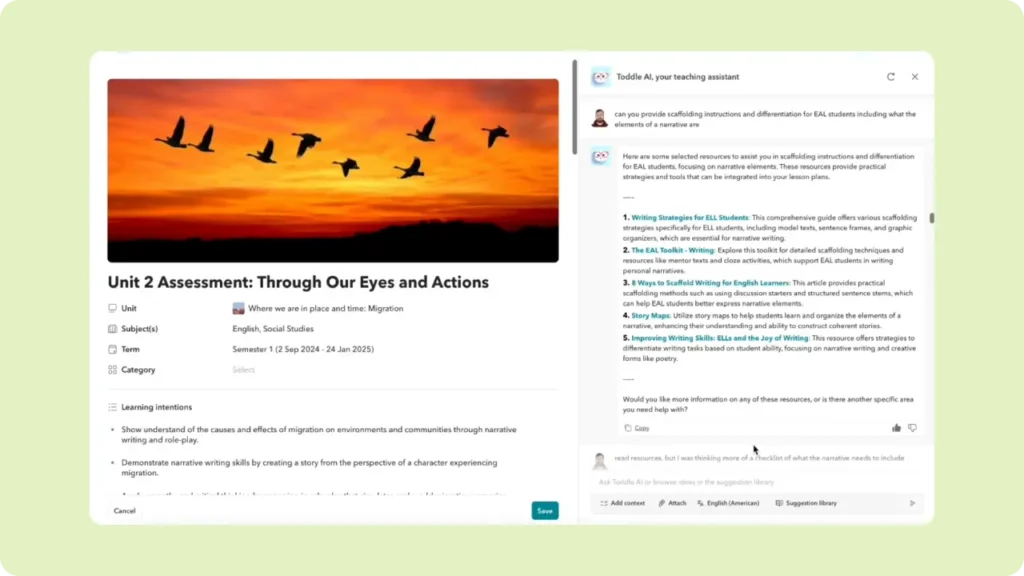
With Toddle AI, teachers are now planning for the full range of learners without doubling their prep time, and students experience the same ideas in ways that match where they are.
Making success criteria clear and concept-aligned
Rubrics tend to be the slowest part of PYP planning because every descriptor has to match the thinking you want to see, in a language that 8-year olds will understand.
Toddle AI gives us a solid starting point here. We select our key concepts, lines of inquiry, and learning goals, and it automatically generates a task-specific rubric in student-friendly language.
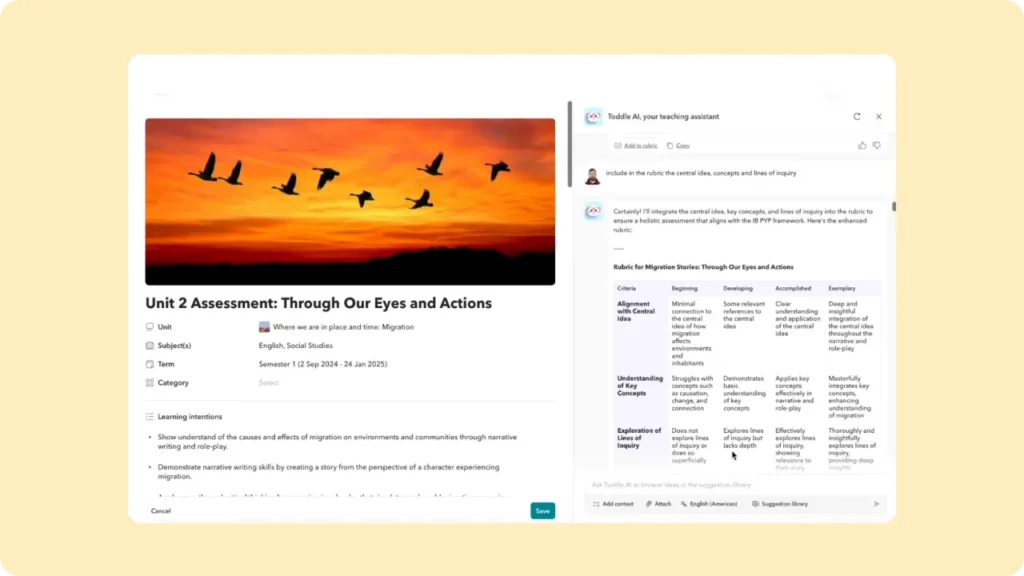
It differentiates levels of achievement. It isn’t vague. It shows what “emerging,” “developing,” and “mastery” looks like for the assigned task and ties to the same conceptual focus we’d planned for.
That kind of judgement usually comes only with teaching experience. Seeing Toddle AI do it so accurately made it clear to us that this was AI designed for PYP classrooms.