



After seventeen years of teaching across Scotland, England, and the Middle East, one truth has stayed constant: great feedback matters, but delivering it consistently is hard. The intention is always there. The time isn’t.
In my classroom we’ve always taken feedback seriously: we build rubrics together, we conference at desks and students review their own work and each other’s. But there is only one teacher and twenty-four children, each needing something different at the same moment.
Before Toddle’s AI Tutors, writing lessons looked like this: students wrote, I collected books, marked late into the evening, and returned feedback days later. Students improved their work in purple pen, but often by the time they responded, we had already moved on. The cycle simply couldn’t keep up.
I remember sitting beside one student while the rest waited. I could feel time slipping, for them and for me. I wanted to focus on next steps, not sit deciphering handwriting late into the evening.
Something had to change.
When feedback arrived at the right moment
I decided to try Toddle’s AI Tutors during a narrative writing unit. Nothing fancy, just a cold write called The Secrets of the Sunken Playground. Students wrote their openers by hand, exactly as they always did. The only difference was what happened next.
Instead of collecting books and taking them home, I asked students to take a photo of their writing and upload it to the AI Tutor. I’d set up the tutor using our class rubric and feedback language, so it knew what good writing looked like and what kinds of questions would push them forward.
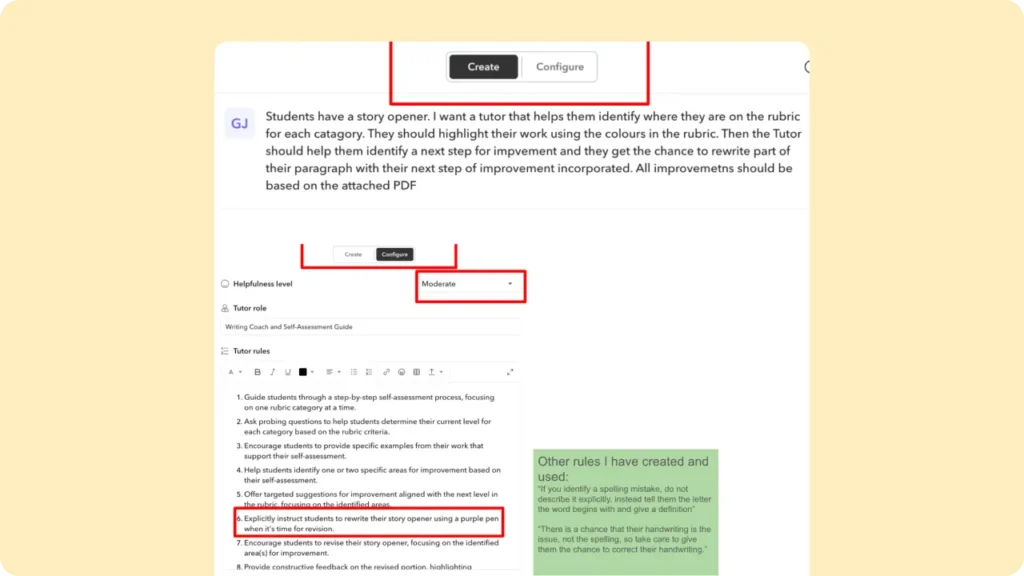
The first time we did it, I set aside a week to teach students how to upload their work and respond to prompts. By the end of that week, they were working independently. Now, it’s just part of what we do.
And what happened next genuinely surprised me.
Adriana began her writing like this: “There was one boy and one girl, and there was one special playground.”
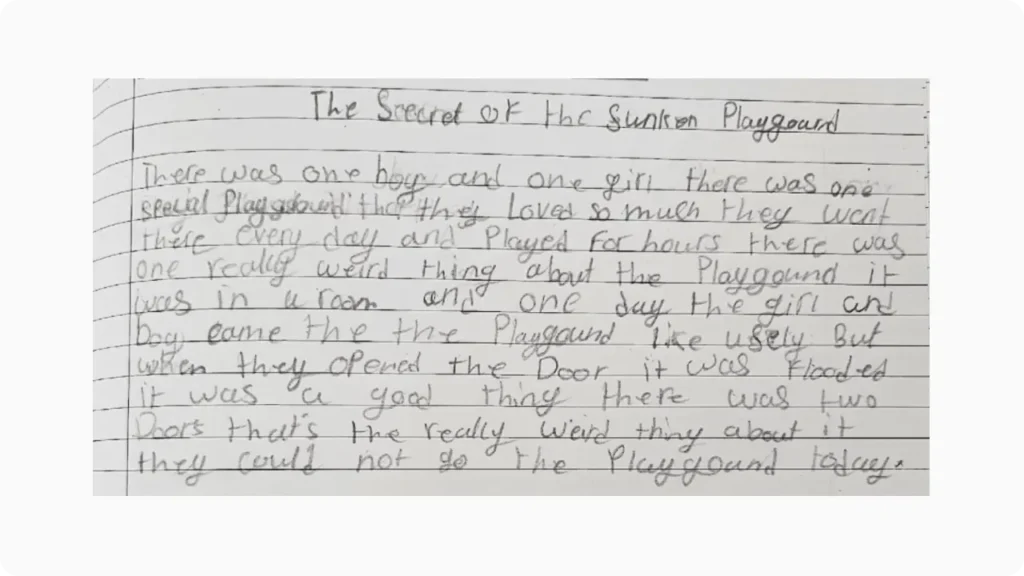
A good start, but simple.
After uploading her work, the AI Tutor asked her to highlight words that she thought were interesting and explain why. It asked what she wanted the reader to feel. It nudged her to think about suspense.
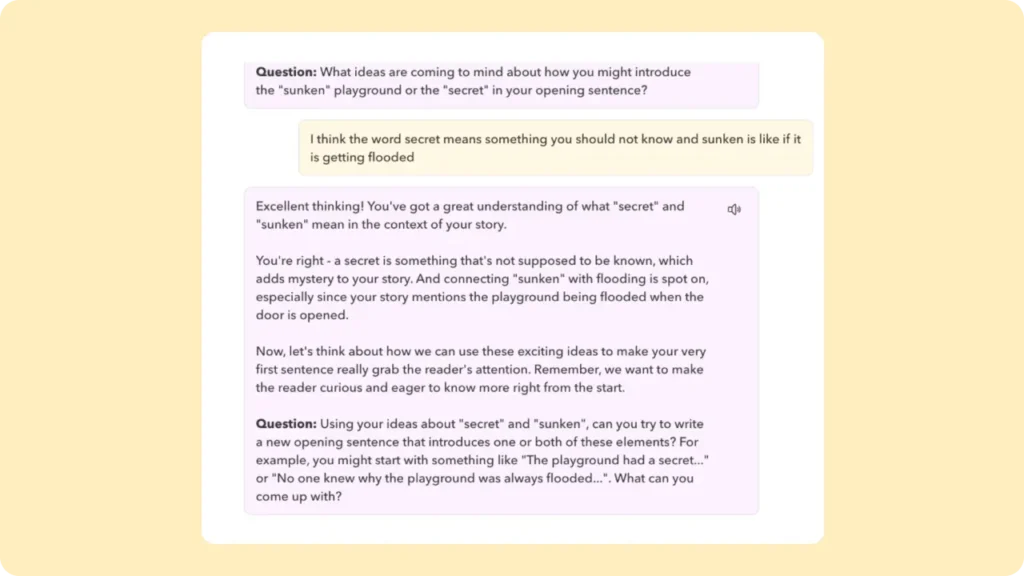
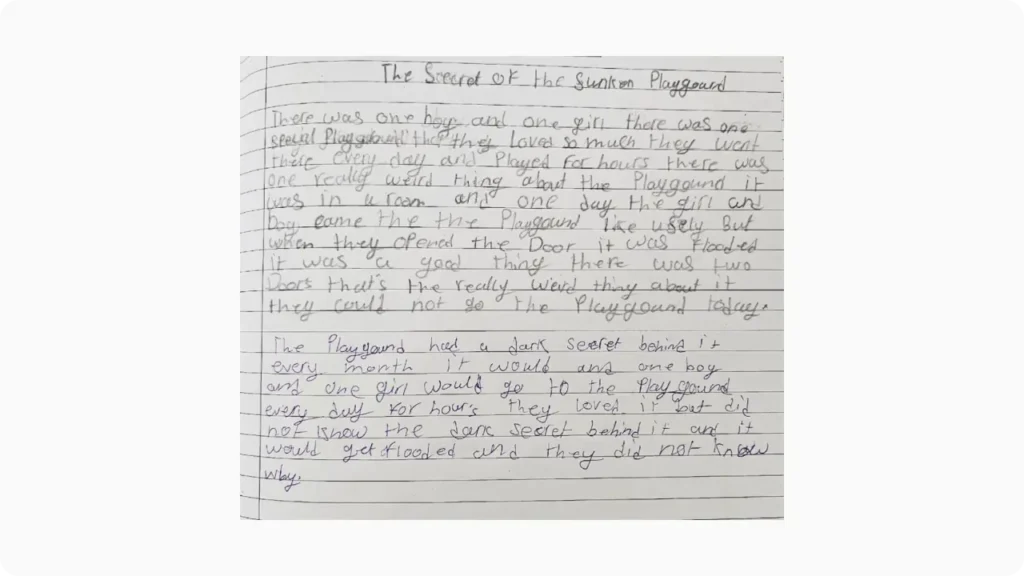
By the end of the conversation, she rewrote her opener as: “The playground had a dark secret behind it. Every month, one boy and one girl would go to the playground.”
A dramatic shift and I didn’t intervene once. The improvement happened at her desk, in real time, driven by her own thinking. She then picked up her purple pen, the colour students use to show how they have responded to feedback, and rewrote her opener directly in her notebook
Teddy had a similar journey. He uploaded a very short sentence. The tutor challenged him to lengthen ideas, add detail, and develop tone. He responded several times, each attempt stronger than the last.
When I later opened his chat to read the conversation, it felt like watching a time-lapse of his thinking. It was powerful to see learning unfold rather than appear suddenly in a finished piece.
What struck me most was this: conversations like that were happening at every desk simultaneously. Not one student at a time. Everyone.
I couldn’t have done that alone.
Teaching forward instead of catching up
Once students completed the task, I could see two things clearly.
At a student level, each child’s work came with a detailed analysis: what they were doing well, where they were stuck, and what their next step should be. I could open any student’s response and see not just the final piece, but the thinking that led there.
At a class level, Toddle’s Insights showed patterns instantly. I could see how many students were beginning, emerging, developing, or approaching mastery, along with shared strengths, common gaps, and suggested next steps for the group.
The same approach worked in mathematics. During a unit on mastering millions, students uploaded their work to the AI Tutor, which analysed their understanding against the success criteria.
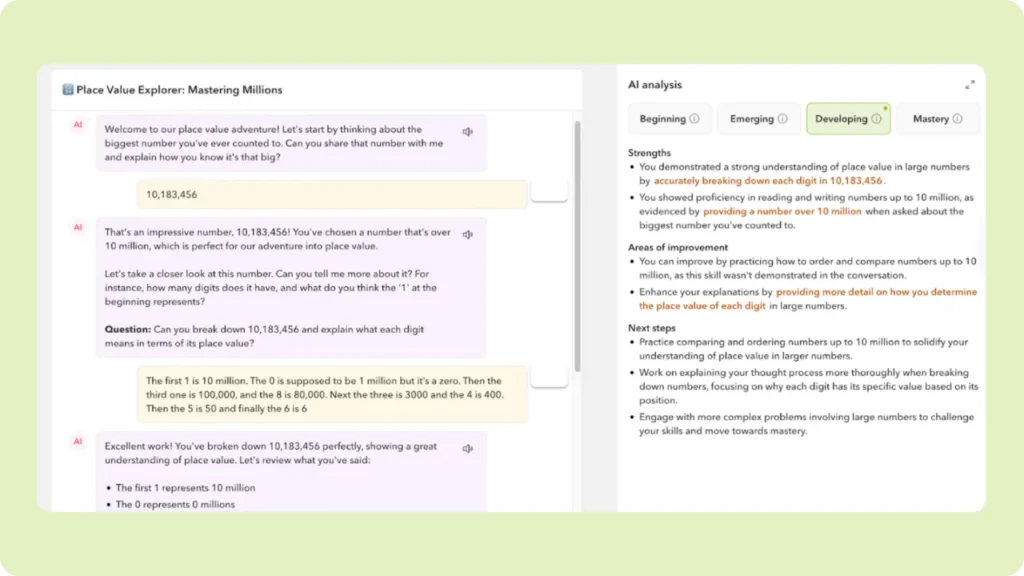
Instead of spending hours marking and then trying to piece together trends, the analysis was already there.
That meant I could:
- Decide what needed to be retaught the very next day
- Group students based on the kind of support they needed
- Adjust questioning in response to what I saw
- Change home learning tasks or lesson sequencing
- Even look at curriculum placement and timetable adjustments when patterns were bigger
The biggest shift was time. Time spent thinking rather than marking. Time spent planning what would actually move learning, rather than recording what already happened.
And the human work of teaching, conferencing, relationship building, noticing, became easier because the heavy lifting was shared.
Sustainable teaching that protects wellbeing
After that first unit, I started using Toddle’s AI Tutors in English, maths and science, and later with students who needed additional support. Sometimes the tutor helps them practise organisational skills. Sometimes it reads feedback aloud when reading is a barrier. Sometimes it builds visual models for maths without being asked.
At Fairgreen, Toddle’s AI Tutors have helped us strengthen feedback culture while protecting teacher wellbeing. Students now receive immediate feedback at the moment when it matters. They revise work independently. They feel more ownership. Teachers spend less time marking and more time on high quality planning and human connection.
And that, for me, is what sustainable teaching really looks like.
If anyone would like to talk through the journey, I am always happy to share more about what we’ve learned and where we are headed next.