

I spent about a year having informal conversations before seriously considering a new platform. I spoke with teachers in hallways, parents after assemblies, and colleagues during meetings.
At first, the issue did not present itself as a simple request for a new learning management system. Teachers were not saying, “We need a new LMS.” What I heard instead was a pattern of friction. Information entered in one place did not always appear where people needed it. Families sometimes struggled to see a coherent picture of learning. Students were not always receiving feedback in the most timely or useful way. Teachers were doing significant work, but the systems around them did not always help that work flow naturally across the full learning cycle.
That is why we did not begin with a product search. We began with diagnosis.
Is the challenge technical, or adaptive?
Ronald Heifetz’s work on adaptive leadership offers a helpful distinction. A technical challenge can usually be solved with existing expertise: adjust a setting, provide training, clarify a process, or improve support. An adaptive challenge is different. It reflects a gap between what an organization values and what its current systems, habits, and structures make possible.
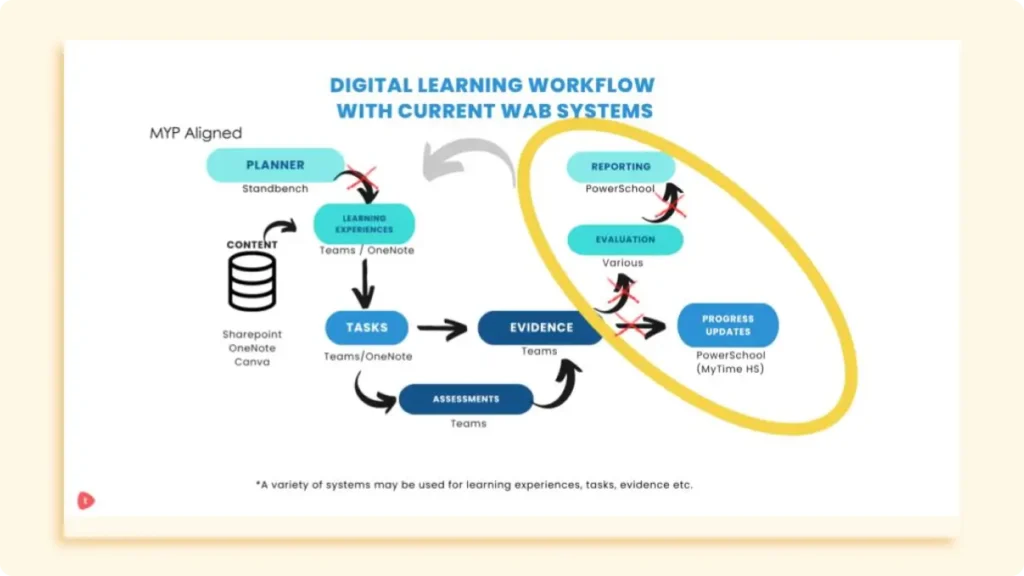
At WAB, the gap was not that any one tool was inadequate on its own. The deeper issue was that our learning workflow had become distributed across several systems. We wanted planning to inform assessment, assessment to inform feedback, and feedback to reach students and families in ways that were timely, visible, and useful. In practice, information often had to be moved, re-entered, interpreted, or reconstructed across different platforms and processes.
What did the diagnosis look like?
We formed a Collaboration for Impact team, WAB’s version of a PLC for innovation, with six colleagues from the middle school and high school. Its mandate was not to choose a tool. It was to gather evidence, understand the current reality, identify options, examine potential impact, and recommend a path forward.
At the time, our middle school and high school workflow included several strong individual components. We had a homegrown planner called Standbench, developed by our high school vice-principal. It was thoughtful and well suited to aspects of our context, but it was just disconnected enough from the rest of the process that it was easy to ignore. The rest of the process required teachers to move between separate environments for planning, assigning work, communicating with students, assessing learning, and reporting progress.
The middle part of the workflow — where teachers created learning experiences and assigned tasks — was reasonably familiar and functional for many colleagues. The greater challenge came later in the cycle. Sharing progress with families often required additional steps. Evaluating performance would involve a different system. By the time information reached PowerSchool for reporting, teachers might be weeks or months removed from the original learning experience. The further the information travelled, the more difficult it became to maintain coherence.
We surveyed faculty about the systems supporting planning, resourcing, assessment, evaluation, reporting, communication, and task assignment. The results helped confirm what conversations had already suggested: many teachers were experiencing the workflow as fragmented. Even in the areas that were working relatively well, confidence was mixed.
When we shared the team’s summary of the current reality with faculty, the response was important. People recognized the picture. They could see their own experience in it. That recognition matters because change is more sustainable when the need for it is collectively understood, rather than imposed as a solution from the technology office.
How do you evaluate options without creating new problems?
Once the diagnosis was clear, we considered two broad paths: improve and integrate the systems we already had, or move toward a more unified external solution. We concluded that building and maintaining internal integrations across multiple platforms would not be sustainable for teachers or for IT.
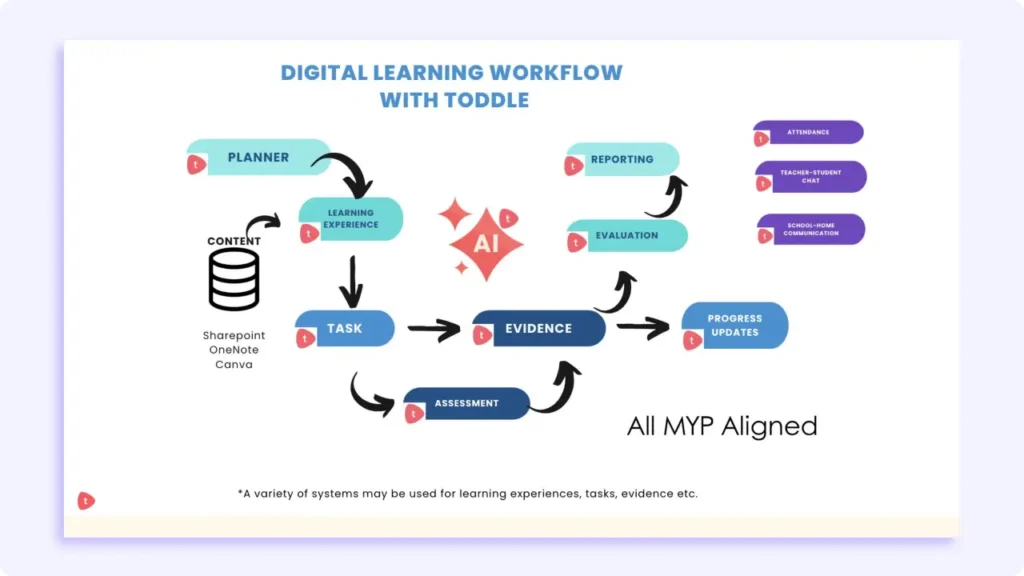
The proposed workflow with Toddle. The entire learning cycle, from planning through reporting, in one system.
We then evaluated external options. The process included product demonstrations, prototypes using real classes, conversations with other schools, and a criteria-based review by the Collaboration for Impact team. We were transparent about the process so faculty understood not only what was being considered, but why.
Our criteria were specific. The selected platform needed to reduce complexity, not simply add more features. It needed to be sustainable for teachers and IT. It needed to avoid creating new information silos. It also needed to meet WAB’s compliance requirements in China, including hosting and data privacy considerations under PIPL.
What happened when we shared the recommendation?
When we returned to faculty, we began with the workflow diagram they had already helped validate. Then we showed how the proposed Toddle workflow could connect planning, assessment, feedback, reporting, and progress updates in one system.
The response was notably positive. Teachers could see that the recommendation was not about replacing one tool with another for its own sake. It was about reducing re-work, improving visibility, and creating a clearer path from planning to reporting. School-home communication, teacher-student interaction, and attendance could also sit within the same broader environment.
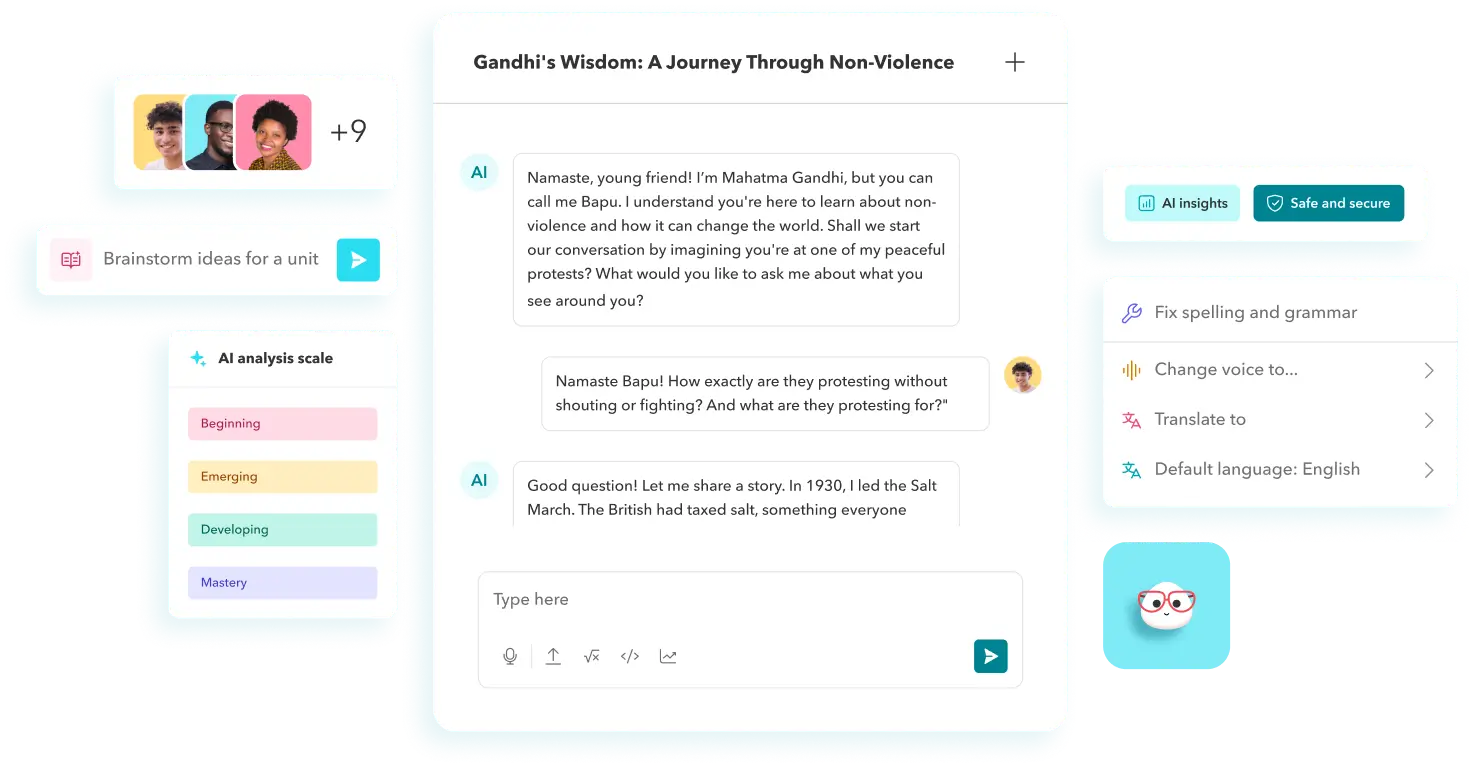
Colleagues asked when they could start experimenting with classes and when planning could begin. The AI features within the platform were interesting, but the greater value was coherence: fewer handoffs, fewer repeated steps, and a more connected learning cycle.
What I would tell another school leader
We announced the change in April and began implementation in August. I would not necessarily recommend that timeline for every school. Our middle school admin was ready to move, and we did not want to wait another year, but the compressed timeline created challenges around teacher skill development. We trained in May, and then the summer break meant many colleagues returned needing time to rebuild confidence.
If I were doing it again, I would allow more time between the decision and full rollout. What I would not change is the process that led to the decision: months of diagnosis, transparent data, a representative team, clear criteria, and a shared picture of the problem before discussing solutions.
The middle school is a year into implementation, and the high school will roll out this fall. What we can already see, however, is that our key goals have been met and the full cycle of assessment and feedback are easier to see, manage, and share. Students are receiving more feedback while it can still influence their learning.
That was the purpose from the beginning: not a new tool, but a stronger learning cycle.