



Anyone who has marked Cambridge examinations knows the tolerance system. You standardise your marking, send it off, and as long as you’re within two marks of the examiner’s mark, you’re cleared to continue. That sounds reasonable until you do the maths: a tolerance of plus or minus two is a range of four marks. On a question worth ten or more, four marks is a grade boundary.
Now scale that to a department. One English teacher grades consistently two marks above. Another grades consistently two marks below. A student on the cusp between two grades could land on either side depending on who happened to mark their paper. We knew the problem existed. We accepted it as part of the profession. Standardisation meetings helped, but they couldn’t close the gap completely.
When we brought in Toddle’s Grading Assistant, the consistency challenge resolved itself. The AI applies the same criteria every time. There is no drift, no fatigue at the end of a long stack of papers, and no subconscious generosity on a Friday afternoon. Marking is done at the same standard, every time. For students sitting on a boundary, that reliability is everything. It also supports teachers who have to teach outside their specialism through staffing changes. Often, it’s not the content where the expertise lies, it’s the marking. Now that consistency holds regardless of who’s in the classroom.
Feedback that tells you how to improve, not just why you got that mark
For our teachers, the bottleneck to feedback was never willingness. It was time. While we wanted to mark in depth, what students often received was a grade and a brief justification. Enough to satisfy the requirement, but not enough to help them get better.
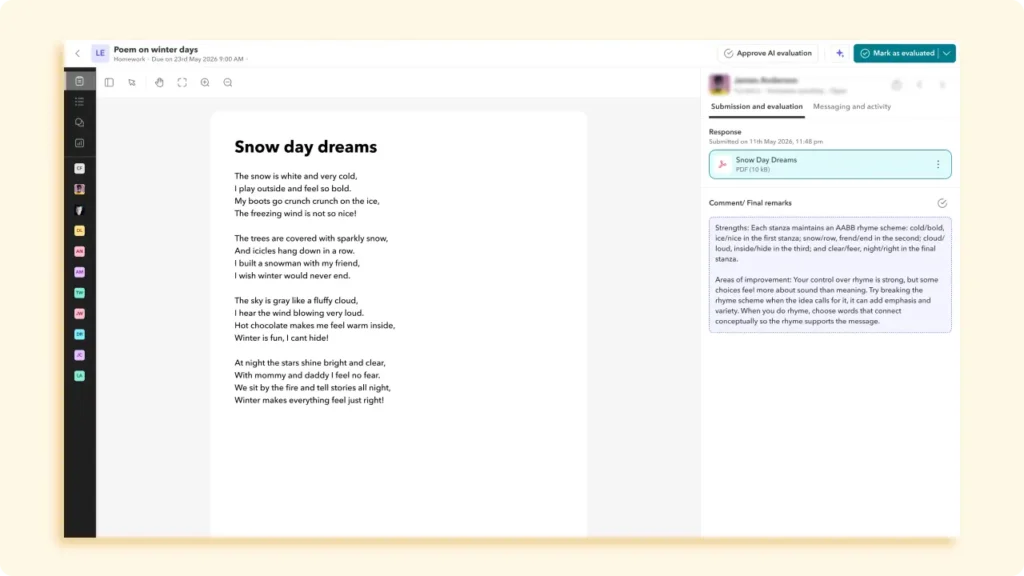
The Grading Assistant changed the substance of what comes back. The feedback is specific. It’s focused on improvement, not just on explaining the mark. Most importantly, it’s fast. A cohort’s worth of coursework that used to take me two weeks to process now takes about an hour and a half. That speed matters to students. When feedback arrives while the work is still fresh, they actually use it.
I still add a personal comment to every piece. Students need to know a human has read their work, so I’ll note what I thought was strong, or flag something specific they should revisit. But the detailed, criteria-linked feedback that would have taken me hours to write for every student? Toddle handles that, and standards have risen by up to 20% across subjects since we started.
Students started seeing their own potential clearly
One of the things I didn’t expect from AI-assisted grading was what happened when we turned on self-assessment. Students submit their own grade estimate before seeing the AI’s mark. What that comparison surfaced surprised me.
Some students are underconfident. They’ll rate themselves a C when they’re actually performing at an A grade. Before, that gap could go unnoticed, until a parent meeting or a one-to-one that happened to go in that direction. Now I see it immediately and I can have that conversation early. I can sit with a student and show them: look at where you think you are, and look at where you actually are. That changes how they see themselves.
It works the other way too. When a student’s estimate sits higher than their mark, that’s a conversation worth having before the exam. Once students develop their metacognitive eye, they start to understand what separates one grade from the next. They stop coming to me with “but Miss, I don’t know how to improve” because they can see the difference in the criteria themselves. That confidence carries into the examination hall.
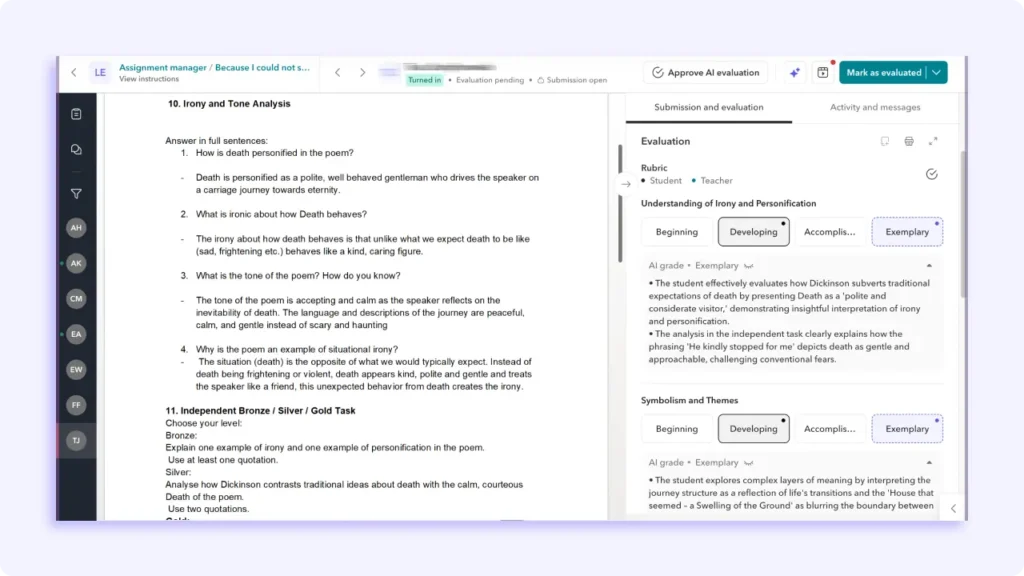
If another Cambridge school asked me whether AI-assisted grading can be trusted, I’d say: absolutely. It is more consistent and goes into more depth than any individual teacher can. The beauty of marking a whole cohort at the same standard is that it is easy to adjust the whole cohort if needed.
However, the key word is “assisted.” It still requires the expert in the room to check it. For coursework, Cambridge states that marking can be AI assisted, however we as teachers need to authenticate that coursework. All AI hallucinates occasionally and that’s fine. That’s what teachers are there for, and that’s why we will always be irreplaceable.