



Most school leaders get six to twelve months to open a campus. I had four weeks on the ground – six if you count the planning phase before I arrived.
Late June, the call came. “We need you in Riyadh. We’re opening a campus.” No time to negotiate. No time to plan the traditional way. By mid-July, I was on the ground, interviewing every parent personally. What I discovered changed everything: parents weren’t looking for fancy facilities or big promises. They were desperate for something simpler – honest communication about their child’s learning that they could track and understand. End of July: thirty-five staff hired. Building ready. Systems? None.
Three weeks until students arrived. Three weeks to build what most schools spend months creating.
But we had one advantage that made the impossible possible: we weren’t starting from scratch. We were bringing a partner we’d spent five years building with in our previous school in Cairo.
We were bringing Toddle.
But having a five-year relationship with a platform doesn’t automatically solve a four-week crisis. Software alone can’t train thirty-five new staff or migrate years of curriculum overnight. What made the difference wasn’t just that we knew Toddle – it was how Toddle showed up for us when the stakes were highest.
Here’s how that partnership turned an impossible timeline into reality.
#1 Meet Sumedha, our Toddle Buddy
On our first call after signing, a woman named Sumedha introduced herself as our “Toddle Buddy.”
I’d worked with plenty of vendors who assigned “account managers” – friendly on kickoff calls, then disappeared into ticketing systems and “we’ll escalate this” email chains. Sumedha became something entirely different.
She became a staff member in our school. Not metaphorically. She works from home somewhere in the world, but she’s as integral to our operations as anyone with an office in our building. Ask any teacher at GAISR who Sumedha is, and they’ll tell you instantly. When someone gets stuck, the response becomes automatic: “Send it to Sumedha. She’ll figure it out.”
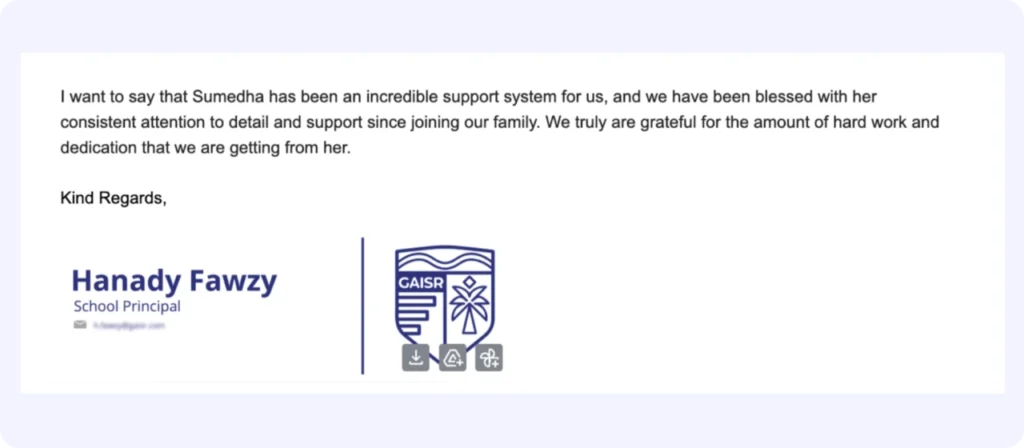
This is what 1:1 support looks like:
- Speed: Ten hours MAXIMUM response time. Even on vacation. I once sent a message at 11 PM Sunday with something critical for Monday morning. By 7 AM, it was handled.
- Access: No ticketing system. No “submit a request and wait 24-48 hours.” We have a WhatsApp group. Some teachers have Sumedha on speed dial. When we need help, we reach out. The barrier between “us” and “them” doesn’t exist.
- Hands-on help: There were moments, many moments in those first weeks, when I’d hit a wall. “I don’t know how to do this. Can you just do it for me?” Her response, every time: “Yep. I’ll upload it. I’ll take care of it. I’ll train them on it.”
- Emotional support: When you’re stressed, when you’re behind, when you have seventy-two hours until students arrive – the person on the other end matters as much as their technical knowledge. Sumedha is calm. Unflappable. “Right, give me some time. I’ll figure it out.” And she always did.
Most vendors give you a manual and wish you luck. Toddle gave us a direct line and personal commitment. That’s the difference between using a platform and being supported by one.
#2 Custom training and support that understands our context
Now, here’s the reality: teachers don’t have time. And they definitely don’t have time when you’re opening a school in four weeks. Any training program that doesn’t start from that truth will fail.
How Toddle trains teachers
On our first Toddle call, I waited for the “here’s how we do it for all our schools” presentation – the standard timeline that wouldn’t fit our timeline. That never came.
Instead, the team asked us questions: “What do your teachers need first? What will parents expect on day one? What can wait until the next term? Do you want live sessions or recorded ones? How long can teachers realistically sit in training? Should we come on-site or keep it virtual?” They didn’t arrive with a one-size-fits-all strategy. We co-created our plan. By the end, we’d identified what our team needed: nine focus areas. Nine modules. Three weeks. Thirty-five teachers who’d never used Toddle before. Almost daily sessions for three weeks. But not all-day workshops that exhaust everyone. Forty-five to sixty minutes. One specific module per session. In and out.
The teachers picked it up on the first go. When they struggled with something like report formatting, we asked Toddle to come back for a second session. They did, immediately.
Getting teachers comfortable with Toddle was only half the battle. Parents needed to trust it too.
In week two, we scheduled parent training sessions in Arabic – we’re in Saudi Arabia, so it made sense. The problem was that seventy percent of our parents are expats who don’t speak Arabic. We discovered this on a Tuesday morning. By Wednesday afternoon, Toddle had completely pivoted. They re-recorded the full session in English, scheduled makeup sessions, and made sure everything was recorded for parents who couldn’t attend live. There was no “we’ll get to it next month” or “let’s discuss with the team.” Just immediate action.

#3 Three days to migrate a school
While training was happening in conference rooms, something else was happening behind the scenes, something our teachers never saw, but which made everything else possible.
We needed to move an entire school’s worth of curriculum from Egypt to Saudi Arabia. Four years of unit plans, assessment frameworks, reporting templates – everything we’d built, tested, and refined in Egypt needed to exist in Riyadh. Ready to use. Day one.
The conversation was deceptively simple: “We need everything from Egypt. Can you pop it on our Toddle set up?” The response: “Done. Give me three days.” Wednesday morning. First day teachers have access to Toddle. They log in expecting… honestly, they don’t know what to expect. Maybe a blank screen. Maybe a skeleton they’ll need to build on over the next few months.
Instead: their classes. Their students. Previous units they could reference. Templates they could adapt. They weren’t staring at a blank system thinking, “How do I even start?” They were looking at something that already felt like theirs. One teacher turned to me in the hallway: “These are my kids.” That sense of ownership happened in seconds, not weeks.
That’s what good technical support does: it’s invisible to the end user, but it’s what makes everything else possible.
What made the impossible possible
Three and a half months after opening a school in four weeks – a timeline most leaders get six to twelve months for – we’re thriving. Teachers are autonomous. Data is consistent. Parents trust the system completely.
The question for school leaders isn’t whether you have the right platform, it’s whether you have the right partner. Someone who answers at 11 PM. Someone who pivots in two days when training needs to switch languages. Someone who migrates five years of curriculum in three days seamlessly.
You probably have more time than four weeks. But whatever your timeline: do you have a partner who will be with you every step of the way?