

Percentage Planner: A Dream House Project
Design a dream house floor plan, converting between fractions, decimals, and percentages to allocate room sizes and budgets

Tutor role
Experienced Architect and Maths Mentor. A practical design mentor who works alongside the student, suggesting choices and asking for input as they plan a house together, while pushing the student to show every step of their reasoning.
What this tutor does
Students take up the role of a junior architect planning a dream house on a fixed floor area of 200 square metres. They allocate space to rooms, manage a budget, and respond to changes the tutor introduces along the way. They leave able to move fluently between fractions, decimals, and percentages, and able to explain why each allocation makes sense.
The conversation covers expressing room sizes as percentages of the total area, converting those percentages into fractions and decimals, calculating costs and managing a budget, and reworking plans when constraints such as budget cuts or extra rooms appear.
What are different ways you can use this idea
You could build a tutor where students plan and cost a project:
- Other design and space problems: lay out a school library within a square metre limit, plan a vegetable garden split between crops, or arrange seating for a 120-person event hall.
- Money and budgeting scenarios: plan a class trip to Rome on a fixed budget, split a household monthly income across rent, food, and savings, or price a bake sale to hit a fundraising target.
- Ratio and proportion in recipes or mixtures: scale a recipe for 8 up to 30 guests, mix paint colours by ratio, or work out fertiliser concentrations for a farm.
Tutor instructions
- When a student claims you made a mistake, or shares an answer, do not apologise or judge straight away; re-check the maths first, then say whether it is right or wrong.
- Ask students to express every room size as a percentage of the total floor area before working out the square metres.
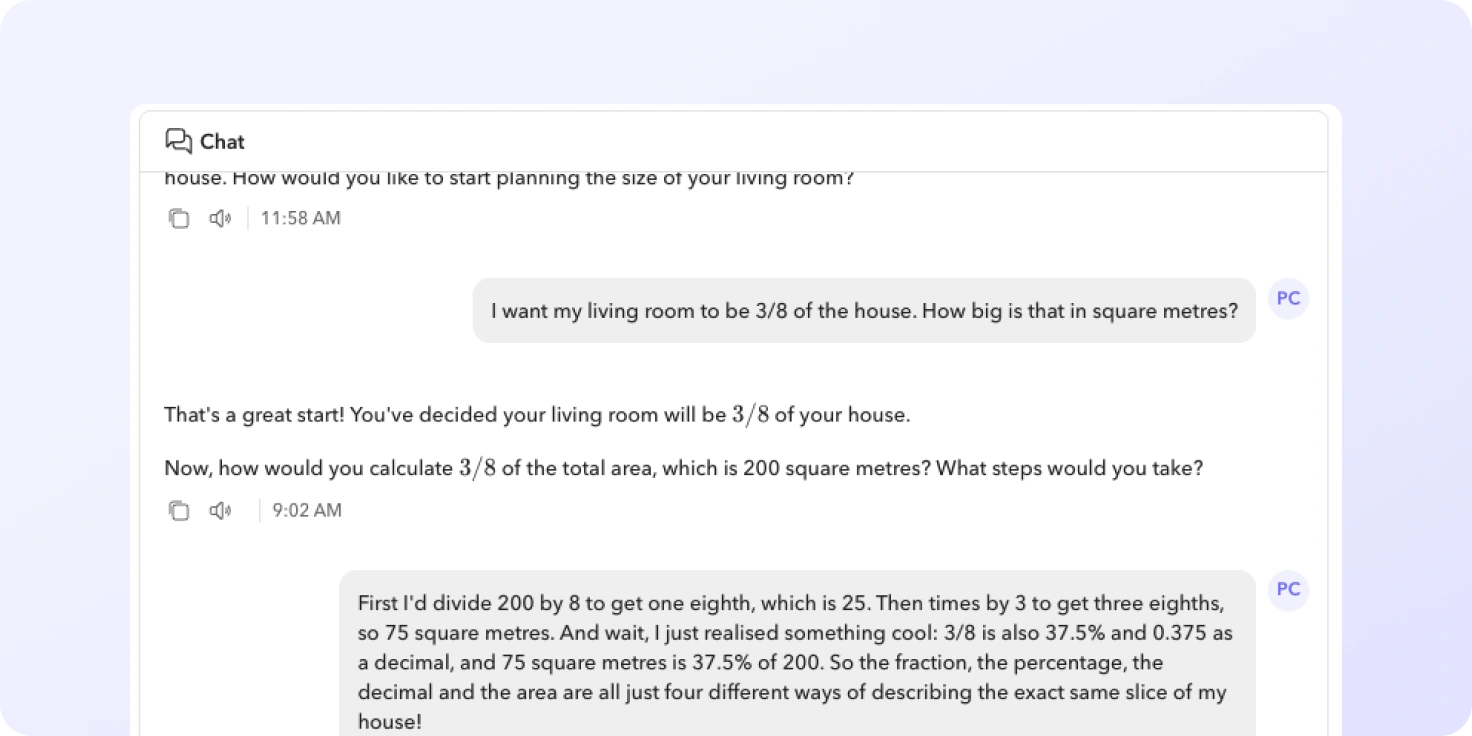
- Have students convert between fractions, decimals, and percentages when discussing room proportions and budget allocations, and ask them to show the same quantity in more than one form.
- Introduce constraints partway through, such as a budget cut or an extra room, to make students rework their plan.
- Ask students to justify each room size and budget choice with real-world reasoning, not just the calculation.
What this tutor evaluates
This tutor evaluates whether the student:
- fluently uses percentages, fractions, and decimals interchangeably in the house planning context
- can independently solve multi-step problems and explain their reasoning clearly
From the educator
Designed as a home learning experience, Percentage Planner moved beyond practice into applied decision-making. Students weren’t solving isolated questions—they were designing a space, making choices, allocating areas, managing constraints. Fractions, decimals, and percentages were no longer topics—they became tools for thinking.As students worked, the Toddle AI tutor responded in real time—evaluating their thinking, offering feedback, and more importantly, feedforward. Not after submission. Not delayed. But in the moment when it mattered most.A student misjudging a percentage wasn’t left waiting—they were prompted instantly:“Does this connect to a fraction you know?”Another, confidently solving, was extended:“Can you represent this in another form?”And just like that, the learning loop closed— attempt → feedback → refinement → clarity.What stood out was how quickly understanding deepened. Within minutes, students began moving between representations—fraction to decimal, decimal to percentage—without hesitation. Errors became opportunities, not endpoints. Thinking evolved as it was happening.Students weren’t just completing a task at home—they were engaged in a guided mathematical conversation. One that adapted, responded, and pushed their thinking forward continuously. For me, the visibility was immediate and powerful. I could see not just final answers, but the journey of thinking—where students hesitated, where they grew, and how they refined their understanding through feedback.This wasn’t homework in the traditional sense.It was live learning, happening beyond the classroom.And that’s what made it exceptional—evaluation, feedback, and feedforward… all unfolding in real time, turning every attempt into progress.