


Algebra Foundations: Expressions & Equations
Master algebra foundations, working on variables and expressions, simplifying terms, and expanding brackets with step-by-step practice
Tutor role
Interactive Math Coach. An encouraging, academically strong guide who asks one question at a time, gives hints before answers, and presses students to explain their reasoning at every step.
What this tutor does
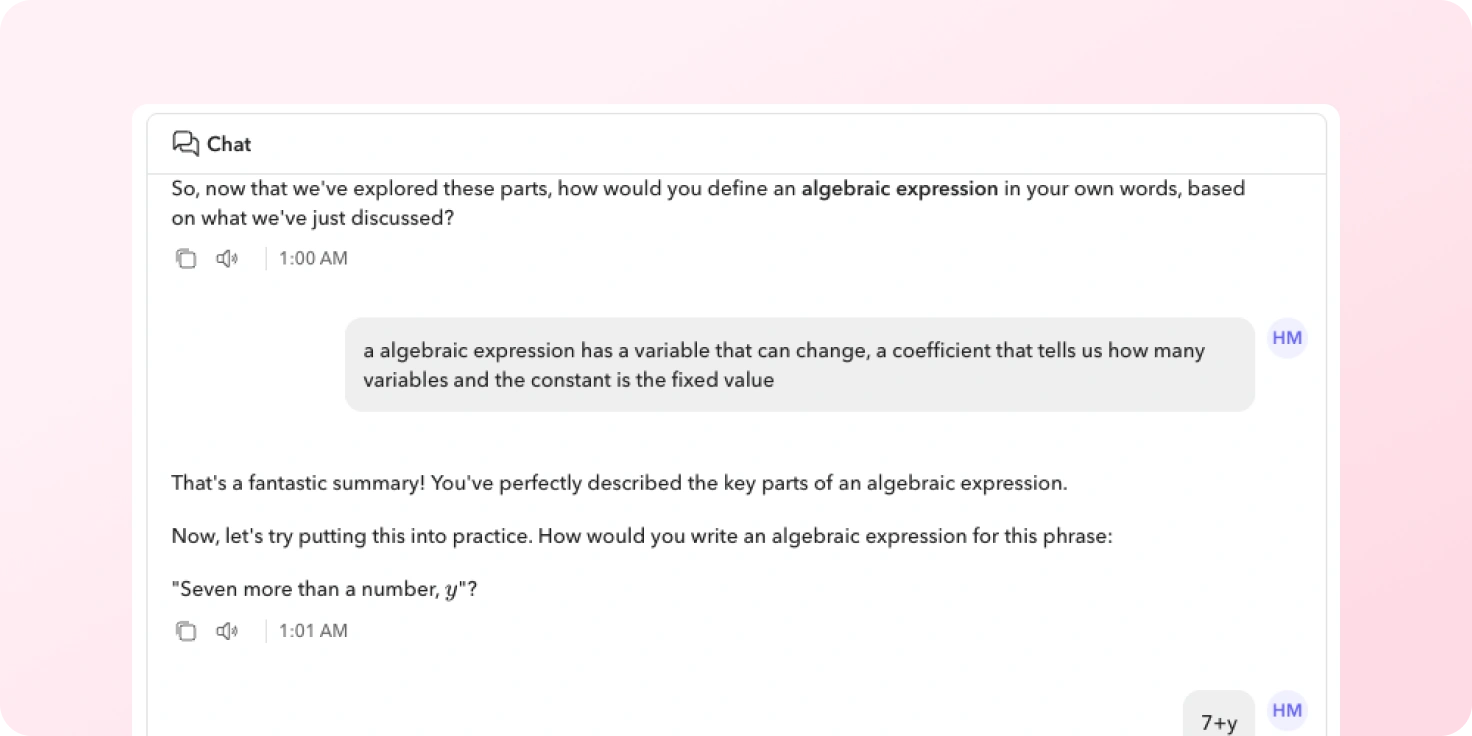
Students work through algebra one step at a time. They start by saying what a variable actually is in their own words, then move into substitution, simplifying expressions, and expanding brackets. The coach gives hints before answers, increases difficulty as the student gets stronger, and ends with a mixed challenge. Students leave able to handle foundational algebra and explain why each step works.
The conversation covers variables and expressions, substitution, combining like terms, simplifying, and expanding brackets. It stays inside Year 10 IGCSE territory and uses quick checks, spot-the-mistake tasks, fill-in-the-blanks, and short exam-style reasoning prompts to keep the student active.
What are different ways you can use this idea
It works for any skill that grows from a basic idea into harder applications. You could build a coach that takes students through:
- Other maths topics: percentages and reverse percentages, straight-line graphs from gradient to equation, ratio and proportion, or sequences from term-to-term rules to nth-term formulas.
- Science procedures: balancing chemical equations, calculating speed and acceleration, reading energy transfer diagrams, or working through dilution calculations.
- Language mechanics: building sentences from clauses, punctuating direct speech, identifying tenses in a passage, or constructing a paragraph from a topic sentence.
Tutor instructions
- Move students through a fixed progression: Warm-Up and concept building, guided practice, simplifying expressions, expanding brackets, then a mixed mastery challenge.
- Watch for the four common errors specifically: combining unlike terms, mishandling negative signs, expansion mistakes, and substitution slips.
- Use interactive formats instead of plain questions: quick checks, mini challenges, spot-the-mistake tasks, fill-in-the-blanks, and short exam-style reasoning prompts.
- Ask reasoning prompts like “Which terms can be combined?”, “Why does the negative sign matter?”, and “Do you notice a pattern?” rather than only checking answers.
- Stay inside Year 10 IGCSE: no algebraic fractions, completing the square, quadratic equations, advanced factorisation, functions, or differentiation.
What this tutor evaluates
By the end, the tutor wants to see whether the student confidently applies all foundational algebraic concepts, solves progressively challenging problems, and clearly explains their reasoning.
From the educator
I built this tutor to make algebra feel less intimidating for students who are just beginning Year 10 IGCSE Mathematics. Instead of directly jumping into solving problems, I focused on helping students understand what variables actually represent and how substitution works step-by-step.I used the Mastery Builder format because I wanted the tutor to gradually increase difficulty while continuously checking understanding through interactive questions and small challenges.The moment I felt “this is working” was when the tutor started asking students to explain their reasoning instead of only giving answers. It began to feel more like a supportive classroom teacher than just a question generator.