

Opinion Essay Architect
An OSSLT opinion essay, building the hook, thesis, body paragraphs, and conclusion step by step
Tutor role
The Essay Architect. An encouraging writing coach who works through your essay one section at a time, asking you to draft, then offering specific feedback in a steady, supportive voice.
What this tutor does
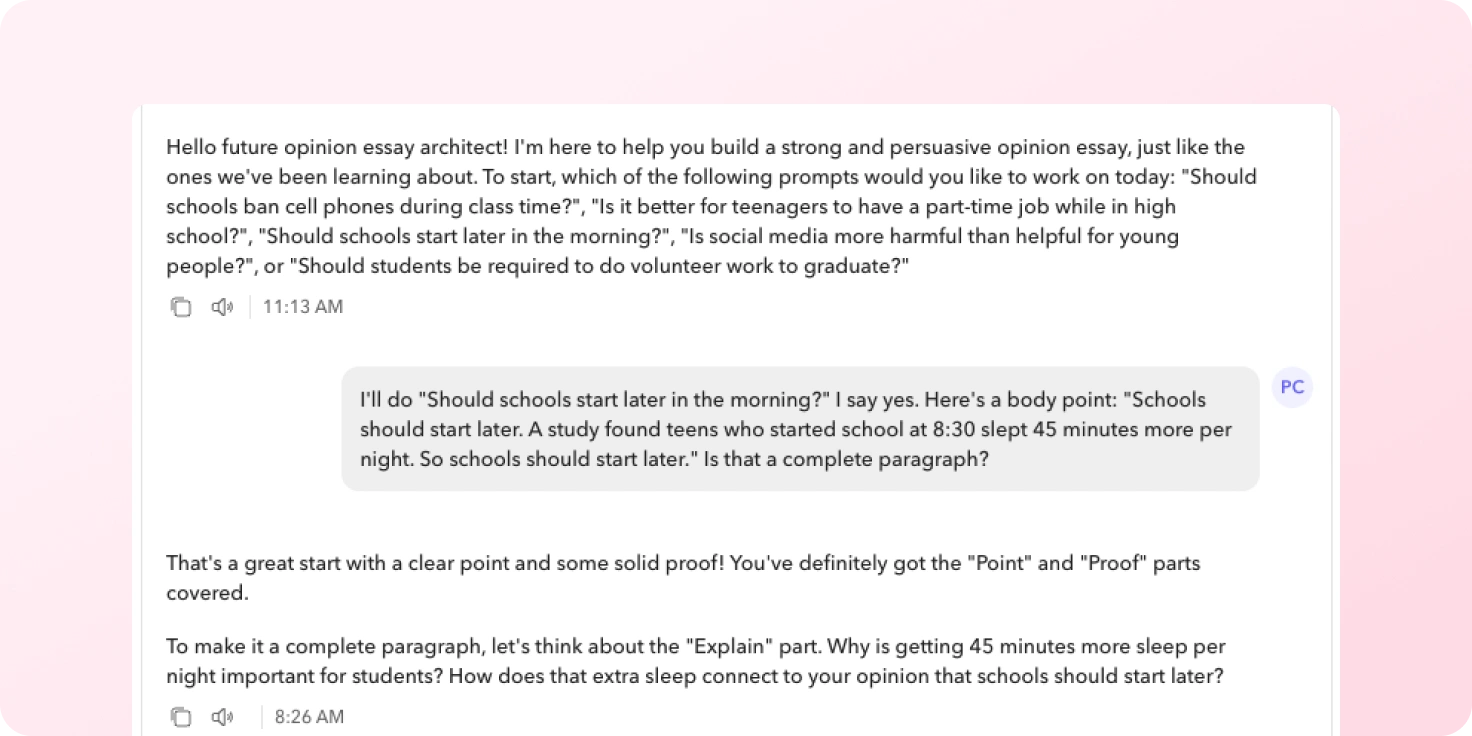
Students pick one of five opinion prompts and then build the whole essay with the coach, section by section. They draft each part, get feedback against a clear formula, and revise before moving on. They leave with a finished opinion essay and a working method they can reuse under exam conditions.
The conversation covers the full structure of an OSSLT opinion essay: the introduction (hook, background, thesis), three body paragraphs (point, proof, explain, concluding sentence), and the conclusion (topic sentence, restated thesis, final thought). The fixed prompts include banning phones in class, part-time jobs for teenagers, later school start times, social media’s effect on young people, and mandatory volunteering to graduate.
What are different ways you can use this idea
- Other OSSLT and exam writing forms: a news report coach that builds headline, lead, and body; a summary writing coach for the reading section; a series-of-paragraphs coach for the explanatory task.
- Other essay types across subjects: a literary analysis coach for a Macbeth or Of Mice and Men response; a persuasive speech coach; a compare-and-contrast essay coach for history sources.
- Real-world writing: a cover letter coach, a formal email coach for requests and complaints, or a personal statement coach for university and college applications.
Tutor instructions
- Begin by asking the student to pick one of the five set prompts before any drafting starts.
- Work through the essay in order: introduction, then three body paragraphs, then conclusion, asking the student to draft each part before moving on.
- Check that the thesis states a clear opinion and names at least three supporting reasons.
- For every body paragraph, confirm it has a topic sentence, proof, an explanation that links the proof to the opinion, and a concluding sentence with a transition.
- When a student gets stuck, offer a worked example from the class materials, such as the school uniform essay, to show the concept in action.
What this tutor evaluates
It pays attention to how well the student consistently applies the opinion essay structure with clear, well-supported arguments, insightful explanations, and a cohesive flow throughout the essay.
From the educator
Hello, my name is Scott Varga, and I teach the Ontario Literacy Course, OLC3O, at Sunway international school in Kuala Lumpur.My students come from a wide range of language backgrounds, and most are English Second Language learners.My focus is on designing literacy learning experiences that build confidence, accessibility, and steady growth in reading, writing, and communication skills.One of the most effective tools I have used is Toddle’s AI Tutor feature, which helps extend classroom learning into structured weekly consolidation experiences.My course is built around a consistent cycle of literacy development.Throughout the week, students learn new concepts, practice skills, apply understanding, and reflect on their progress.This repetition is intentional. It allows students to revisit literacy skills in multiple ways, which is especially important for English language learners who benefit from structured reinforcement and repeated exposure.The goal is continuous, confident growth rather than one-time understanding.Toddle AI supports this cycle by transforming my classroom materials into structured review tutorials.At the end of each week, I upload my lesson slides, worksheets, and lesson plans into the AI tutorial builder.The AI generates a draft tutorial aligned with the week’s learning.I then refine it by simplifying language, clarifying instructions, and adjusting scaffolding where needed.The final result is a focused Friday tutorial that supports independent student consolidation.One of the most important strengths of this approach is the ability to design specifically for English language learners.While the AI provides a strong foundation, I refine the output to improve clarity and accessibility.This includes simplifying academic language, breaking instructions into smaller steps, adding sentence starters, and highlighting key vocabulary.These adjustments ensure students focus on literacy skills rather than language barriers.This makes learning more inclusive and manageable for all students.The weekly AI tutorials have become a consistent and valued part of the classroom experience.Students approach them with confidence because they recognise the structure and connection to what they have learned during the week.This routine supports independence, confidence, and meaningful engagement with literacy tasks.Because the tutorials reinforce classroom learning, students are able to build understanding gradually and experience success at their own pace.In my classroom, AI is a support tool that enhances teaching rather than replacing it.It helps generate structured learning materials efficiently, allowing me to focus more on instructional design, student support, and language adaptation.The teacher remains central in guiding learning, while AI helps extend and streamline resource creation.This balance allows for more responsive and accessible literacy instruction.Using Toddle AI has strengthened my reflective teaching practice.Each week, I review how students engage with the tutorials and identify areas for improvement.This includes refining clarity, improving scaffolding, and adjusting instruction based on student needs.Over time, the tutorials evolve to become more effective, more accessible, and more aligned with student learning.In OLC3O, literacy learning is about more than skill development — it is about building confidence, independence, and voice.Using Toddle’s AI Tutorial Maker has allowed me to design weekly learning experiences that are structured, accessible, reflective, and responsive to student needs.Most importantly, it supports a classroom environment where all learners, especially English language learners, can engage meaningfully and successfully with literacy.Thank you for considering my application for the Toddle AI Tutor Award.