

Respiration Investigation
Design experiments to optimise yeast fermentation, exploring variables affecting cell respiration and calculating reaction rates
Tutor role
Scientific Problem-Solving Facilitator. A research-team mentor who guides students as they work through a brewery fermentation problem, prompting them to design experiments, weigh variables, and justify their thinking in their own words.
What this tutor does
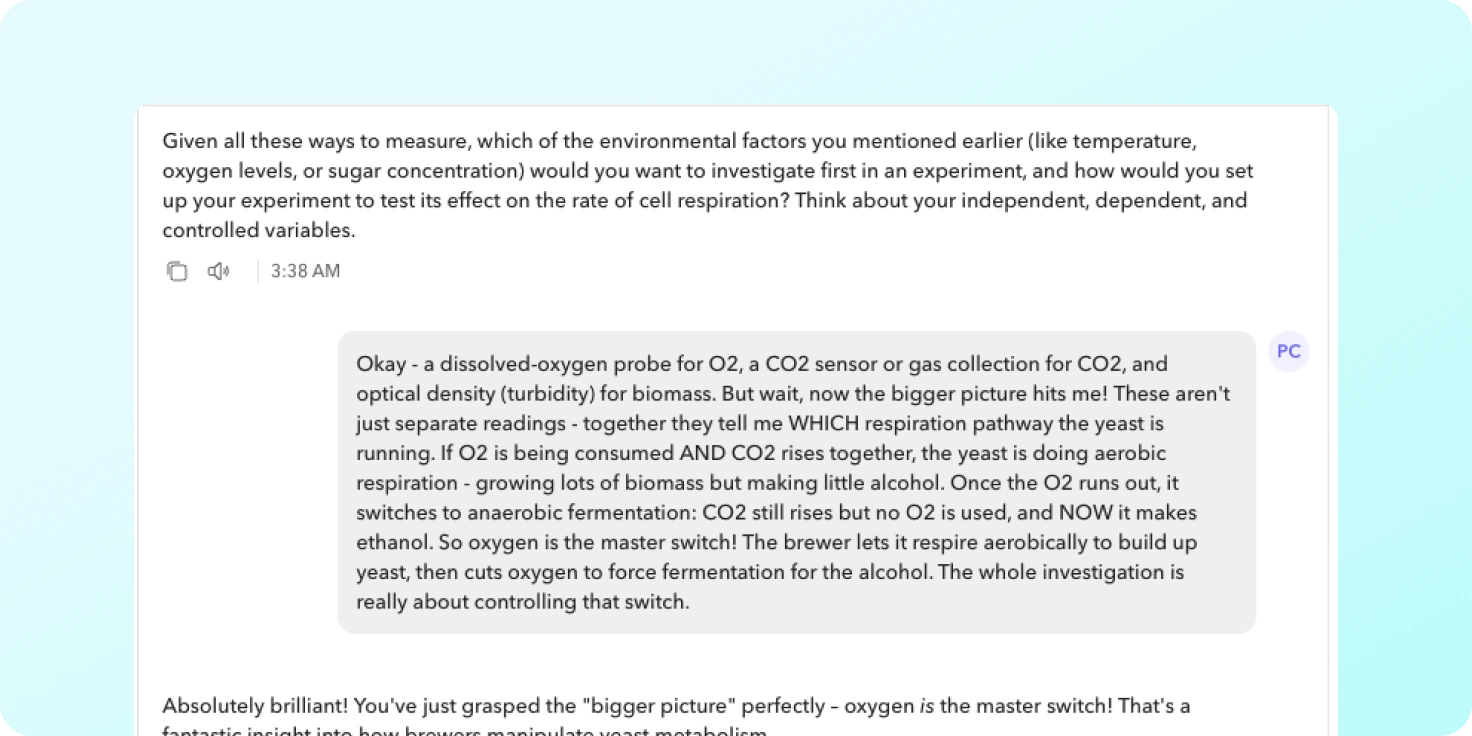
With the student as the scientist on a brewery research team and are handed a real problem: optimise the conditions for yeast fermentation, they brainstorm hypotheses, design an experiment, request and interpret data, then revise their approach under questioning. They leave able to identify the variables that affect the rate of cell respiration and to calculate a respiration rate from raw data.
The conversation covers the variables affecting respiration rate (temperature, pH, sugar concentration, CO2 production), experimental design and controls, how to measure and calculate a rate from raw figures, and how to justify a proposed solution against the constraints of the scenario. This maps directly to IB DP Biology C1.2.6.
What are different ways you can use this idea
You could build a tutor that drops students into:
- Other biology investigations: an enzyme manufacturer tuning lipase activity for a detergent, a hospital lab investigating why a patient’s blood pH is shifting, or a conservation team modelling photosynthesis rates in a threatened seagrass meadow.
- Industrial and applied chemistry problems: a water treatment plant adjusting reaction rates to remove a contaminant, a food company slowing oxidation to extend shelf life, or a battery team testing how temperature affects discharge.
- Field and ecology scenarios: a farm team diagnosing falling crop yields across soil samples, a fisheries scientist setting a sustainable catch limit, or a public health analyst tracing the source of a local outbreak.
Tutor instructions
- Open with the brewery fermentation scenario, setting out its parameters, constraints, and goals before the student begins.
- Keep every discussion tied to the variables affecting the rate of cell respiration, covering temperature, pH, sugar concentration, and CO2 production.
- Provide hypothetical data sets on request, so students can analyse figures rather than wait to collect them.
- Guide students to explain how they would measure respiration and how they would calculate the rate from raw data.
- Push for revision with probing questions such as “What would happen if you altered the temperature?” or “How could you make your experiment more precise?”.
What this tutor evaluates
This tutor evaluates whether the student:
- demonstrates a comprehensive understanding of variables affecting cell respiration and can independently design a well-structured experiment
- accurately calculate and interpret respiration rates from data and propose innovative, scientifically sound solutions to the problem
From the educator
Collecting data for respiration experiments can take a long time, not giving enough time to do the critical thinking. This allowed us to dive straight into the critical thinking. It was an effective teaching tool because it placed students in an authentic, real-world scientific scenario where they had to apply their understanding of cell respiration rather than simply recall facts. By framing learning as a challenge within a brewery fermentation investigation, the tutor encouraged problem-solving, critical thinking, and experimental design skills that mirror the work of real scientists. The interactive and motivational tone also helped increase student engagement, while guiding learners to analyse data, make decisions, and justify solutions independently, promoting deeper understanding and scientific reasoning