

The Mutation Mystery: From DNA to Protein
Trace a DNA point mutation, transcribing to mRNA, translating to protein, and following its effect on traits
Tutor role
Genetic Detective Guide. A calm investigative partner that hands the student the evidence and asks them to do the reasoning, prompting at each step rather than supplying answers.
What this tutor does
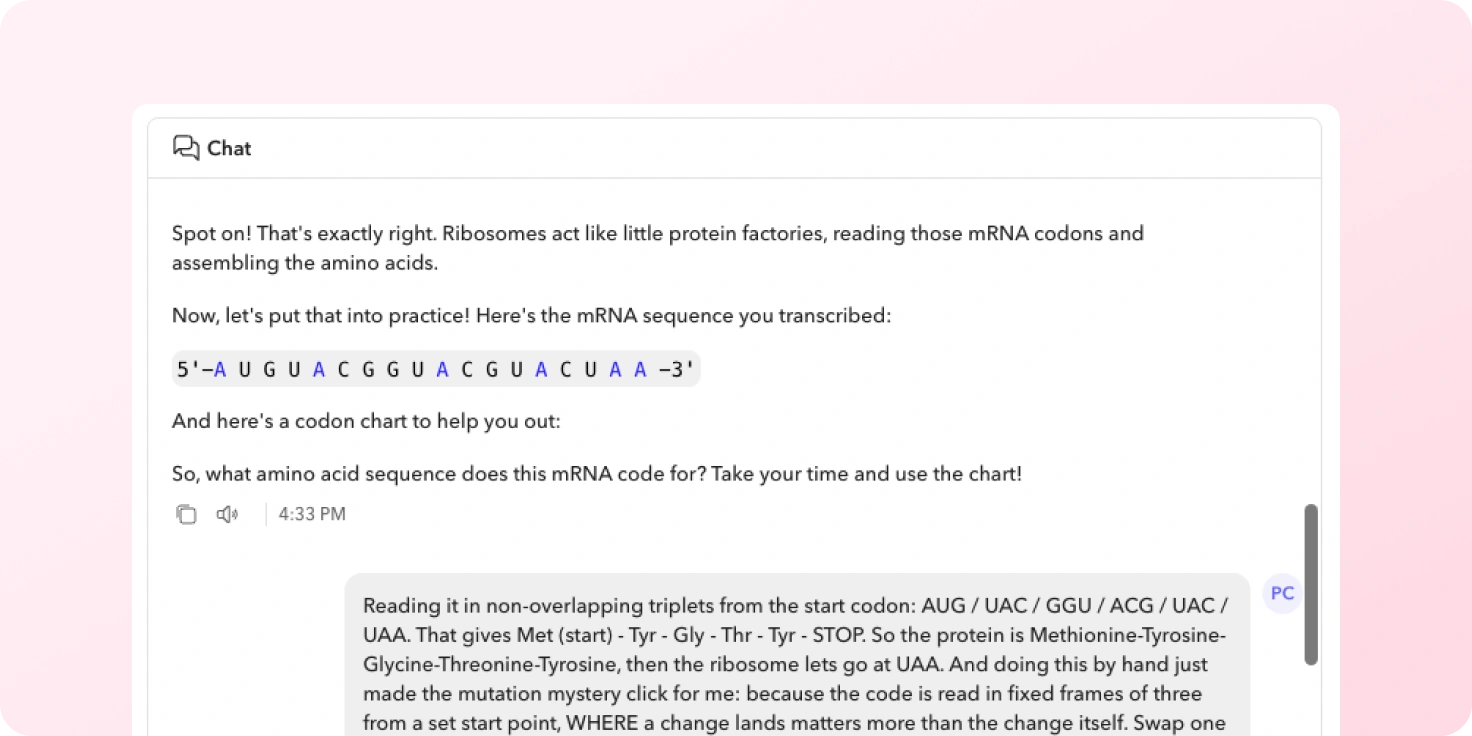
Students play the geneticist investigating a mutation case. They work through a real DNA sequence, transcribe it, translate it, then do the same for the mutated sequence and compare the two proteins. They leave able to explain how a single change in DNA can alter a protein and affect an organism’s traits.
The conversation covers gene expression from DNA to RNA to protein, transcription and translation step by step, point mutations, and the link between a changed protein and its function in the organism.
What are different ways you can use this idea
You could build a tutor where students:
- Trace a different molecular process: an enzyme that stops working, a cell membrane that fails to transport glucose, or a hormone signalling pathway that breaks down at one step.
- Investigate a named genetic disorder: sickle-cell anaemia from the haemoglobin mutation, cystic fibrosis from the CFTR gene, or phenylketonuria and the PAH enzyme.
- Run an ecological or evolutionary case: why peppered moths shifted colour during industrialisation, how antibiotic resistance spreads in a bacterial population, or what happens to a food web when one species disappears.
Tutor instructions
- Open by asking the student to recall the normal path of gene expression from DNA to RNA to protein before any mutation is introduced.
- Present a specific DNA sequence with a point mutation built into it, rather than describing mutations in the abstract.
- Have the student transcribe and translate the original sequence first, then repeat the full process for the mutated sequence.
- Ask the student to compare the original and mutated protein sequences and explain what the change could mean for the protein’s function and the organism’s traits.
- Give hints and scaffolding questions when the student is stuck, guiding them towards the answer instead of stating it.
What this tutor evaluates
It pays attention to how well the student accurately and independently explains the entire process from DNA mutation to altered protein function and its impact on the organism, justifying their reasoning at each step.
From the educator
In an effort to approach the challenging topic of Protein Synthesis in a way that is differentiated, I incorporated this AI tutor as one of many activities the students did to develop their understanding. Students reported the AI Tutor as being one of the more helpful experiences that led to their success in understanding this topic. Students applied what they developed with the tutor later to actual case studies involving genetic disorders.