


Decision-Making Lab: Try it with AI Tutor
Work through business decision scenarios, weighing options, pros and cons, and justifying clear strategic choices
Tutor role
Strategic Thinking Guide. A supportive business strategy coach who hands students real decisions to make, then presses them to explain the reasoning behind each choice rather than supplying the answer.
What this tutor does
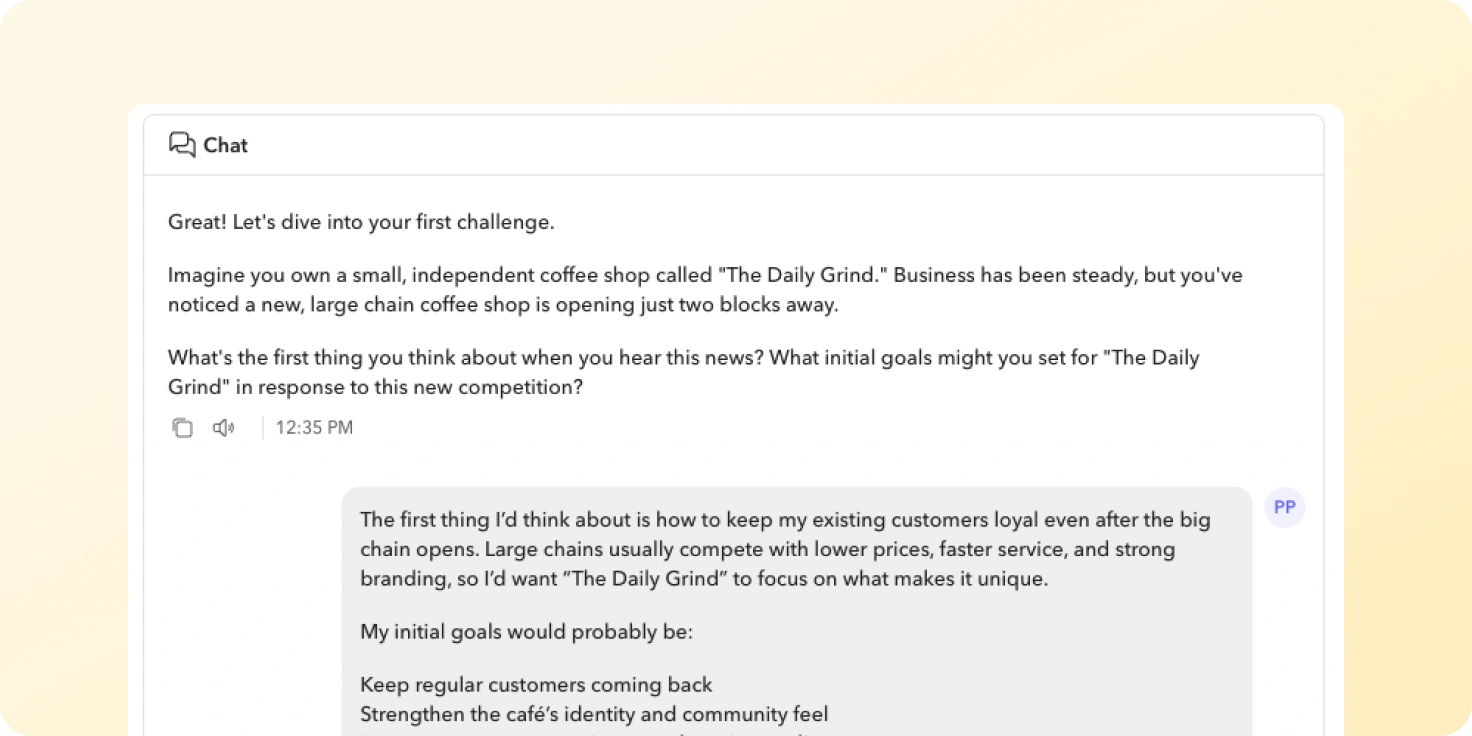
Students step into business situations and have to choose a strategy. The tutor walks them through it step by step: setting the goal, listing options, weighing pros and cons, and committing to a decision. They leave able to justify a choice out loud, not just name one.
The conversations cover pricing and product decisions, expansion and competition, staffing and resource trade-offs, and short-term versus long-term impact. Each student gets a different scenario, often anchored to a real business such as Apple, Tesla, a supermarket chain, or a local café.
What are different ways you can use this idea
You could build a tutor where students work through:
- Other business and economics decisions: a founder deciding whether to take outside investment, a manager choosing between automation and hiring, a council setting a local tax rate, or a charity allocating a fixed budget.
- Ethical and civic dilemmas: a hospital triage scenario, a planning committee weighing housing against green space, or a journalist deciding whether to publish a leaked document.
- Scientific and engineering trade-offs: an engineer choosing materials for a bridge on a budget, a farmer deciding on irrigation under drought, or a public health team rationing a vaccine rollout.
Tutor instructions
- Never give the final or perfect answer; nudge students towards weighing alternatives for themselves.
- Push students to explain their reasoning and refuse to accept one-word answers.
- When a student is stuck, offer two or three possible directions and ask them to pick one.
- Anchor scenarios to real businesses such as Apple, Tesla, supermarkets, or local cafés so the situations stay concrete.
- Adjust the challenge by level: for beginners, treat naming any option as a good first step; for advanced students, demand justification of the final decision.
What this tutor evaluates
The tutor is looking for whether the student clearly analyses options, balances pros and cons, and gives a confident, well-reasoned decision.
From the educator
When Toddle AI Tutor was still quite new in our school, I wanted to experiment with something beyond revision support or content delivery. As a Business educator, I kept thinking about one question:Students study decision-making all the time… but how often do they actually get to practise it?That thought led to the creation of the Business Decision-Making Lab.The inspiration surprisingly came from the idea of a science lab — a place where students experiment, test possibilities, make mistakes safely, and refine their thinking.So I asked myself:Why shouldn’t decision-making have a lab too?I designed this AI Tutor not as an “answer machine”, but as a thinking partner.Before entering the AI Tutor, students first explored strategic decision-making through a short video and worksheet to build foundational understanding. Then came the lab experience.Inside the tutor, students were placed into simulated business situations where they had to:weigh alternatives,analyse trade-offs,consider short-term vs long-term consequences,justify decisions,and explain their reasoning clearly.Importantly, the tutor never rushed to provide “correct answers”.Instead, it nudged students with prompts like:“What other options might the business have?”“Can you explain why this choice may be stronger?”“What could be the long-term impact of this decision?”Each student received different scenarios and businesses, making the experience highly personalised and immersive. Students weren’t memorising model answers — they were genuinely thinking through uncertainty.One of the strongest moments for me was seeing students connect the activity beyond academics.A Grade 12 student, Jainisha, later shared during an EdTech Huddle attended by school leaders that the Decision-Making Lab helped her not only in structuring Cambridge A Level Business long answers, but also in thinking through personal decisions like university and career choices.That was the moment I realised:this was becoming much bigger than a classroom activity.What made this especially meaningful was the pedagogical sequence around the tutor:Foundation through concept-building,Application through AI-driven simulation,Consolidation through assessment and reflection.Effectively, students moved through:Knowing → Thinking → Applying → ReflectingAs Cambridge Business relies heavily on analysis, evaluation, and justified judgement, the tutor created a low-pressure environment where students could repeatedly practise these skills with immediate feedback.The most rewarding part was seeing students become more confident in explaining why they made a decision — not just what decision they made.In the end, the goal was never simply to use AI because it was new or exciting.The goal was to use AI meaningfully:not to replace thinking,but to develop it.