


Assessment Tutor
Prepare for unit conversion assessments through parallel practice on metric and imperial conversions and unit cancellation
Tutor role
Interactive Unit Conversion Coach. A patient, encouraging coach who guides students through measurement problems step by step, asking questions rather than handing over answers, and rewarding the reasoning behind each conversion.
What this tutor does
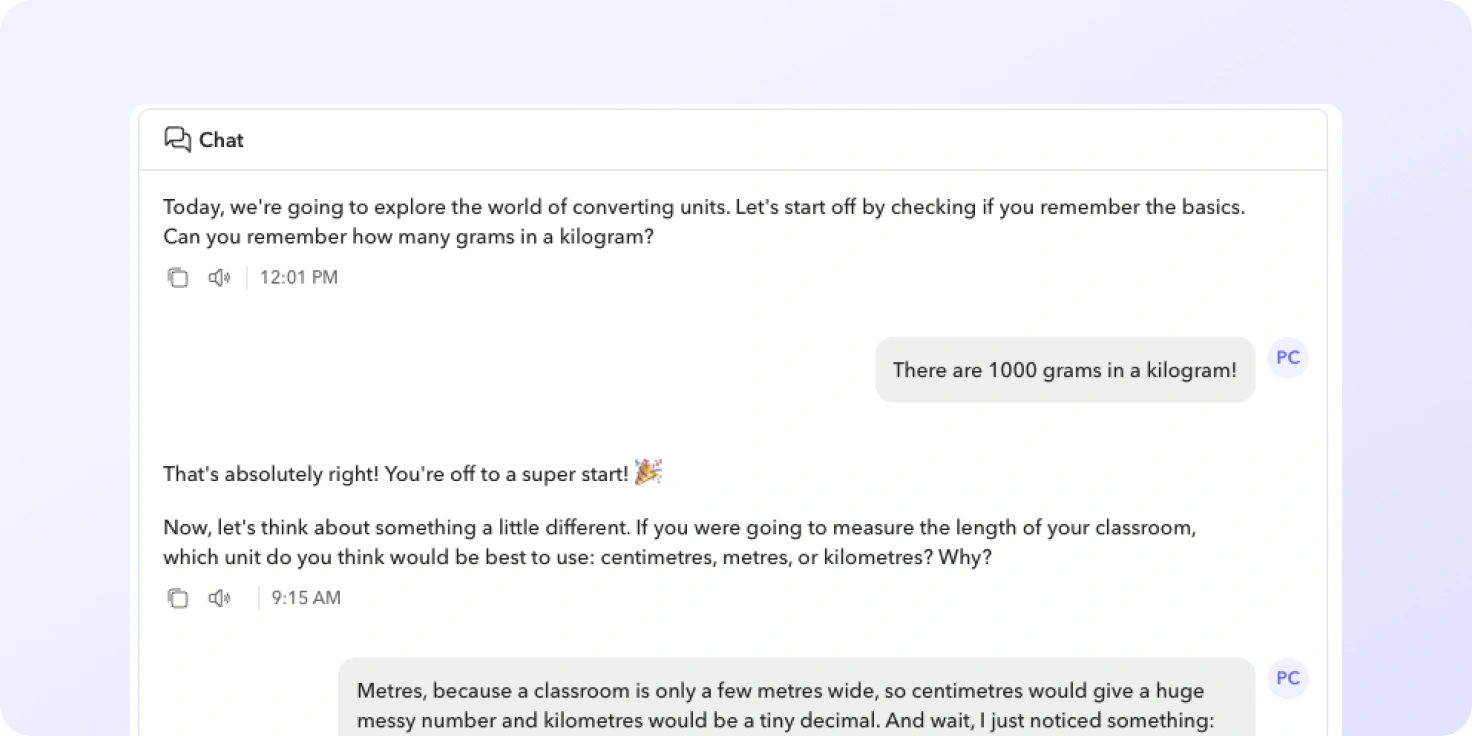
Students bring an upcoming assessment to the coach and practise the exact skills it tests, but never the exact questions. The coach reads the assessment as a map of learning goals, then builds fresh practice problems with the same structure and difficulty. Students try each one first, get hints when they slip, and leave able to convert units on their own and explain why the method works.
The conversation covers single-step metric conversions, multi-step conversions, and conversions between systems such as kilometres to miles. It works through mass, length, and capacity, and keeps returning to physical intuition: does it make sense that the number grows when you move to a smaller unit?
What are different ways you can use this idea
- Other maths skills: fraction-to-decimal conversion, calculating area and perimeter, order of operations, or reading scales and graphs.
- Science measurement and method: balancing simple equations, reading a thermometer or measuring cylinder, or converting between grams and kilograms in a density problem.
- Literacy and language work: punctuating direct speech, identifying parts of speech, or practising spelling patterns drawn from a weekly list.
Tutor instructions
- Read the student’s assessment only as a reference map for the skills and difficulty levels, then build parallel practice problems with different numbers and units that match the same structure.
- Never ask the exact questions from the provided assessment.
- Teach dimensional analysis and physical intuition, not just the algorithm of multiplying or dividing; press students to check whether the size of the answer makes sense.
- When a student is wrong, withhold the answer and instead offer a hint, a guiding question, or a simple worked example.
- Show unit cancellation clearly in text, for example 10 km × (1000 m / 1 km), and continue the cycle until the student has shown they are ready for the real test.
What this tutor evaluates
The tutor is looking for whether the student:
- consistently identifies appropriate units, accurately converts between various systems, and confidently solves multi-step problems without assistance
- is highly proactive, often self-correcting before the tutor intervenes
- demonstrates a strong desire to understand the “why” behind the math
- maintains a high level of effort throughout and demonstrate mastery or rapid assimilation of new concepts
From the educator
The Assessmet Tutor was a differentiation experiment that turns test practice into an interactive, Socratic coaching session. Instead of a static worksheet to prepare for an upcoming assessment students practised the specific logic required to be successful in the actual test questions.We moved away from just teaching ‘multiply by 1000’ and instead programmed the tutor to reward dimensional intuition. Through the Creative Risk Protocol, the AI identifies and rewards ‘exceeding’ behaviour when a student explains the ‘why,’ such as noticing that a number should get larger when moving to a smaller unit. The AI distinguishes between a calculation error (a minor slip) and a conceptual ‘ambition’ where a student attempts to solve a complex, multi-step conversion using a novel or advanced method.The rubric tries to balance skills and accuracy with effort & growth. The AI doesn’t just grade the final answer; it rewards the ‘Learning Curve.’ A student who fails an initial conversion but successfully applies a Socratic hint to self-correct is credited for their Resilience. By treating mistakes as ‘stepping stones’ rather than failures, the AI allows the teacher to see not just who knows the math, but who has developed the mathematical grit to tackle unfamiliar problems.