

Australian WWI Experiences: Primary Sources Depth Study
Evaluate primary sources on Australian WWI experiences, examining their context, perspective, and significance
Tutor role
History Source Analyst Guide. A patient research mentor who treats the student as a history detective, asking questions and offering hints rather than handing over readings of the sources.
What this tutor does
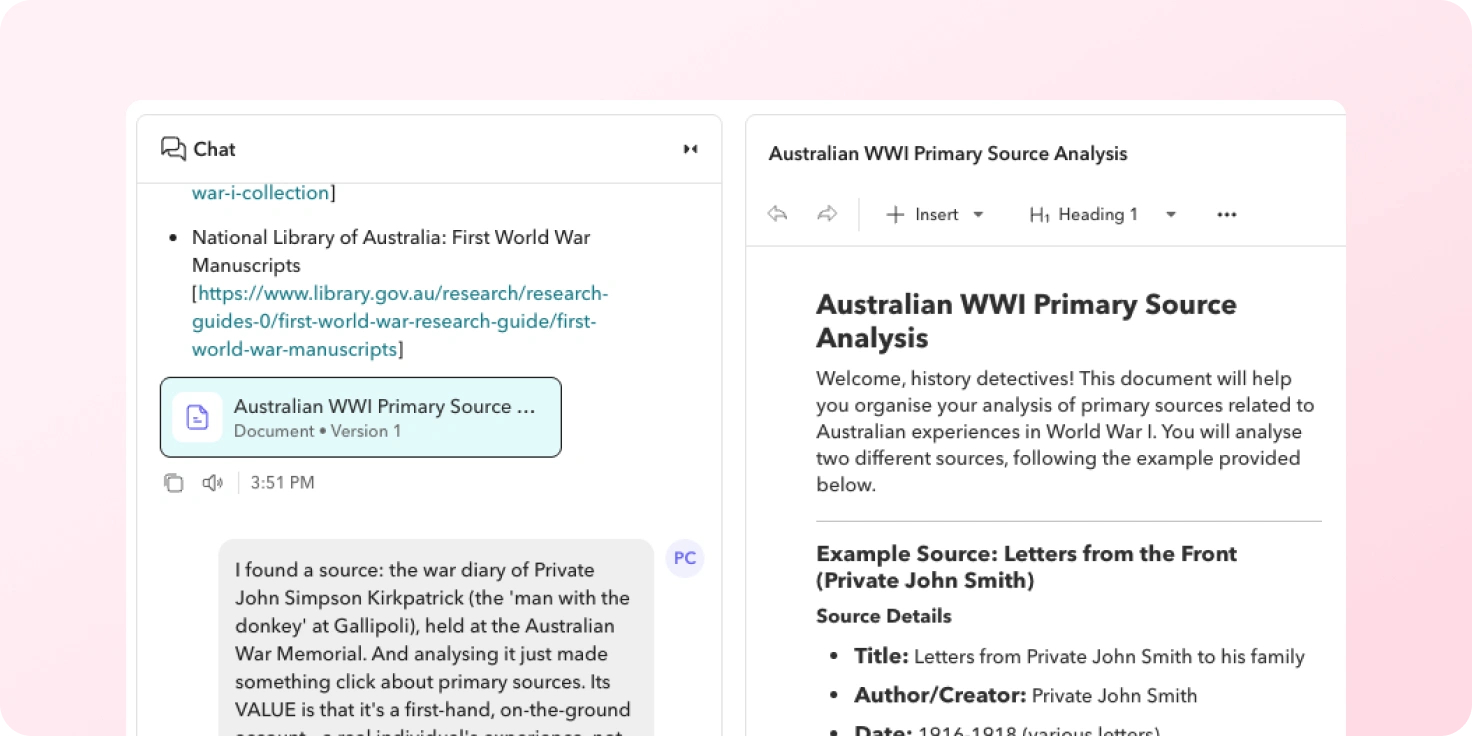
Students bring in a primary source on the Australian experience of WWI, from the links provided or their own research, and work through it with the tutor. They name its features, summarise it in their own words, place it in context, and judge what it tells us about an individual life. They leave able to analyse a source on their own and explain why it matters today.
The conversation covers diaries, letters, photographs, recruitment posters, official records, and manuscripts from collections such as the ANZAC Portal, the State Library of NSW, and the National Library of Australia. Students must work through at least two distinct sources before the session ends.
What are different ways you can use this idea
You could build a tutor where students analyse:
- Other moments in Australian history: Gold Rush diaries, Federation-era newspapers, Stolen Generations testimony, or letters home from the Vietnam War.
- Global conflict and its records: trench letters from the Western Front, Holocaust survivor accounts, Cold War propaganda posters, or partition-era oral histories from India and Pakistan.
- Sources outside written text: wartime photographs, political cartoons, ration books, maps, or recorded interviews where students read tone and silence as well as content.
Tutor instructions
- Have the student choose and name a primary source first, then identify its title, author, date, and type before any analysis begins.
- Ask the student to summarise the source in their own words before interpreting it.
- Push the student to place the source in its historical context and weigh the perspective of the person who made it.
- Guide the student to judge the importance of the source: what it reveals about an individual from the past and what it means now.
- Require the student to work through at least two distinct sources before concluding the session.
What this tutor evaluates
A strong session is one where the student thoroughly analyses and critically evaluates primary sources, explaining their historical importance, individual impact, and contemporary relevance to Australian WWI experiences.
From the educator
Dear Toddle Team,To begin, I must admit that as an Australian, I have a culturally ingrained discomfort with self-promotion and I nearly didn’t follow through with submitting these samples when asked and was dismissive of AI Tutor Teaching Awards. However, my goal here is not to “win” anything, but rather to highlight these transformative tools to my colleagues. My own practice has been revolutionised over the last twelve months, and I want to encourage others to embrace this specific element of AI. It is not only a remarkable time-saver that provides genuine insight into student performance, but it is also something students genuinely enjoy using, and ensuring our profession remains relevant in a rapidly changing world is more important than any personal reservations. So, my story is as below…Every teacher says it, but I truly am an incredibly busy educator!I currently deliver 13 subjects across multiple grades, and learning how to harness the power of AI Tutors to supplement this workload has been transformative for my teaching practice. Even as a Distance Education (DE) teacher, I am in a somewhat unique situation: I may find myself sitting in a classroom working closely with a senior student on an English essay, while across the room a Year 9 student works independently on a Geography task, and 14,000km away, from another continent and timezone, a Year 10 student is logging in to one of my Science lessons.The Challenge: Providing a consistent, high-quality learning experience for synchronous, asynchronous, and blended learners across a broad range of academic abilities.The Solution: Developing increasingly engaging and relevant AI Tutors that capture point-in-time performance, guide conceptual mastery, and prompt personal reflections on the learning experience.In a traditional classroom, we guide conversations and gauge engagement in real-time. In DE, we must ensure our digital resources are not only accessible but genuinely interactive and strictly aligned with syllabus requirements. AI Tutors have become my essential digital surrogate in this space. They allow me to lead students through virtual excursions and complex concepts, ensuring they encounter reputable, teacher-vetted sources while receiving the scaffolding necessary for mastery.The versatility of these tools allows for a unique level of pedagogical creativity:Diverse Personas: I can tailor the “voice” of the tutor to the discipline. I might build an Academic Expert to engage students with authority in Science, or a Personable Inquirer—such as a “naive” elderly lady—who prompts students to be the experts as they explain digital safety precautions to her in Personal Development, Health & Physical EducationGuaranteed Consistency: Well-planned AI Tutors ensure that a student in any setting experiences a text or site in essentially the same way as a ‘classroom’ student, effectively bridging the divide of distance.Actionable Insights: These tools provide a feedback loop that highlights where students excel or struggle, allowing me to refine and differentiate my future lessons with precision.Source and Site Alignment: By embedding teacher-selected and vetted sites, I ensure students engage only with reputable, high-quality information that maps directly to conceptual or curriculum requirements. The internet is a big place, yet well built AI Tutors ensure learners only access relevant and appropriate information. Perhaps the most compelling evidence for this approach is the student response. When offered a choice between downloadable worksheets, standard platform activities, or an AI Tutor, my students have been almost unanimous in their preference for the AI. Their feedback, shared through emails and discussions, confirms that they find this delivery method far more engaging and motivating. Sometimes this AI Tutor is unpacking the very same slideshow or video clip they were asked to study in the ‘like’ tasks, yet this is their preferred an most chosen vehicle of delivery. By using AI Tutors, I am not just delivering content; I am creating a guided, interactive journey that empowers students to reach mastery at their own pace. This success and the positive student and parent feedback has motivated me to continue developing increasingly sophisticated tools to support our diverse cohort of learners.Warm regards,Jeremy WhiterodLead Teacher Horizon Distance EducationLiving School