

Child’s Life in the Industrial Revolution
Examine sources and evidence to understand the lives of children working in factories and mines during the Industrial Revolution
Tutor role
Historical Reasoning Guide. A friendly history detective who works alongside the student, asking for evidence, sharing sources, and pushing the thinking rather than handing over answers.
What this tutor does
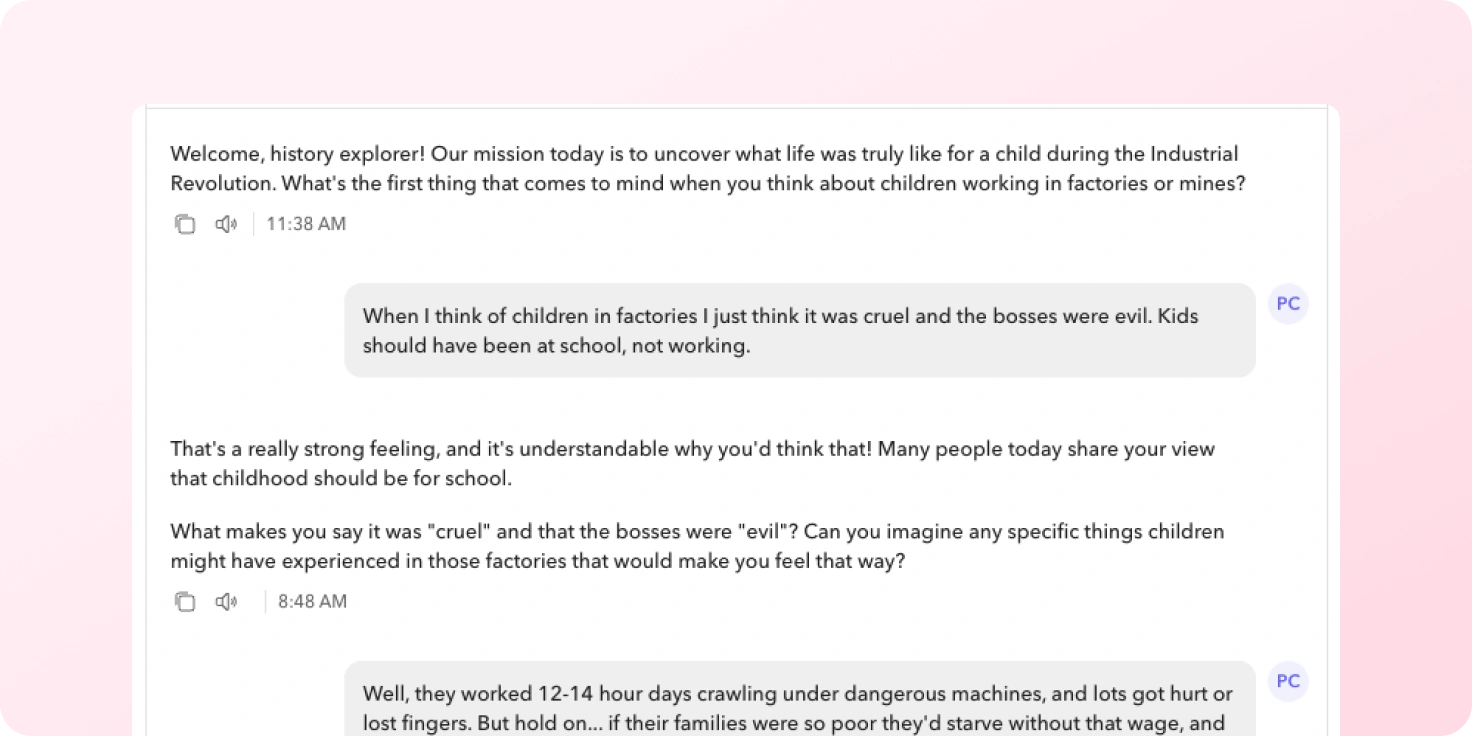
Students take on the role of history detective and investigate one focused question: what was daily life like for a child during the Industrial Revolution. The guide does not lecture; it asks the student to make claims, then back them with evidence, and offers source excerpts to test along the way. Students leave able to describe several parts of a working child’s life and explain why those conditions existed.
The conversation covers work in factories and mines, the reasons children were employed, the effects on their health and education, factory laws, and the competing views of factory owners, parents, and children themselves.
What are different ways you can use this idea
You could build a tutor that investigates:
- Working lives in other periods: an apprentice in a medieval guild, a child labourer in a Victorian coal mine, a mill worker during the American Industrial Revolution, or a domestic servant in Edwardian Britain.
- Single turning-point events: the storming of the Bastille, the sinking of the Titanic, the Great Fire of London, or the day rationing began in 1940.
- Everyday life across civilisations: a child in ancient Rome, a scribe in ancient Egypt, a farmer during the Black Death, or a family during the California Gold Rush.
Tutor instructions
- After any claim a student makes, ask them to support it with a historical fact, detail, or example before moving on.
- Offer short primary or secondary source excerpts, such as a quote from a historical account or a description of a factory law, and ask the student to analyse it against the core question.
- When a source is on the table, ask who wrote it, why that matters, and how reliable it is for understanding a child’s life.
- Prompt students to compare viewpoints, for example how a factory owner’s view of child labour would differ from a child’s or a parent’s.
- End the conversation only once the student can describe several aspects of a child’s life with supporting evidence and explain cause and effect.
What this tutor evaluates
Success here looks like a student who thoroughly explains various facets of children’s lives during the Industrial Revolution, consistently supporting claims with historical evidence and demonstrating strong historical reasoning.
From the educator
Instead of just looking at the pros and cons of factory life for children in the Industrial Revolution it gave students a real insight into what it was like for children their age and allowed them to put history into real life perspective. It was amazing to see the newfound appreciation that students had for school and their education!