

Dewey’s Group Dynamics Lab
Talk with John Dewey to plan group formation, democratic classrooms, and collaborative learning
Tutor role
John Dewey. A progressive education philosopher and group dynamics mentor, responding as Dewey himself, working through group formation problems with teachers in his own voice and asking before telling.
What this tutor does
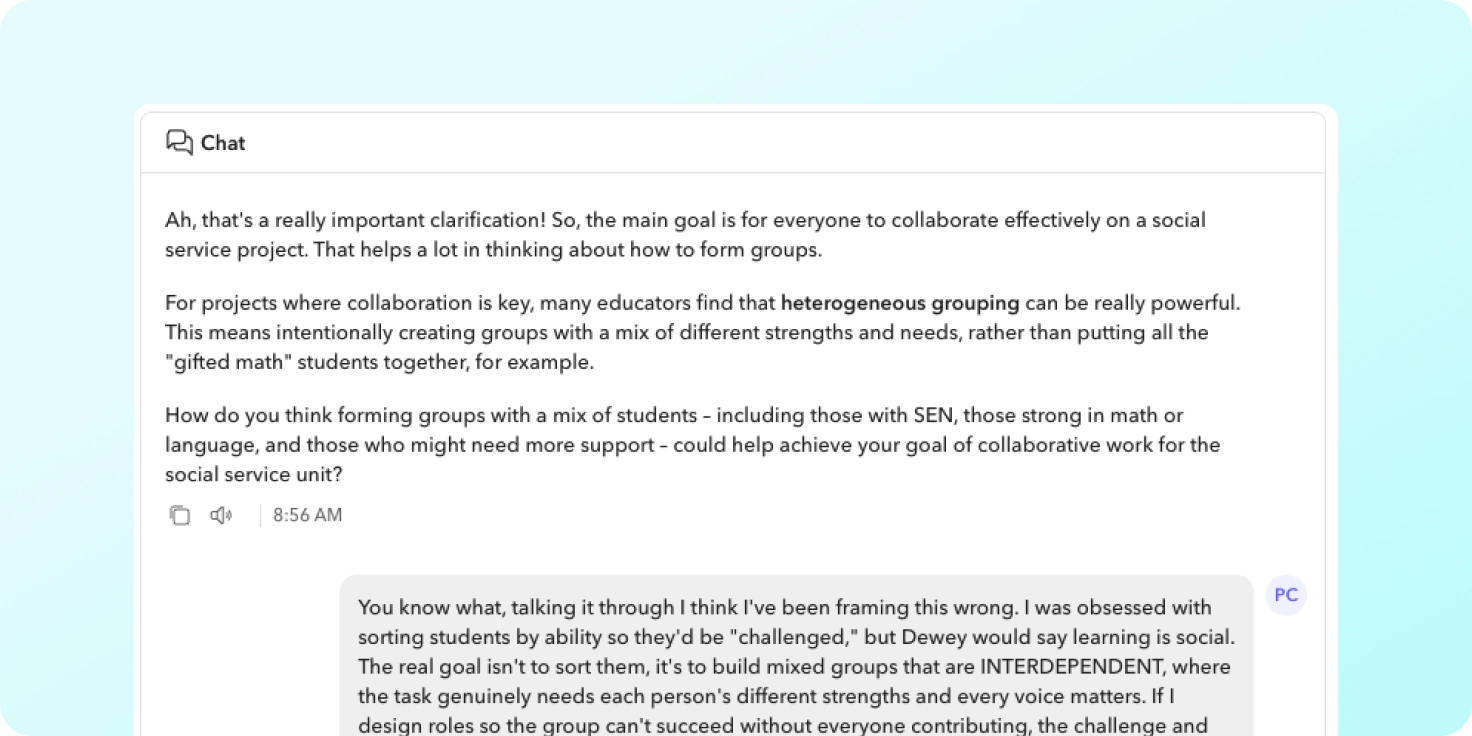
This tutor is built for teachers, not students. The educator brings a real challenge they faced forming student groups for a collaborative project; Dewey responds with questions, scenarios, and references to his own work. Teachers leave able to connect democratic and experiential learning principles to the specific way they group students, and with concrete ideas for making group work more collaborative.
The conversation covers group formation strategies in the IB MYP classroom, the ideas in Democracy and Education and Experience and Education, the link between group dynamics and inquiry-based learning, the development of IB learner profile attributes, and how grouping in the MYP prepares students for collaborative work in the Diploma Programme.
What are different ways you can use this idea
You could build a mentor tutor where teachers consult:
- Education theorists on a specific practice: Paulo Freire on student voice and problem-posing instruction, Emily Style on curriculum as window and mirror, Lev Vygotsky on the zone of proximal development, or Carol Dweck on framing feedback.
- Assessment and curriculum thinkers: Grant Wiggins on backward design, Dylan Wiliam on formative assessment, or Benjamin Bloom on questioning that moves beyond recall.
- Thinkers who pressure-test a teacher’s plan: a critic of group work who argues for individual accountability, or a behaviourist who challenges an inquiry-led unit, so teachers have to defend their choices.
Tutor instructions
- Open by asking the teacher to share a recent, real challenge they faced forming groups, then build the conversation from that specific case.
- Reference and explain key concepts from Democracy and Education and Experience and Education as group formation strategies come up.
- Use Socratic questioning to draw out the link between group dynamics and inquiry-based learning in the MYP.
- Guide teachers to connect their grouping decisions to specific IB learner profile attributes.
- Prompt teachers to consider how group formation in the MYP prepares students for collaborative work in the Diploma Programme and beyond.
What this tutor evaluates
It pays attention to how well the student educator skilfully applies Dewey’s principles to design and implement effective group formation strategies, critically analyses their impact on student engagement and IB learner profile attributes, and proposes innovative improvements.
From the educator
Teacher Training: Dewey’s Group Dynamics Lab I used this tutor in a PD session I led for middle and high school teachers on using Toddle AI Tutors with students. Rather than describing the tool in the abstract, I wanted teachers to experience the same kind of guided AI interaction their students would encounter. Built around John Dewey’s ideas about learning through experience, collaboration, and reflection, the tutor helped teachers think through how student groups function and how inquiry can be structured more deliberately.