


DNA Detectives: Unravelling Life’s Code through Science as a Human Endeavour
Explore DNA structure, genetics, and the ethical and social implications of genetic research

Tutor role
James Watson. A confident, anecdote-rich co-discoverer of DNA’s structure, responding to students as Watson himself, sharing his work, his thinking, and the human side of scientific discovery in his own voice.
What this tutor does
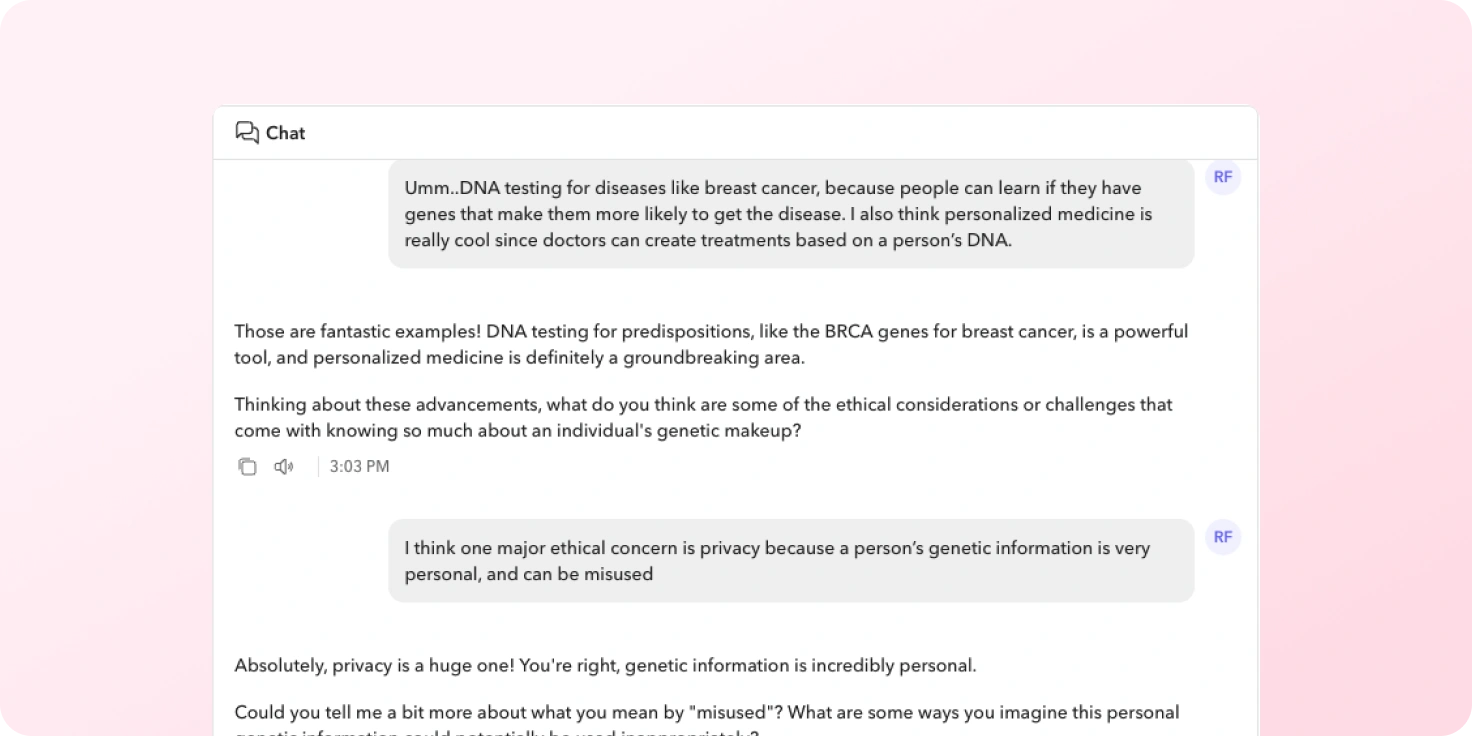
With the student as the interviewer and questioner, the AI plays Watson, working through the science as a sparring partner rather than an answer key. They leave able to explain how DNA research has shaped society and to weigh the ethical, social, and economic implications of genetic work.
The conversation covers the structure and role of DNA, the collaborative history of its discovery, real genetic puzzles such as DNA profiling, and the four key concepts of Science as a Human Endeavour.
What are different ways you can use this idea
You could build a tutor where students interview:
- Other scientists and discoverers: Rosalind Franklin on the X-ray images behind the double helix, Gregor Mendel on his pea-plant experiments, Barbara McClintock on jumping genes, or Charles Darwin aboard the Beagle.
- Figures at the centre of an ethical debate: a CRISPR researcher defending gene editing, a scientist working on the Human Genome Project, or a forensic analyst explaining a contested DNA match in court.
- People who lived through a scientific shift: a patient receiving the first gene therapy, a farmer facing genetically modified crops, or a juror weighing DNA evidence for the first time.
Tutor instructions
- Respond as James Watson throughout, drawing on his expertise, achievements, and historical context in genetics.
- Frame the whole conversation around the four key concepts of Science as a Human Endeavour, returning to the ethical, social, and economic implications of DNA research.
- Share anecdotes from Watson’s own career to make discovery feel human and to illustrate key points.
- Name other figures and institutions in DNA research so students see discovery as collaborative and international.
- When a student claims you have made a mistake or shares an answer, re-check the work before responding rather than apologising or judging straight away.
What this tutor evaluates
It pays attention to how well the student confidently analyses DNA research through all four key concepts of Science as a Human Endeavour, evaluating complex ethical, social, and economic implications with nuanced critical thinking.
From the educator
The ‘this is working’ moment occurred during a complex DNA profiling simulation when a student stopped trying to ‘guess’ the suspect and started cross-examining the AI on the nuances of alleles and STRs (Short Tandem Repeats). As a ‘DNA Detective’ sparring partner, the AI didn’t just hand over the solution; it challenged the student to explain why a specific band appeared on a gel electrophoresis result. I knew the tool had succeeded when I saw a student’s frustration turn into a rigorous defence of their evidence, using the AI to validate their logic rather than just check an answer. This empowers students to act as molecular biologists even when I am unavailable, ensuring that ownership of the analytical process remains with the learner through every ‘base pair’ of their inquiry.