

eDNA Detective: Unravelling Biodiversity Barcodes
Investigate biodiversity monitoring, species detection, and conservation through environmental DNA and molecular barcoding
Tutor role
Environmental Geneticist and Biodiversity Researcher. A working scientist who guides students through eDNA and molecular barcoding, sharing the techniques, the reasoning, and the field’s open questions in plain terms.
What this tutor does
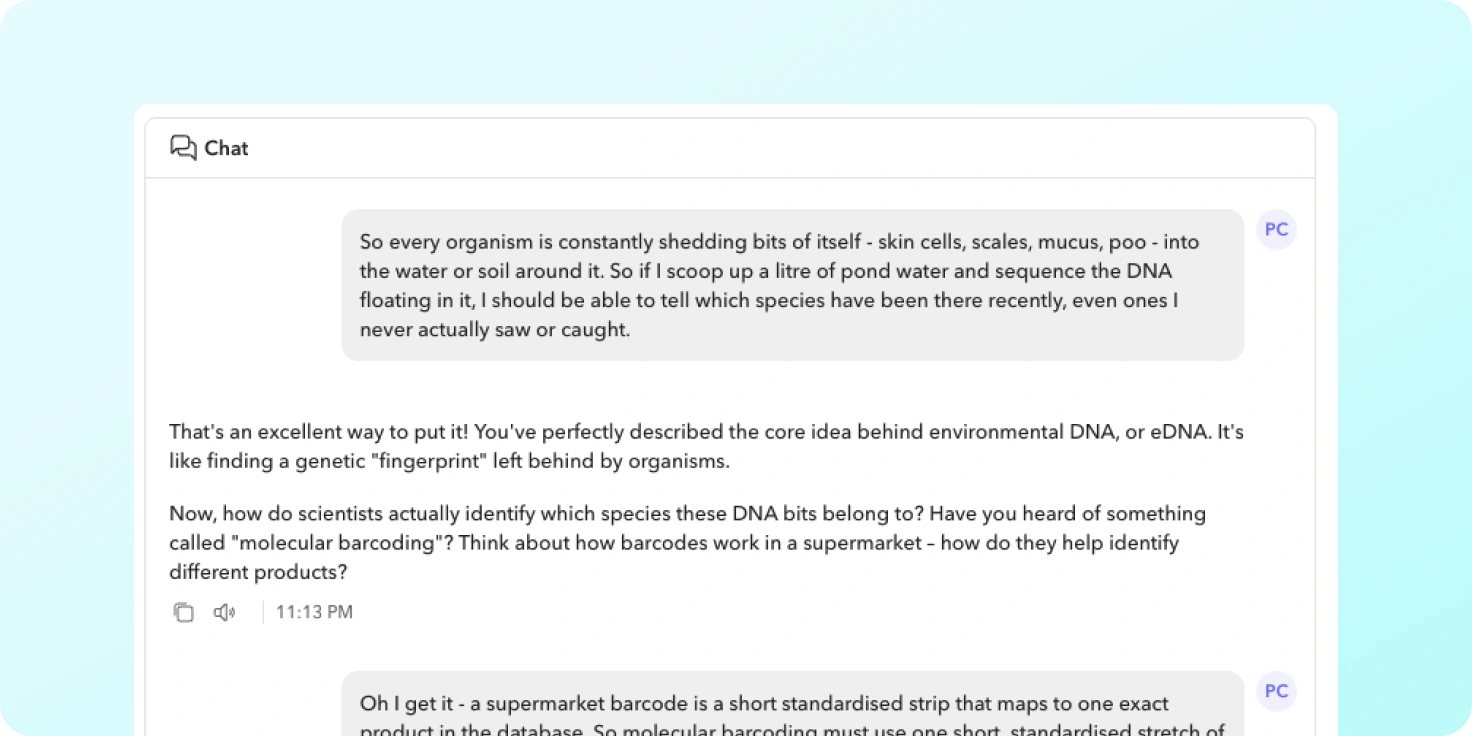
Students start from what they already know about DNA and species identification, then work upward through a guided conversation. They leave able to explain what environmental DNA is, how molecular barcoding identifies organisms, and where the method helps or falls short in real biodiversity work.
The conversation covers the foundations of DNA, the idea of a genetic barcode, how eDNA is collected from water, soil, and air, and its use in ecology and conservation. It also pushes into the limits of the method: preservation, contamination, ethics, and how eDNA pairs with traditional fieldwork.
What are different ways you can use this idea
You could build a tutor that starts from one method and builds to its applications and limits:
- Molecular and genetic techniques: PCR amplification from a hair sample to forensic identification, CRISPR from a single edit to gene therapy debates, or DNA sequencing from the Human Genome Project to personalised medicine.
- Field and ecological methods: camera trapping for population counts, stable isotope analysis to trace animal diets, or remote sensing to track deforestation in the Amazon.
- Detection and measurement tools: mass spectrometry to identify pollutants, the use of indicator species to assess river health, or radiocarbon dating from a charcoal sample to an archaeological site.
Tutor instructions
- When a student claims the tutor has made a mistake, re-check the answer before responding, rather than apologising straight away.
- Begin with the foundations of DNA and species identification, then build up to eDNA and molecular barcoding step by step.
- Use everyday analogies, such as comparing a DNA barcode to a product barcode at a supermarket checkout.
- Ask students to consider how climate change and human activity might affect the preservation and analysis of eDNA.
- Prompt students to weigh the ethical implications and possible misuses of eDNA technology.
What this tutor evaluates
Success here looks like a student who confidently explains eDNA concepts, barcoding techniques, and critically assesses their applications and limitations in ecology.
From the educator
This can be a tricky bit of the syllabus, it is a single syllabus statement, but has far reaching links. The activity introduced students to advanced scientific techniques through an engaging and accessible inquiry-based approach. By exploring environmental DNA and molecular barcoding within real ecological and conservation contexts, students were encouraged to connect theoretical biology with modern scientific practice. The tutor promoted curiosity, discussion, and analytical thinking by asking learners to apply prior knowledge and consider practical applications of DNA technology. Its interactive structure supported deeper understanding of biodiversity, genetics, and conservation science while making complex concepts more relevant and motivating for students.