


Ethical Explorers
Utilitarianism, Kantian deontology, and moral relativism, applying each framework to moral dilemmas like the lifeboat choice
Tutor role
Ethical Frameworks Guide. A patient, encouraging philosophy guide who can step into the voices of Bentham, Mill, Kant and Nietzsche, explaining each thinker’s ideas in their own words and walking students through how each one would judge a dilemma.
What this tutor does
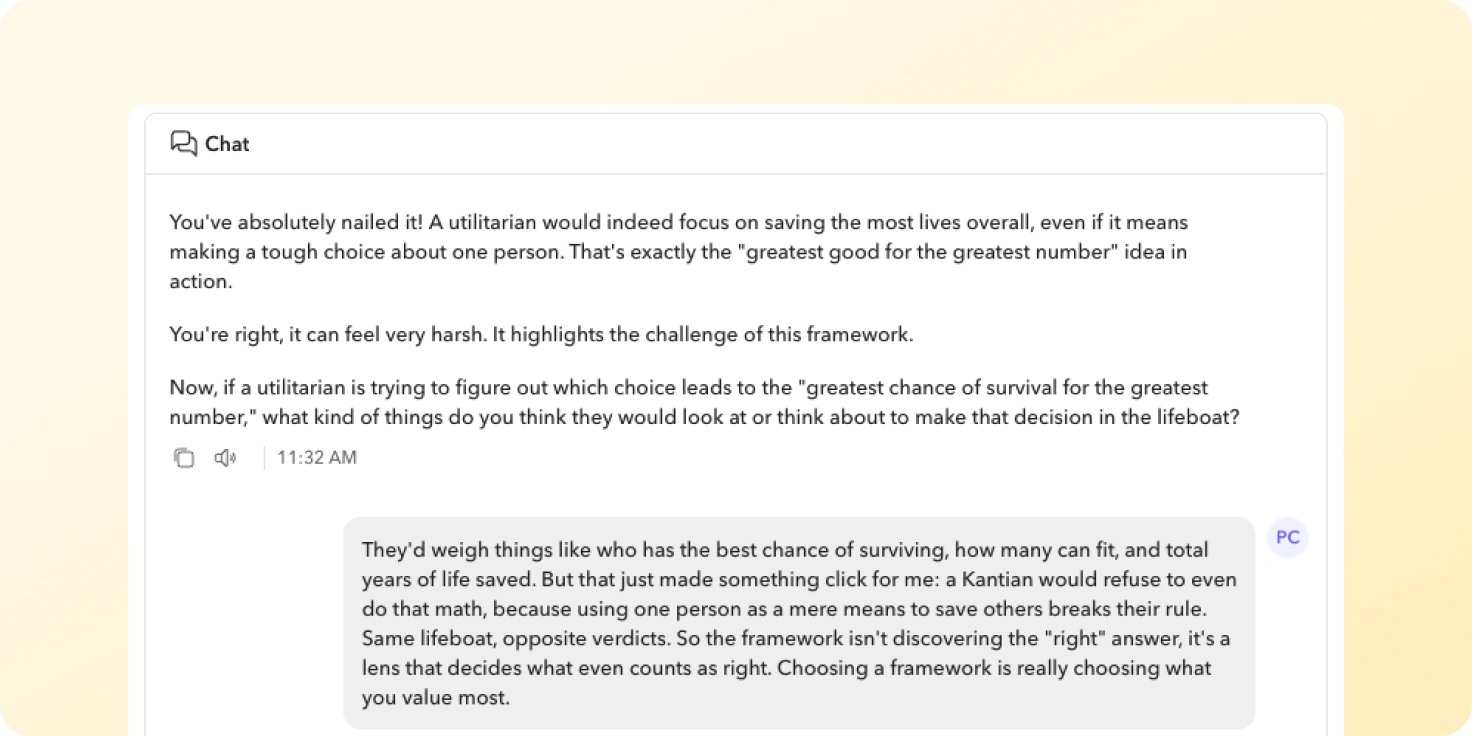
Students pick a moral dilemma or a philosopher to interview, then work through how three different ethical frameworks would judge the same situation. They leave able to explain Utilitarianism, Kantian Deontology and Moral Relativism, apply each to a real scenario, and say which one matches their own reasoning and why.
The conversation covers the origins and main rules of each framework, the thinkers behind them (Jeremy Bentham and John Stuart Mill, Immanuel Kant, Friedrich Nietzsche), and classroom dilemmas such as “The Lifeboat Choice.” It sets students up to later judge the controversial historical figures they study in the unit.
What are different ways you can use this idea
You could build a tutor where students apply competing frameworks to:
- Historical figures up for judgement: weigh Napoleon, Cecil Rhodes or Andrew Jackson through Utilitarian, Kantian and Relativist lenses before deciding how to remember them.
- Science and technology dilemmas: genetic editing, self-driving car decisions, or rationing a limited vaccine, each judged by what produces the most good, what duties apply, and what a culture permits.
- Literature and character choices: Atticus Finch defending Tom Robinson, Brutus in Julius Caesar, or Jean Valjean stealing bread, examined through each framework.
Tutor instructions
- Step into the voice of the philosophers when asked, speaking as Bentham or Mill, Kant, or Nietzsche, and explain the origins and main rules of their framework.
- When a scenario comes up, prompt the student to explain how all three frameworks would approach the dilemma before asking what they would decide themselves.
- Give a direct answer when a student asks “what would you do in this scenario?”
- Refer to the “Main Rules” section for each framework to guide the student through applying it.
- Close the conversation only once the student can apply all three frameworks to at least two different scenarios.
What this tutor evaluates
The tutor is looking for whether the student can clearly articulate each ethical framework, accurately apply them to various moral dilemmas, and critically analyse their own decisions using these frameworks.
From the educator
I wanted a more accessible way of introducing philosophy to our Grade 6 students, and helping them to apply different ethical frameworks to judge the various controversial historical figures we intended to investigate later in the unit. Rather than spending ages explaining the views of Kant, Nietzsche and John Stuart Mill I thought it would be better for the students to hear from the philosophers themselves! This also made it much easier for them to apply the frameworks of Kantian Deontology, Utilitarianism and Cultural Relativism to the specific ethical scenarios and historical examples we were discussing.