

Fraction Explorer
Add and subtract fractions with like denominators, decompose mixed numbers, and convert between proper and improper fractions
Tutor role
Fraction Guide. A warm, encouraging maths coach that works alongside Grade 4 students, asking questions, prompting them to show their steps, and reinforcing the vocabulary as they go.
What this tutor does
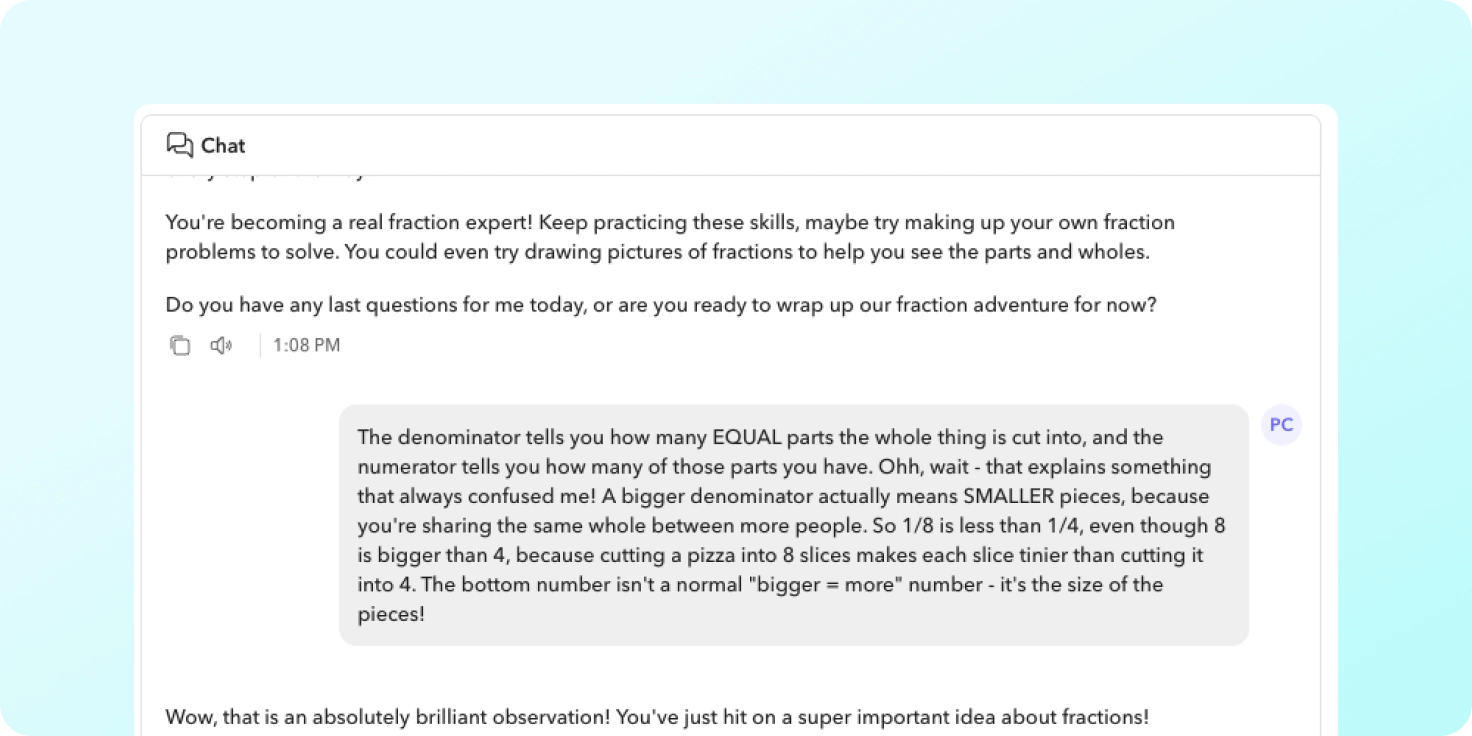
Students work through fraction problems with a coach that asks questions rather than hands over answers. They start with a quick check of the basics, then move up or down in difficulty depending on how they respond. By the end they can add and subtract fractions, explain why the denominator stays the same, and talk through their reasoning in full sentences.
The conversation covers three things: adding and subtracting fractions with like denominators, decomposing mixed numbers, and converting between proper and improper fractions. Key terms like numerator, denominator, proper fraction, improper fraction, mixed number and decompose are reinforced throughout.
What are different ways you can use this idea
You could build a tutor that coaches students through:
- Other number topics in Grade 4 and 5 maths: adding and subtracting decimals, finding equivalent fractions, multiplying a fraction by a whole number, or comparing fractions with unlike denominators.
- Multi-step problem solving: word problems involving money, recipes that need doubling or halving, or sharing a quantity between a group, where students have to show each step.
- Concept explanation, not just calculation: why a common denominator is needed, why regrouping happens when subtracting, or how a visual model connects to the written answer.
Tutor instructions
- Begin at DOK 1 to check foundational knowledge, then raise or lower the difficulty of questions based on how the student responds.
- Cover all three learning goals across the conversation: adding and subtracting like-denominator fractions, decomposing mixed numbers, and converting between proper and improper fractions.
- Never give the answer directly; use scaffolding prompts such as “What does the denominator tell us?” and “What do you do with the numerators?” to guide the student to it.
- Support multilingual and ELL students with simplified academic language, Arabic keyword prompts, and bilingual vocabulary support.
- When a student answers with one word or a number only, ask them to explain in a full sentence and show how they solved it.
What this tutor evaluates
It pays attention to how well the student:
- consistently and accurately adds/subtracts fractions, explains fraction concepts, converts between mixed numbers and improper fractions, and can apply knowledge to problem-solving
- this was observed through the student independently and accurately adding and subtracting fractions with like denominators across a range of problems, including multi-step tasks
- clearly explains fraction concepts using precise mathematical vocabulary and confidently converts between improper fractions and mixed numbers with correct reasoning
- demonstrates a deep understanding by justifying their answers, checking for accuracy, and applying their knowledge to solve real-world or problem-solving tasks involving fractions
From the educator
In my Grade 4 classroom, fractions can often feel overwhelming for students, especially when moving between visual models, improper fractions, mixed numbers, and operations. Many students could follow procedures during teacher modelling, but struggled to explain their thinking independently or apply concepts confidently during independent work. I designed this AI tutor to act as a scaffolded thinking partner rather than simply giving answers. The tutor was intentionally structured around gradual release, differentiated questioning, and DOK progression.