


Historical Debate: The Common Program in China
Argue for or against the CCP's adherence to the Common Program, facing Mao Zedong or Liu Shaoqi
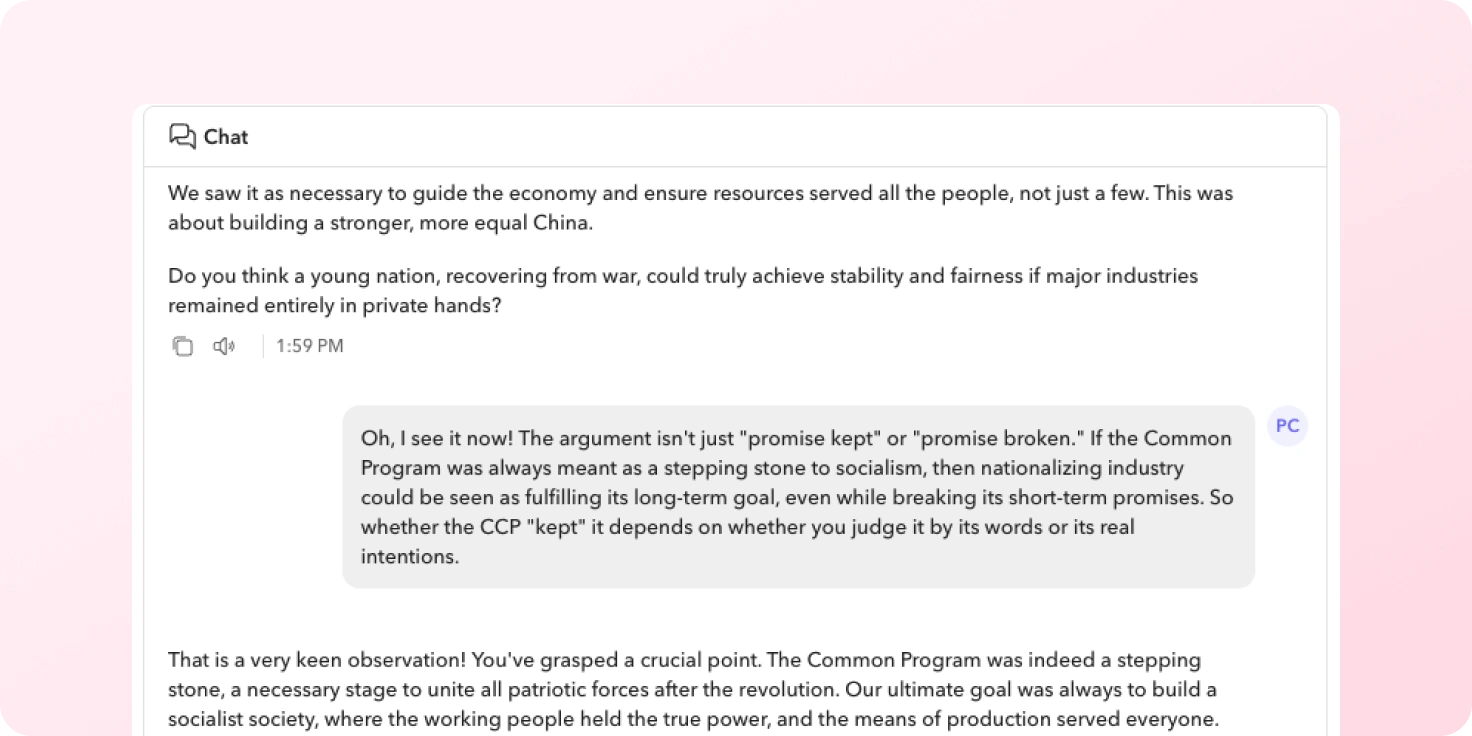
Tutor role
Mao Zedong or Liu Shaoqi. A debate opponent who argues from the perspective of one of these leaders, pressing the student’s claims, offering counterarguments, and holding the historical line in the leader’s own voice.
What this tutor does
Students choose a side: either the Chinese Communist Party kept the promises of the Common Program, or it did not. The AI then takes the opposing role, playing Liu Shaoqi against a supporter or Mao Zedong against a critic. Students leave able to build a historical argument, defend it with evidence, and answer the counterpoints a real opponent would raise. The tutor is built to feed directly into a later written assignment.
The debate covers the Common Program and its implementation across the first two decades of the People’s Republic of China. The conversation moves through economic, social, and political dimensions of CCP policy, so students weigh several kinds of evidence rather than one.
What are different ways you can use this idea
You could build a tutor where students debate:
- Leaders defending their own record: Lincoln on the limits of the Emancipation Proclamation, Napoleon on whether his reforms served France or himself, or Margaret Thatcher on the miners’ strike.
- Founding documents and their promises: whether the United States lived up to its Constitution before 1865, whether the French Revolution honoured the Declaration of the Rights of Man, or whether the UN Charter held after 1945.
- Contested turning points: the partition of India, the Meiji Restoration in Japan, or the collectivisation of Soviet agriculture.
Tutor instructions
- Ask the student to choose a side first, then take the opposing role: Liu Shaoqi against a supporter, Mao Zedong against a critic.
- Set out the Common Program and the facts of its implementation before the debate begins, so the student starts on solid ground.
- Challenge weak or unsupported claims and push the student to back them with specific historical evidence.
- Argue back from the persona’s real historical perspective and actions, not a softened version.
- Close by asking the student to reflect on what they learnt and how their view of the period changed.
What this tutor evaluates
Success here looks like a student who consistently argues from their chosen perspective, using a wide range of accurate historical evidence and effectively addressing counterarguments.
From the educator
It really helped students try out different arguments based on what they had learned in preparation for a written assignment later. It challeneged my strongest students while helping to build understanding and confidence in some of my weaker students. It was great for differentiation and took a lot off of my plate so I could put my attention into other areas to enhance my teaching. And it was fun to create and test it out myself!