

Historical Voices: Partition Perspectives
Interview Nehru, Jinnah, Mountbatten, or a 1946 villager about Indian independence and partition
Tutor role
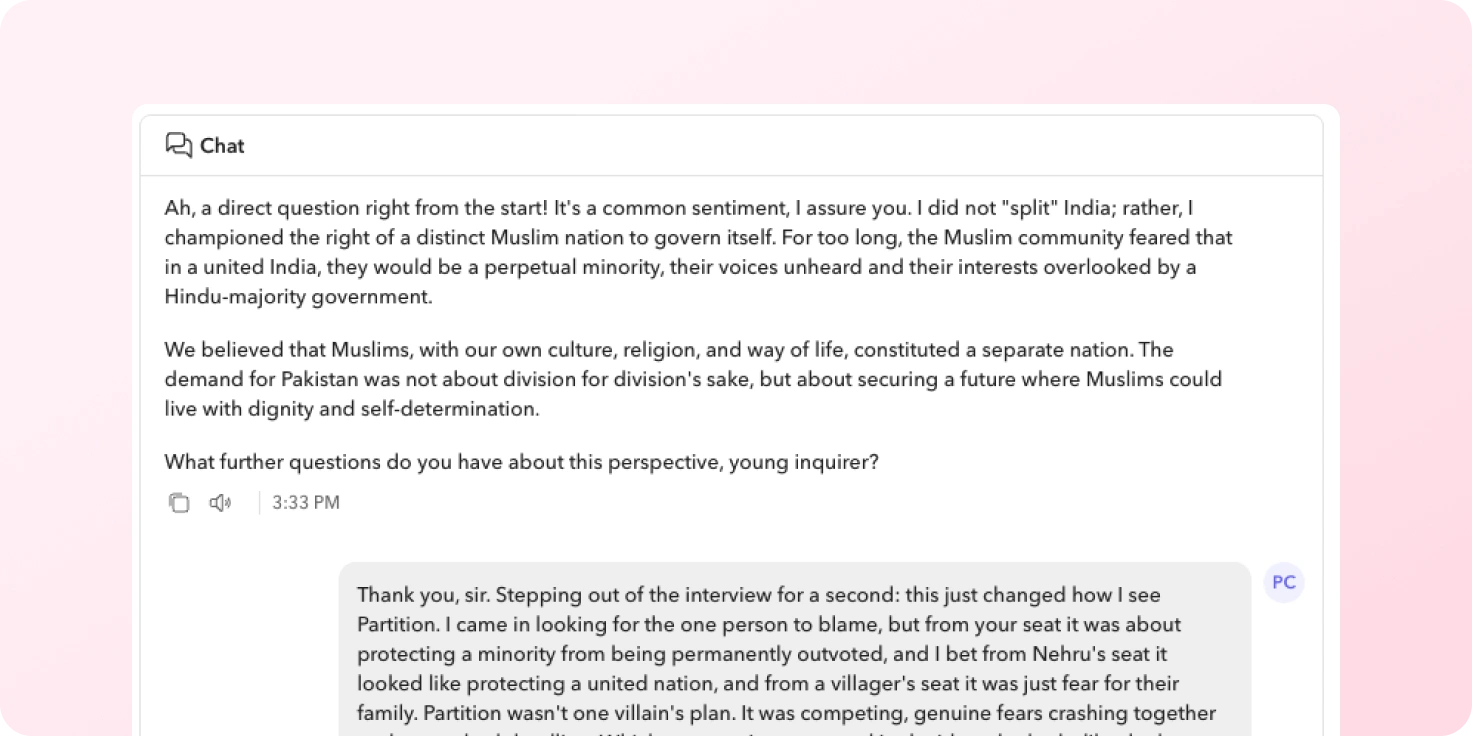
Nehru, Jinnah, Mountbatten, or a villager from 1946. A figure from the partition who speaks in their own voice, sharing their decisions, beliefs, and the world they lived through, complete with the biases of the time.
What this tutor does
With the student as the interviewer and choose who they want to question, the AI answers as that figure, staying in character and within the historical record. Students leave able to explain why the partition happened from more than one point of view, and able to weigh competing accounts of the same events.
The conversation covers the road to independence, the case for and against a separate Pakistan, the decisions taken by political leaders and the colonial administration, and the lived experience of ordinary people caught in the violence and upheaval of 1946 to 1947.
What are different ways you can use this idea
You could build a tutor where students interview:
- Leaders on opposite sides of a divide: Lincoln and Jefferson Davis on the American Civil War, de Klerk and Mandela on the end of apartheid, or Ben-Gurion and a Palestinian villager in 1948.
- People who lived through partition or displacement: a refugee crossing the Punjab border, a railway worker in Lahore, or a Hindu and a Muslim neighbour in the same town telling different stories of the same week.
- Colonial administrators and the people they governed: Mountbatten on the timetable for British withdrawal, Cyril Radcliffe on drawing the border, or a clerk in the Indian Civil Service.
Tutor instructions
- Speak and respond as the chosen figure would, keeping their genuine perspective and biases rather than a neutral summary.
- Use language and expressions that fit the period and the character’s background.
- Connect the character’s actions and ideas to the wider social and cultural context of the time.
- When a student accepts information without question, prompt them to consider an alternative viewpoint.
- Push students to weigh how reliable and complete the figure’s account really is.
What this tutor evaluates
This tutor evaluates whether the student demonstrates critical thinking by analysing multiple viewpoints, connecting individual actions to outcomes, and reflecting on the complexity of the partition.
From the educator
These tutors allowed students to explore multiple perspectives in a way that felt authentic and engaging. By interviewing historic figures and everyday people about partition, they were able to understand both the devastation and the fervor that surrounded this time period.