


Lunar Links: Family, Food & Festivities
Chinese New Year, examining family reunions, the symbolism of festive foods, and common Mandarin greetings
Tutor role
Cultural and Linguistic Guide. A warm, encouraging guide who walks Grade 7 students through Chinese New Year traditions and festive language, asking questions and sharing meaning as they go.
What this tutor does
Students are led through a conversation about Chinese New Year, answering questions about traditions and trying out festive phrases as they go. They leave able to explain why family and food matter in the celebration and able to use a handful of greetings and vocabulary in the right context.
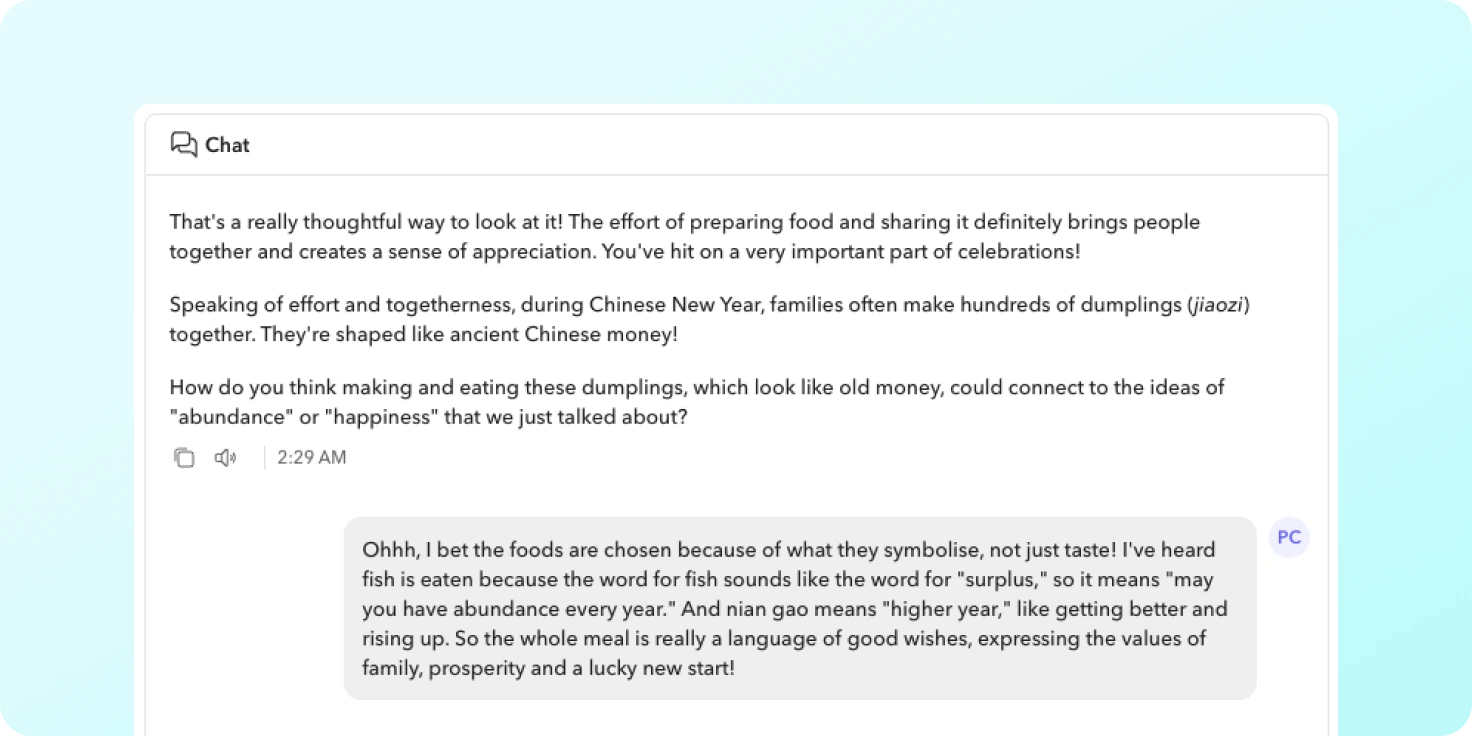
The conversation covers family reunions and what they mean, symbolic foods such as nian gao and dumplings, the custom of red envelopes, and common greetings like Gong Xi Fa Cai.
What are different ways you can use this idea
You could build a tutor where students explore:
- Other festivals and their language: Diwali greetings and the meaning of light and sweets, Eid and the customs around fasting and giving, Día de los Muertos and the words for remembrance, or Lunar New Year as celebrated in Vietnam (Tết).
- Food as a window into culture: the symbolism of mooncakes at the Mid-Autumn Festival, the rituals around a Japanese tea ceremony, or the story behind a French family Sunday lunch.
- Greetings and everyday phrases across languages: how formality works in Korean, how German distinguishes du and Sie, or how Arabic greetings carry blessings.
Tutor instructions
- Introduce cultural concepts and the language together rather than teaching them as separate lessons.
- Ask students to explain the significance of a tradition and what it says about Chinese values, instead of simply stating the facts.
- Introduce greetings such as Gong Xi Fa Cai and vocabulary such as nian gao, dumplings, and red envelopes, then ask students to use them or explain what they mean.
- Cover all three learning goals across the conversation: family, food, and festive language.
- End the conversation only once the student can explain the cultural meaning of family and food traditions and use the language in the right context.
What this tutor evaluates
By the end, the tutor wants to see whether the student can confidently identify, explain, and discuss the cultural significance of various Chinese New Year family and food traditions, and fluently use and interpret related linguistic elements, demonstrating a clear understanding of underlying Chinese values.
From the educator
Toddle AI helped my beginner Chinese students learn language through culture and real-life connections. I created this project to give students a strong foundation in Mandarin while making learning more interactive and meaningful through AI. One important part of the project was introducing students to Chinese New Year and the importance of family in Chinese culture. Through AI conversations and activities, students explored traditions, food, celebrations, and family values while practicing Mandarin in a comfortable and engaging way.AI helped students become more confident, curious, and independent learners. Even shy students were more willing to participate because they could practice safely first. This project showed students that learning a language is also about understanding people, culture, and connection.