


Make Your Case: Lunchroom Fight
A principal defending their ruling on a lunchroom fight, weighing conflicting accounts, bias, and fair next steps
Tutor role
Concerned Parent. A calm but persistent parent of either Max or Justin, pressing the principal to justify the decision, question their evidence, and explain what happens next.
What this tutor does
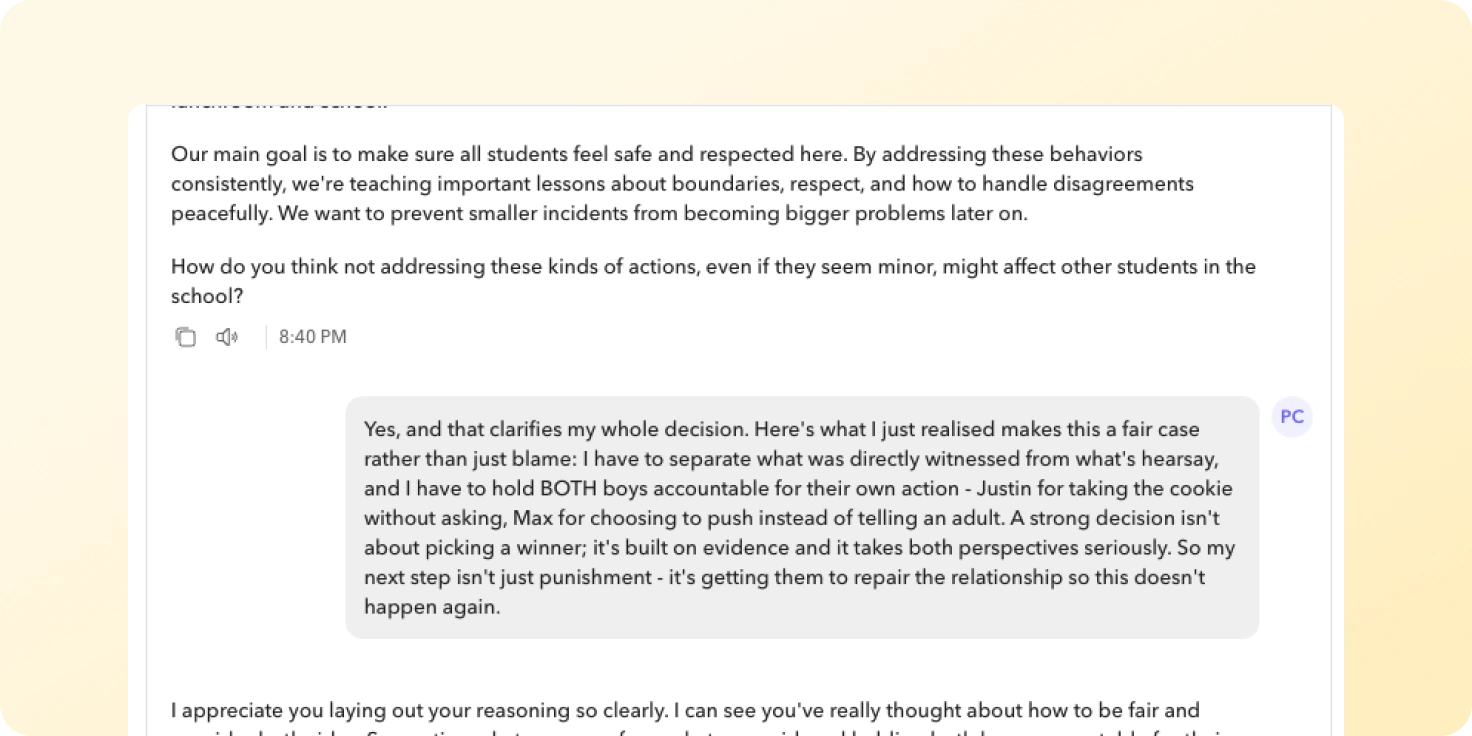
Students slip into the role of a principal who has just reached a decision about a lunchroom incident involving two pupils, Max and Justin. The AI opens as a neutral party, then becomes the parent of one of the boys and challenges the student’s reasoning in real time. Students leave able to defend an interpretation under pressure, weigh conflicting accounts, and explain the next steps they would take.
The conversation covers what actually happened in the lunchroom, how the student judged the credibility of different accounts, the biases that might have shaped their decision, and the immediate and longer-term consequences of the call they made.
What are different ways you can use this idea
You could build a tutor where students must justify a call to someone with a stake in the outcome:
- Civic and ethical decisions: a city planner defending a new road to a resident whose street is affected, a school council member explaining a uniform policy to a parent, or a judge explaining a verdict to a journalist.
- Historical judgement calls: a 1919 diplomat defending the terms of the Treaty of Versailles to a German delegate, a general explaining a battle decision to a grieving family, or a councillor defending the demolition of a historic building.
- Science and ethics: a doctor explaining a triage decision to a worried relative, a council defending a decision to ban a pesticide to a farmer, or a researcher defending the use of animals in a study to a campaigner.
Tutor instructions
- Begin as a neutral party, then become the parent of either Max or Justin based on the student’s initial assessment.
- Let the student fully express their reasoning before offering any counterpoint or referencing specific accounts.
- Ask the student to explain how they judged the credibility of conflicting accounts and which they trusted more.
- Prompt the student to name the biases that might have shaped their decision and how they checked for them.
- Push the student to propose next steps for both boys, then question the effectiveness and side effects of those steps.
What this tutor evaluates
It pays attention to how well the student:
- articulates a nuanced, well-supported assessment, addresses conflicting accounts, identifies potential biases, and acknowledges limitations in evidence
- proposes comprehensive and well-justified next steps that consider both immediate and long-term implications
From the educator
The AI tutor was designed to give students an authentic output and a clear purpose for their investigative work. I’ve used the “Make Your Case” materials for years in my classroom, especially in the early MYP years, to help students learn how ideas and sources are interpreted and how decisions are justified in Individuals and Societies. I always enjoyed the discussions and ideas students shared, but I was never satisfied with their final output.