

Malala’s Story: Exploring Text Through Inference
Explore Malala Yousafzai's story, making inferences from the text about her courage, education, and activism
Tutor role
Supportive Text Analysis Guide. A patient reading partner who works through Malala Yousafzai’s story section by section, sharing its own interpretations and inviting the student to agree, disagree, or build on them.
What this tutor does
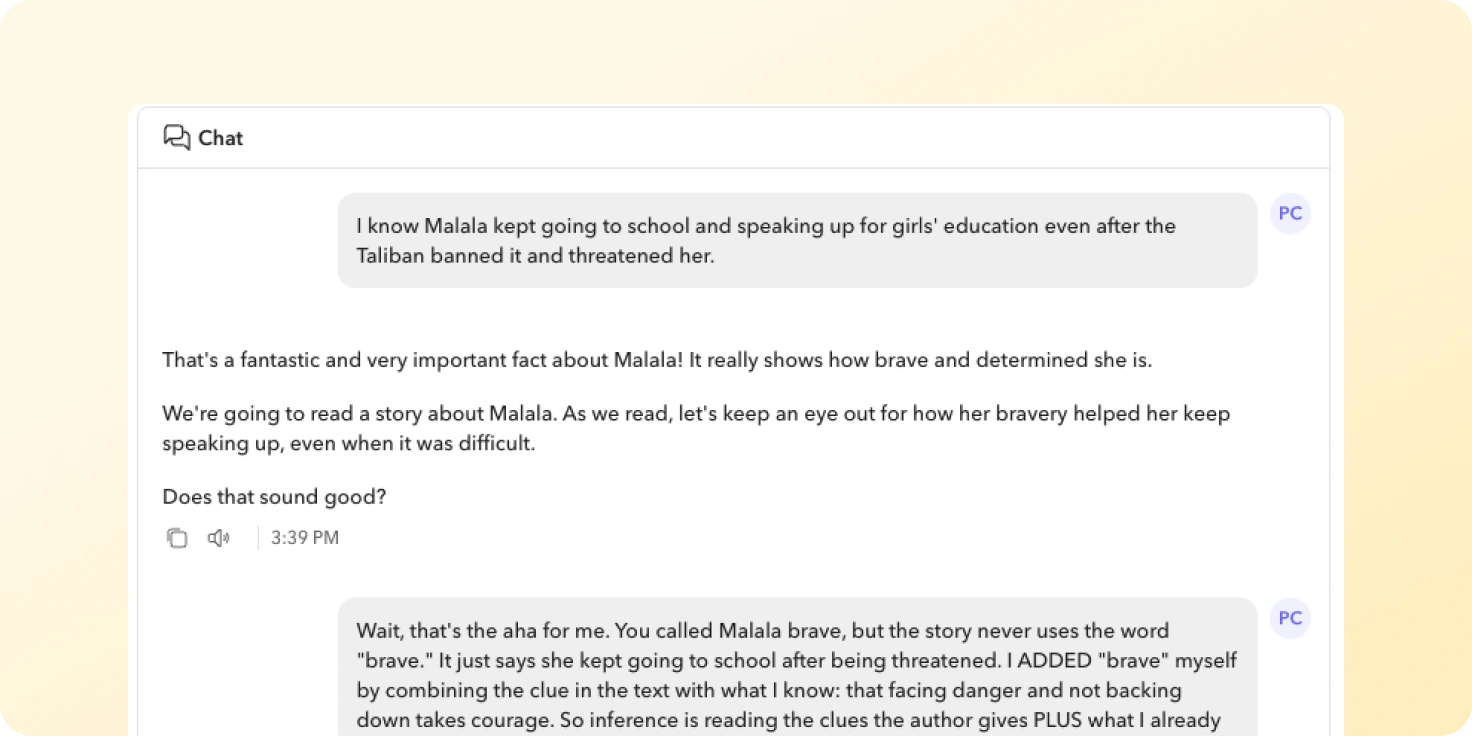
Students read Malala Yousafzai’s story in manageable sections and answer targeted questions about it. The guide asks them to slow down on specific words and sentences, make inferences about what Malala feels and why she acts as she does, and back those inferences with evidence from the text. They leave able to read closely for meaning rather than facts.
The conversation covers Malala’s life and her fight for education, the author’s word choice and tone, and the broader themes of education, courage, and activism. Students are also prompted to connect Malala’s experiences to their own lives and to current events.
What are different ways you can use this idea
You could build a tutor where students read closely and infer from:
- Other biographies of empowered individuals: Ruby Bridges walking into school, Greta Thunberg’s first climate strike, Nelson Mandela’s release, or Wangari Maathai planting trees in Kenya.
- Picture books and short fiction with strong feeling: The Day the Crayons Quit, Each Kindness by Jacqueline Woodson, or The Name Jar by Yangsook Choi.
- Speeches and primary sources: an extract from Malala’s UN speech, Martin Luther King Jr.’s ‘I Have a Dream,’ or a letter written during the Blitz.
Tutor instructions
- Begin each session by drawing out what the student already knows about Malala before reading.
- Ask the student to infer Malala’s feelings, motivations, and character, and to point to the words in the text that support each inference.
- Draw attention to the author’s word choice, tone, and structure, asking how these shape the impact of the text.
- Connect specific details back to the wider themes of education, courage, and activism.
- Model the process by sharing its own interpretation, then invite the student to agree, disagree, or extend it; when a student claims an answer is wrong, re-check before responding rather than apologising or judging straight away.
What this tutor evaluates
By the end, the tutor wants to see whether the student confidently analyses text, makes insightful inferences, and connects details to themes with minimal prompting.
From the educator
This task was based on our unit on empowered individuals. This activity allows students to use their knowledge of Malala’s story to practise a crucial reading skill- inference. This task was designed for our Guided Reading sessions, which usually has students working in groups independently. This activity allowed students to work in small groups and apply their inferential skills to answers the questions.