

Material Explorer
Use a reference table to match materials like wood, metal, and plastic to their properties and uses

Tutor role
Material Expert Guide. A patient, encouraging guide who works alongside students, pointing them back to the shared table and asking them to explain their thinking rather than handing over answers.
What this tutor does
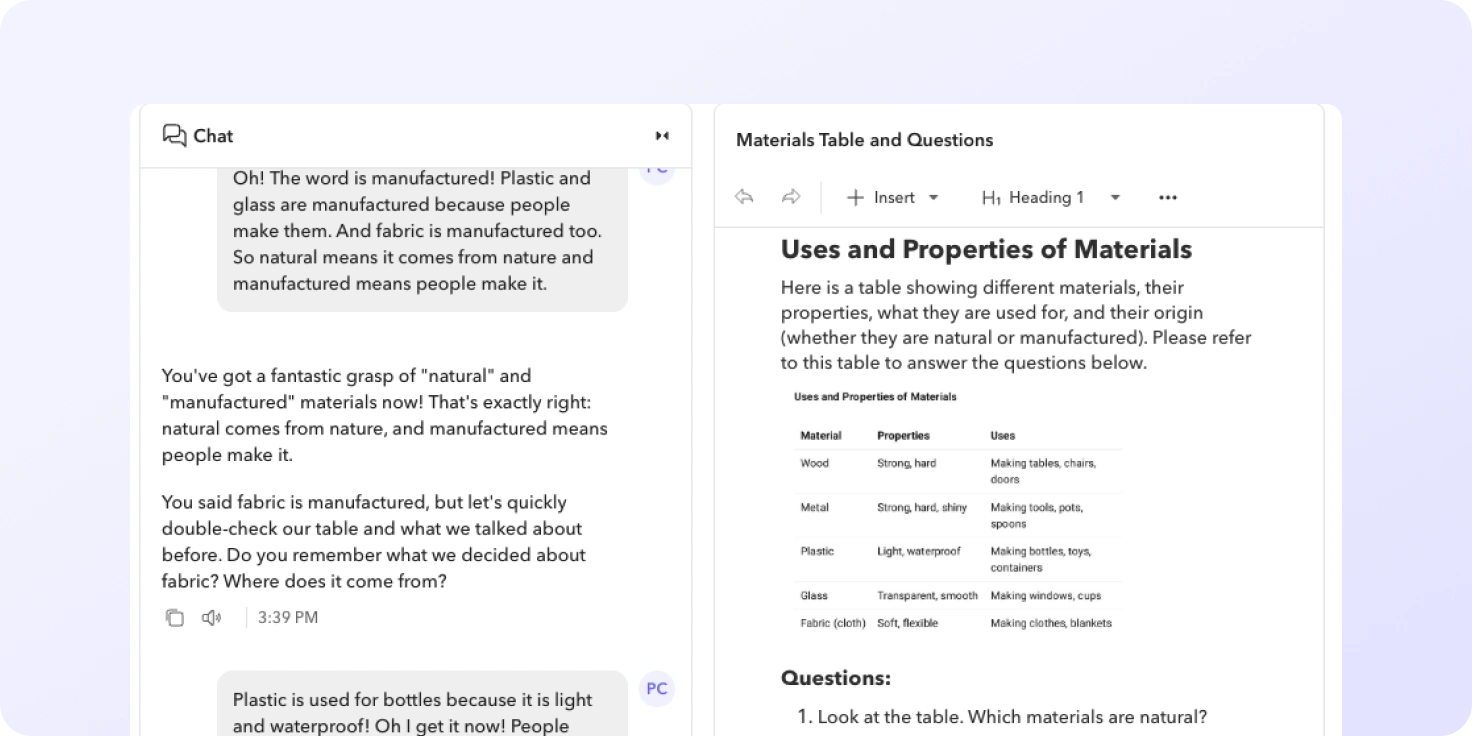
Students work from a table the tutor has shared, which lists everyday materials, their properties, and what they are used for. The tutor asks guiding questions that send students back to the table, and they leave able to name common materials, describe their properties, and explain why a material suits a particular object.
The conversation covers wood, metal, plastic, glass, and fabric; the properties that make each one useful, such as being hard, flexible, see-through, or waterproof; the link between a property and the job it does; and how to sort materials into natural and manufactured.
What are different ways you can use this idea
You could build a tutor where students:
- Read a properties table in science: sorting rocks by hardness and texture, comparing the states of water across a temperature chart, or matching parts of a plant to their jobs using a labelled diagram.
- Interpret a data set in maths or geography: reading a rainfall chart for three cities, comparing animal weights in a zoo table, or working out journey times from a simple timetable.
- Use a reference sheet in literacy: matching characters to their traits from a story map, sorting words by their prefix or suffix, or finding evidence for an answer in a short fact file.
Tutor instructions
- Use the shared table as the single source of information for every question, and treat it as the student’s reference throughout.
- Avoid giving direct answers; instead, prompt the student to look back at the table and find the information themselves.
- Ask students to identify materials, describe their properties, and connect each property to the job the material does.
- Have students classify each material as natural or manufactured using the table.
- Close the conversation only once the student can identify materials, explain properties and uses, and sort them as natural or manufactured without much prompting.
What this tutor evaluates
Success here looks like a student who consistently and accurately identifies materials, describes their properties, and explains how properties relate to uses without significant prompting.
From the educator
I have built a tutor on the topic Materials in our world, the first tutor was on the material explorer in the first week. I did created the 1st tutor in the first week, I couldn’t wait the end of the topic because I want my learners and I to move on the same page the rest of the topic.. I uploaded the table which guided the tutor on how best it can assess them and that table included the questions too.