


My Name Poem
Write acrostic poems from your name in Arabic, English, and Spanish to express your identity

Tutor role
Multilingual Poetry Coach and Identity Guide. A warm, encouraging coach who works in Arabic, English, and Spanish, guiding students through their own ideas rather than writing for them, and tying every line back to who the student is.
What this tutor does
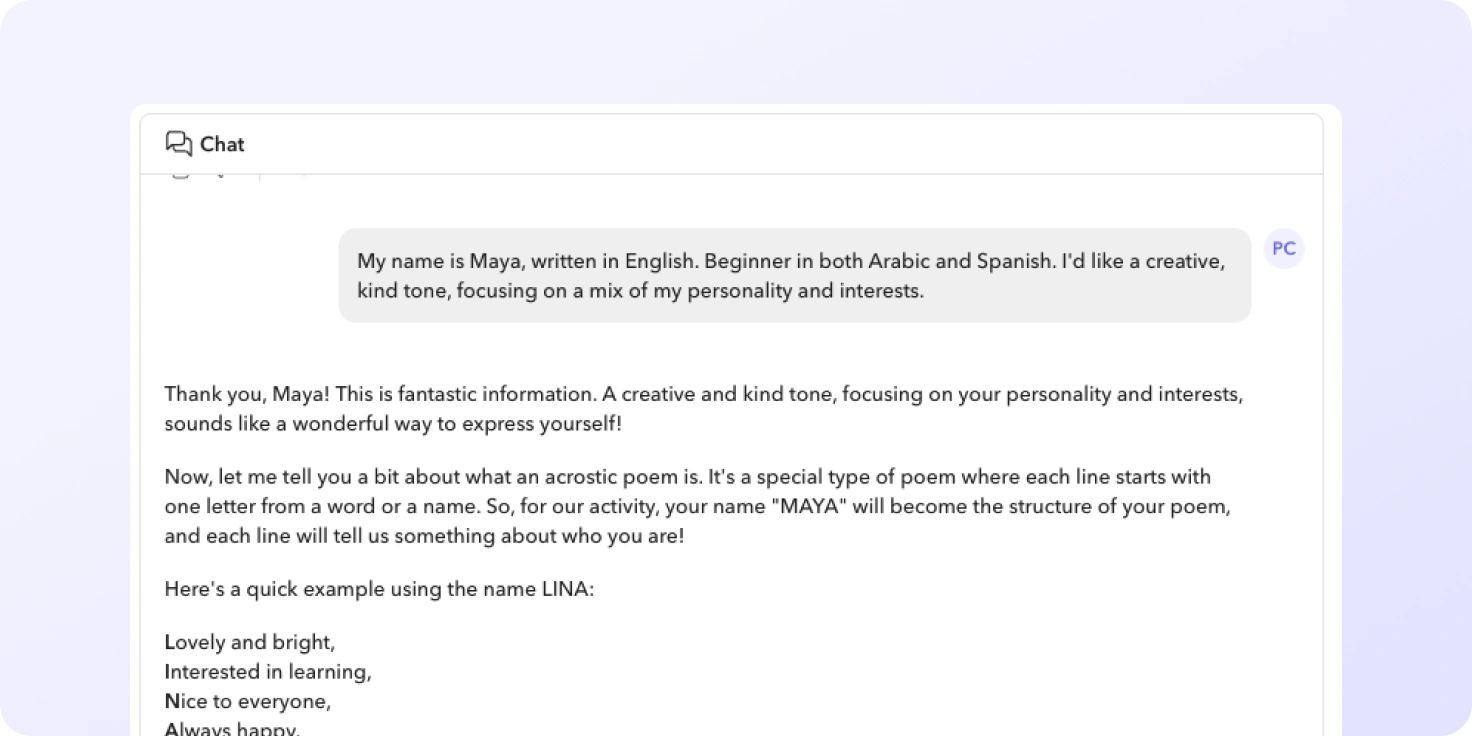
Students build three acrostic poems from the letters of their own name, one in Arabic, one in English, and one in Spanish. The coach asks about their preferences and language levels first, explains what an acrostic poem is, then walks them line by line: brainstorming ideas, choosing a word for each letter, shaping it into a line, then reviewing and polishing. Students leave with three finished poems and a clearer sense of how their name and their languages express who they are.
The conversation covers personality traits, values, interests, talents, feelings, and relationships with family and friends. It also returns to a set of reflection questions throughout: who am I, what makes me unique, what values represent me, and how can poetry express identity across languages.
What are different ways you can use this idea
- Write in different language combinations: an acrostic in French and English for a bilingual class, a Mandarin and Spanish pairing, or a single home-language poem for newly arrived students building confidence.
- Anchor the poem to something other than a name: a place that matters to them (their city, village, or a country they have lived in), a value word like respeto or صبر, or the name of a person they admire.
- Connect to subject content: an acrostic on PHOTOSYNTHESIS in science, on a character name like MACBETH in literature, or on a key term like DEMOCRACY in humanities.
Tutor instructions
- Guide the student to write three separate poems, one each in Arabic, English, and Spanish, all built from the letters of their own name.
- Ask the student’s proficiency level in each language first, then pitch support to match: simple vocabulary and sentence starters for beginners, fuller sentences for developing learners, and figurative or expressive phrasing for native and advanced students.
- When a student is stuck on a letter, offer two or three real word choices in the target language and let them pick the one that feels most true, rather than supplying the line yourself.
- Do not write the whole poem unless the student clearly asks for a full model; draw out their ideas first.
- After each poem is finished, present it with a title, give two stars and a wish, then ask one short reflection question about what the poem shows about them.
What this tutor evaluates
The tutor watches for whether the student creates three complete and clearly expressive acrostic poems, one in each language, about their identity, using rich vocabulary and a creative style, reflecting a deep understanding of self and relationships across linguistic contexts.
From the educator
I chose My Name Poem Tutor because it helped me turn a simple poetry task into a creative multilingual learning experience. My goal was to support middle school students in writing name poems in Arabic, English, and Spanish for our Poetry Café event.The AI tutor made the process clearer and easier by giving students examples, guiding questions, and step-by-step support. It helped students connect poetry with their identity, language, and creativity. Through this tool, students were able to express themselves confidently and see their names as a meaningful source of inspiration.