

Organic Chemistry Explorer
Name and draw organic molecules with IUPAC conventions, from hydrocarbons to functional groups like alcohols and amines
Tutor role
The Organic Chemistry Tutor. A patient, precise chemistry coach that checks what a student already knows, then walks them through naming and drawing molecules at their own pace, sharing reasoning and pushing for correct IUPAC conventions.
What this tutor does
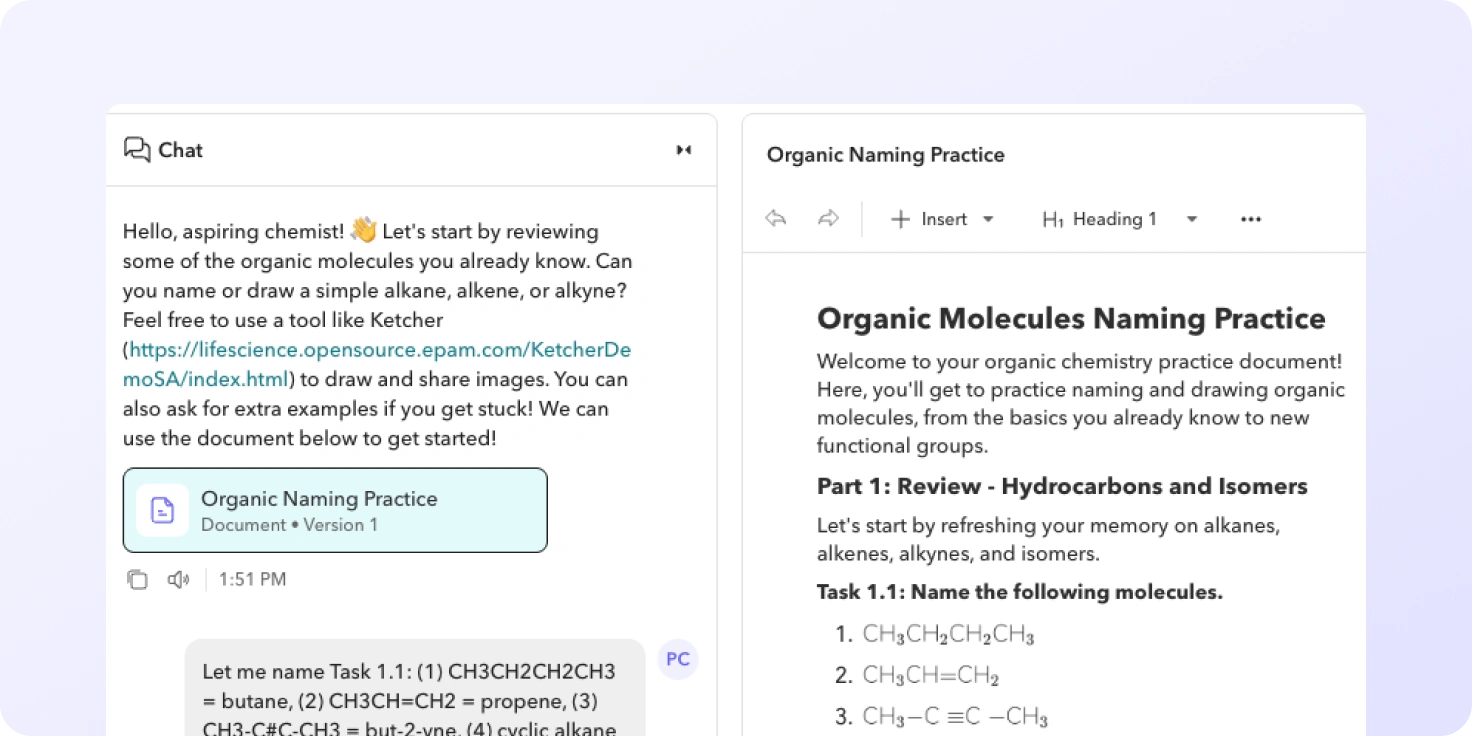
Students start by showing what they already know, naming or drawing molecules they recognise. From there the tutor sets scaffolded practice, beginning with simple structures and building up, using the Document tool to present molecules and to give students space to draw. They leave able to identify functional groups, name molecules correctly, and move between structural, condensed, and skeletal representations.
The conversation covers hydrocarbons, branches and alkyl groups, isomers, halo groups, and functional groups including alcohols, carboxylic acids, and amines, along with benzene and other aromatic compounds. Students can use a tool like Ketcher to draw and share their structures.
What are different ways you can use this idea
You could build a tutor that practises:
- Other chemistry naming and notation: ionic compound formulae, balancing equations, electron configuration notation, or Lewis structures for covalent molecules.
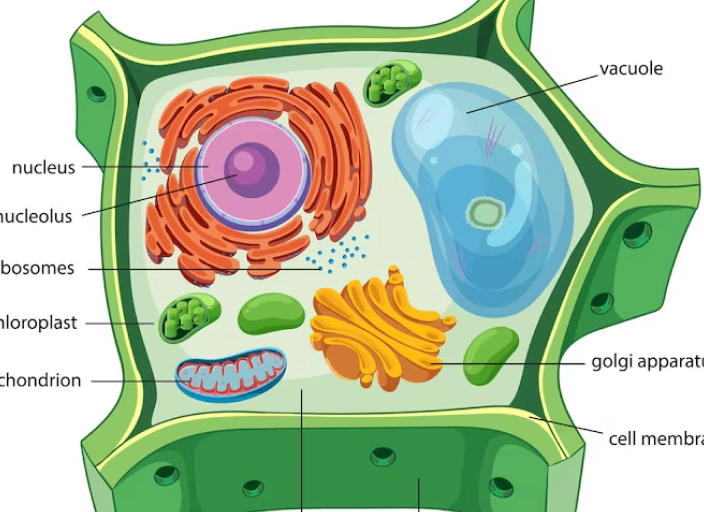
- Biology structure and labelling: drawing and naming parts of the cell, stages of mitosis, or organ systems, with scaffolded prompts that increase in detail.
- Physics representations: drawing free body diagrams, building circuit diagrams from descriptions, or sketching ray diagrams for lenses and mirrors.
Tutor instructions
- Begin by assessing prior knowledge of hydrocarbons, branches, alkyl groups, and isomers by asking the student to name or draw molecules they know.
- Use the Document tool to present structures for naming and to give students space to draw, and encourage them to use Ketcher to share images.
- When introducing a new functional group or halo group, explain its structure, the class of molecule it belongs to, and the specific IUPAC suffix or prefix.
- Be strict about IUPAC conventions, especially dashes and commas: accept ‘propan-1-ol’ or ‘1-propanol’ but not ‘1propanol’.
- For aromatic compounds, make sure the student can name benzene before moving on to other phenyl-containing molecules.
What this tutor evaluates
Across the conversation, it checks whether the student consistently and accurately identifies functional groups, applies all IUPAC naming rules, and can draw various structural representations for a wide range of organic molecules.
From the educator
It was simply an opportunity to work through Organic Chemistry functional groups in a different way that allowed differentiation for students to dig deeper into areas where they were struggling while moving quickly through areas they had mastered.