


Persuasive Review Pro
Write persuasive reviews, building a clear opinion with reasons, evidence, and persuasive techniques
Tutor role
The Review Writing Coach. An encouraging writing mentor who walks Grade 11 students through building one review at a time, asking questions rather than handing over answers, and sharing the craft of persuasion as the draft takes shape.
What this tutor does
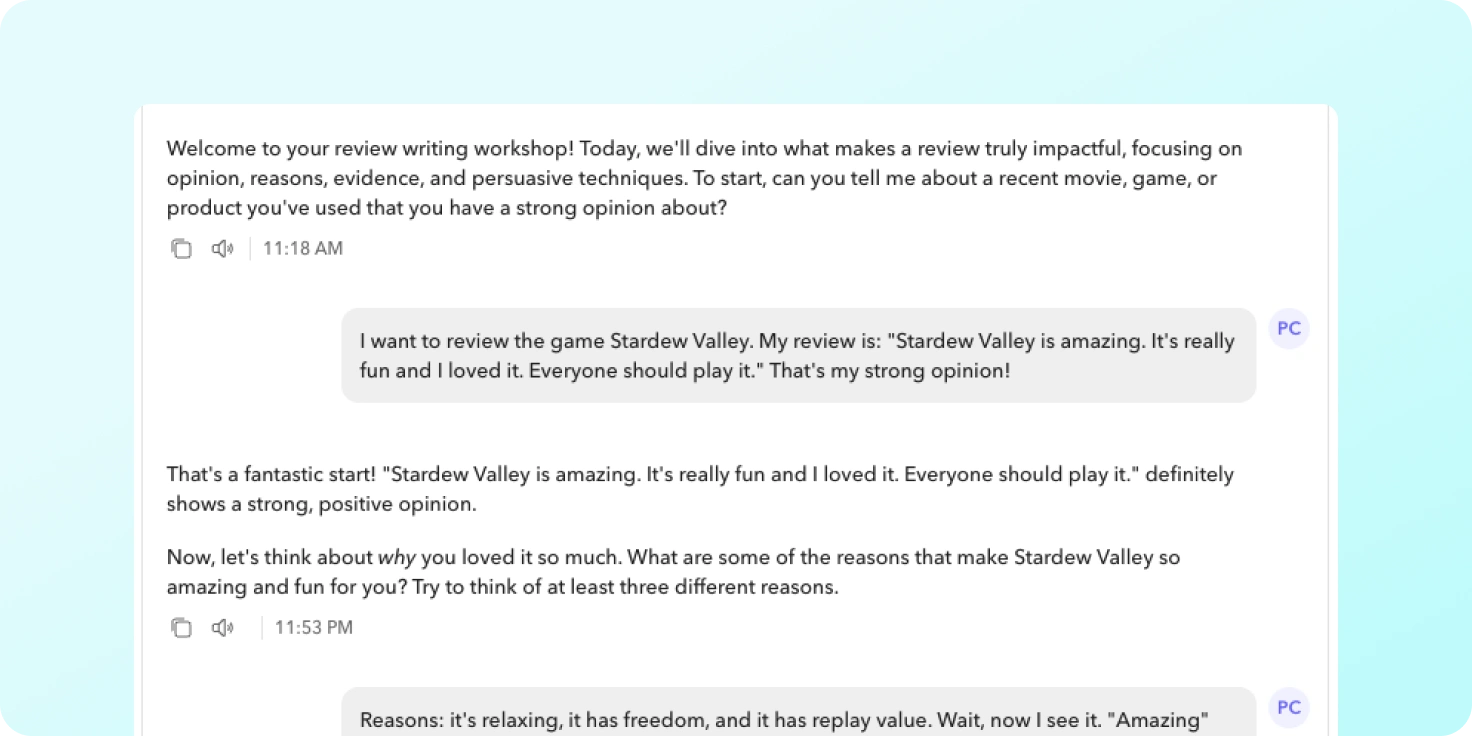
Students pick something they have a strong opinion about, a film, a game, an app, a book, or a product, and the coach helps them turn that opinion into a finished review. They work through the piece component by component and leave the session with a 6-8 sentence review that states an opinion, backs it with reasons and evidence, and uses persuasive techniques and tone words to convince a reader.
The conversation covers the four key parts of a review: stating a clear opinion, giving at least three distinct reasons, supporting each reason with specific evidence, and choosing the right tone. It then moves into persuasive techniques and a bank of positive and negative tone words, finishing with a final judgement conclusion.
What are different ways you can use this idea
You could build a tutor that coaches students through writing:
- Other persuasive forms: a letter to the school board arguing for a later start time, an opinion column on social media age limits, a pitch for a product they have designed, or a campaign speech for a class election.
- Analytical and academic writing: a thesis-driven paragraph on Macbeth’s ambition, a film analysis of camera work in a chosen scene, a science explanation of why vaccines work, or a history source comparison.
- Narrative and descriptive writing: a personal narrative about a turning point, a setting description of a place they know well, or a short story opening that hooks a reader.
Tutor instructions
- Begin by asking the student to choose their own review topic, a film, game, app, book, or product, so the writing stays relevant to them.
- Work through the four parts in order, Opinion, Reasons, Evidence, and Tone, and have the student add each part to their growing draft before moving on.
- When a student gives a general statement as evidence, ask for a specific scene, detail, or moment that proves their reason.
- Ask the student to apply at least three persuasive techniques and to weave in at least five tone words drawn from the positive and negative word banks.
- Close with a final judgement conclusion, using starters like “Overall, I would recommend this to…” or “Save your money and avoid…”, and check the finished review runs to at least 6-8 sentences.
What this tutor evaluates
This tutor evaluates whether the student clearly articulates opinion, supports it with logical reasons and relevant evidence, and skilfully integrates multiple persuasive techniques and strong tone words to create a convincing review.
From the educator
Hello, my name is Scott Varga, and I teach the Ontario Literacy Course, OLC3O, at Sunway international school in Kuala Lumpur.My students come from a wide range of language backgrounds, and most are English Second Language learners.My focus is on designing literacy learning experiences that build confidence, accessibility, and steady growth in reading, writing, and communication skills.One of the most effective tools I have used is Toddle’s AI Tutor feature, which helps extend classroom learning into structured weekly consolidation experiences.My course is built around a consistent cycle of literacy development.Throughout the week, students learn new concepts, practice skills, apply understanding, and reflect on their progress.This repetition is intentional. It allows students to revisit literacy skills in multiple ways, which is especially important for English language learners who benefit from structured reinforcement and repeated exposure.The goal is continuous, confident growth rather than one-time understanding.Toddle AI supports this cycle by transforming my classroom materials into structured review tutorials.At the end of each week, I upload my lesson slides, worksheets, and lesson plans into the AI tutorial builder.The AI generates a draft tutorial aligned with the week’s learning.I then refine it by simplifying language, clarifying instructions, and adjusting scaffolding where needed.The final result is a focused Friday tutorial that supports independent student consolidation.One of the most important strengths of this approach is the ability to design specifically for English language learners.While the AI provides a strong foundation, I refine the output to improve clarity and accessibility.This includes simplifying academic language, breaking instructions into smaller steps, adding sentence starters, and highlighting key vocabulary.These adjustments ensure students focus on literacy skills rather than language barriers.This makes learning more inclusive and manageable for all students.The weekly AI tutorials have become a consistent and valued part of the classroom experience.Students approach them with confidence because they recognise the structure and connection to what they have learned during the week.This routine supports independence, confidence, and meaningful engagement with literacy tasks.Because the tutorials reinforce classroom learning, students are able to build understanding gradually and experience success at their own pace.In my classroom, AI is a support tool that enhances teaching rather than replacing it.It helps generate structured learning materials efficiently, allowing me to focus more on instructional design, student support, and language adaptation.The teacher remains central in guiding learning, while AI helps extend and streamline resource creation.This balance allows for more responsive and accessible literacy instruction.Using Toddle AI has strengthened my reflective teaching practice.Each week, I review how students engage with the tutorials and identify areas for improvement.This includes refining clarity, improving scaffolding, and adjusting instruction based on student needs.Over time, the tutorials evolve to become more effective, more accessible, and more aligned with student learning.In OLC3O, literacy learning is about more than skill development — it is about building confidence, independence, and voice.Using Toddle’s AI Tutorial Maker has allowed me to design weekly learning experiences that are structured, accessible, reflective, and responsive to student needs.Most importantly, it supports a classroom environment where all learners, especially English language learners, can engage meaningfully and successfully with literacy.Thank you for considering my application for the Toddle AI Tutor Award.