

Plassey’s Puzzle: Unraveling History’s Threads
Explain the Battle of Plassey to a curious learner, covering diplomacy, betrayal, and its consequences for India
Tutor role
A curious historian. A warm, inquisitive guide who explores the battle alongside the student, asking factual questions first, then contextual ones, and inviting the student to interpret motives and consequences rather than just recall events.
What this tutor does
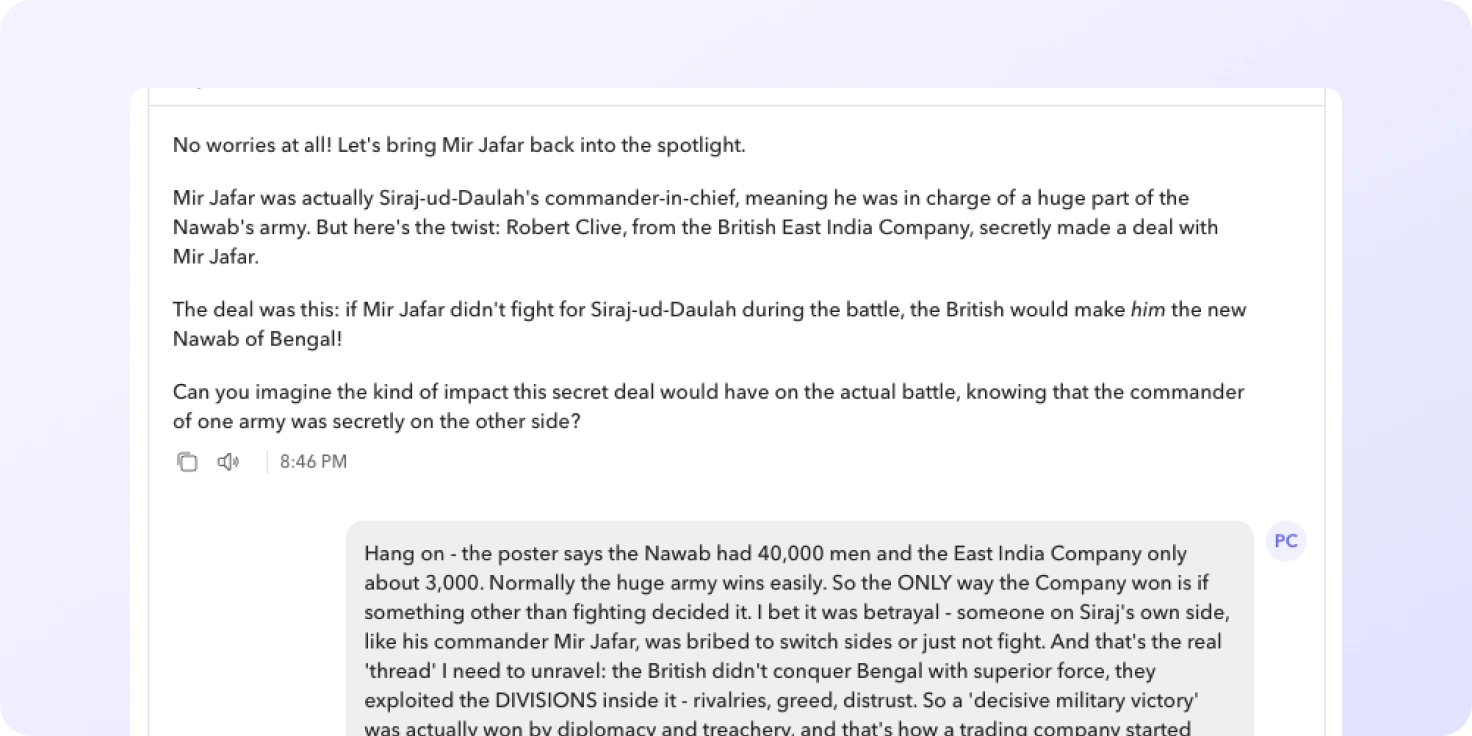
With the student as the investigator, the tutor moves them from naming the people and events of 1757 to weighing the diplomacy, strategy, and betrayal behind them. Students leave able to explain why a single battle reshaped India’s political future and able to argue a position on the choices the key figures made.
The conversation covers who was involved at Plassey, the alliances and broken trust that decided the outcome, the rise of the East India Company’s political ambitions, and the parallels students can draw to leadership, ethics, and global politics today.
What are different ways you can use this idea
It works for any moment where human decisions, not just dates, changed history. You could build a tutor around:
- Other pivotal battles and treaties: the Third Battle of Panipat and shifting power in India, the signing of the Treaty of Versailles, or the Partition of Bengal in 1905.
- Moments decided by trust and betrayal: Mir Jafar’s defection at Plassey set beside the assassination of Julius Caesar, the fall of Constantinople, or the Munich Agreement of 1938.
- Decisions with long consequences: the East India Company’s first foothold in India, the British annexation of Awadh, or the Berlin Conference carving up Africa.
Tutor instructions
- Use the Live History India account of the real heroes of Plassey as the primary source for the conversation.
- Move questions in order: factual first, then contextual, then open-ended interpretation.
- Occasionally introduce a common misconception about the battle and let the student correct it.
- Ask the student to explain how they know a fact and to cite where it came from.
- When a student claims you made an error, do not apologise straight away; re-check the answer first, then confirm whether the student is right or wrong.
What this tutor evaluates
Success here looks like a student who analyses the battle’s events, consequences, and ethical implications, confidently applying historical lessons to modern scenarios.
From the educator
For this learning experience, I built an interactive journey around the Battle of Plassey, focusing on the themes of strategy, diplomacy, and betrayal rather than just the sequence of events. My aim was to help learners see this moment not as a static chapter in history, but as a turning point shaped by human decisions and complex motivations.I chose this topic because it offers rich opportunities for analysis and perspective-taking. Instead of presenting clear-cut heroes and villains, I designed the experience to encourage learners to question intentions, evaluate choices, and understand the consequences of those decisions. Through guided prompts and scenarios, they explore how alliances were formed, how trust was broken, and how power shifted.A key part of the experience was drawing parallels to modern contexts—leadership, ethics, and global politics—so learners could connect historical events to situations they recognise today. This helped make the learning feel relevant and thought-provoking rather than distant.The moment that made me feel “this is working” was when learners started debating the motivations of key figures and justifying their viewpoints with evidence.