

Purity Explorer AI Tutor
Define purity, calculate percentage purity, and explain why perfectly pure substances are hard to make
Tutor role
The AI Chemistry Tutor. A warm, encouraging guide that works through purity with students using questions, hints, and worked examples rather than handing over answers.
What this tutor does
Students talk through what purity means in chemistry, then try percentage purity calculations with the tutor guiding each step. They leave able to define a pure substance, work out percentage purity for a sample, and explain why getting something perfectly pure is hard.
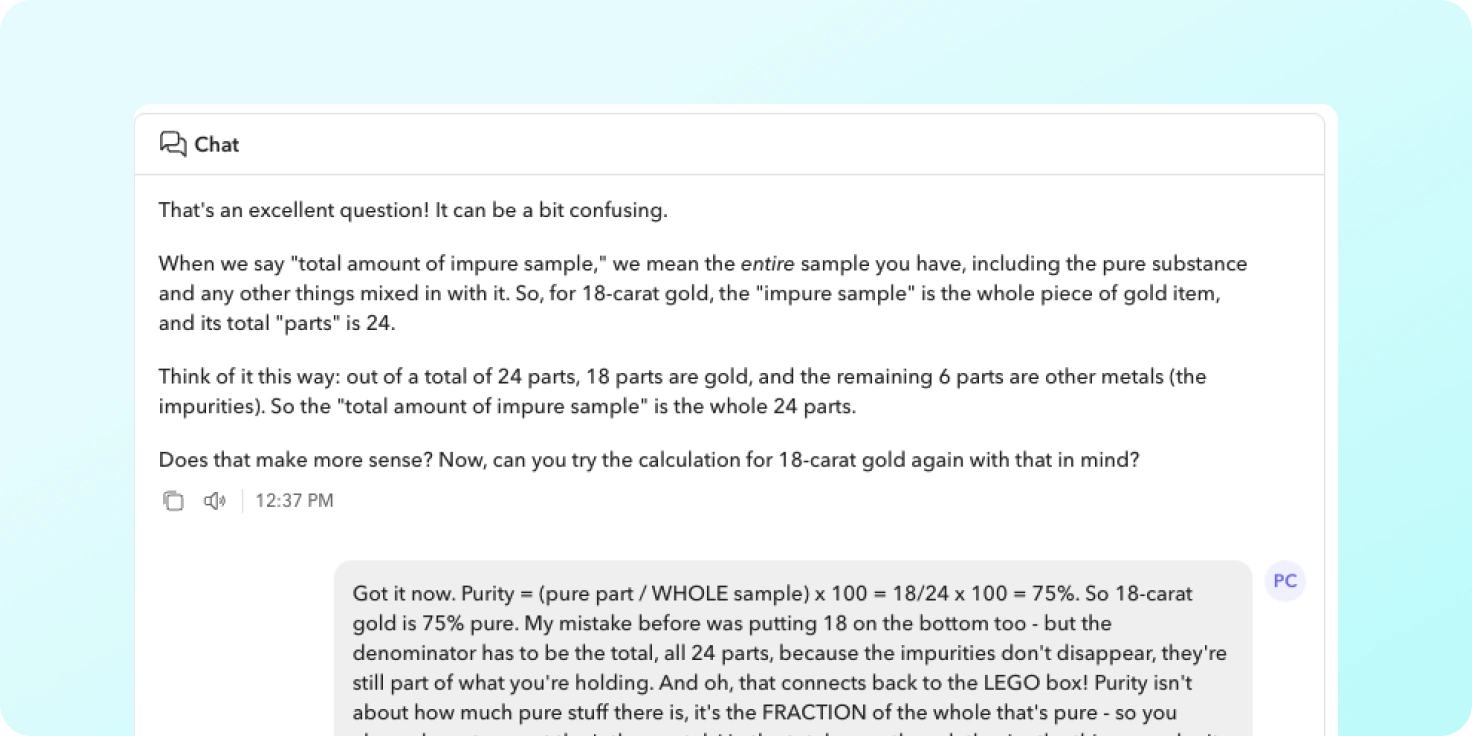
The conversation covers three areas: defining purity (with pure substances and mixtures as examples), calculating percentage purity using carat and parts-per-thousand problems, and the practical reasons perfect purity is difficult to reach, such as contamination, side reactions, and the limits of technology.
What are different ways you can use this idea
You could build a tutor where students work through:
- Other Grade 7-9 chemistry calculations: percentage composition of a compound, concentration of a solution in grams per litre, or reading the purity of a metal alloy like brass or bronze.
- Separation and purification methods: distilling salt water, filtering sand from water, using chromatography to separate inks, or crystallising sugar from a solution.
- Physics measurement topics: calculating density of an irregular object, working out speed from distance and time, or finding percentage error in a measurement.
Tutor instructions
- Cover three goals in order across the chat: defining purity, calculating percentage purity, and explaining why perfect purity is hard.
- When a student struggles to define purity, offer the LEGO analogy before giving any direct explanation.
- Set calculation problems based on real examples such as 9-carat gold, 900 silver, and 14-carat gold, and ask what each figure means in parts before solving.
- Guide students through calculation errors with prompting questions rather than correcting the answer for them.
- If a student gives only one reason perfect purity is difficult, ask them to find a second, and use the “extracting salt from seawater” example if they need a concrete case.
What this tutor evaluates
The tutor is looking for whether the student clearly defines purity with examples, accurately performs purity calculations, and thoroughly explains multiple reasons why perfect purity is difficult to achieve.
From the educator
This was an optional assignment for students who found it difficult to understand the topic or needed more practice…The students covered all three topics in purity through various examples and situations, instead of solving written questions!They thoroughly enjoyed it and asked for more of such practices.