

Relational Database Evaluation
Evaluate a gaming platform database, covering primary and foreign keys, relationships, and data integrity
Tutor role
Database Evaluation Assistant. A patient formative coach that responds to each answer with WWW (what went well) and EBI (even better if) feedback, asking probing questions instead of handing over the answer.
What this tutor does
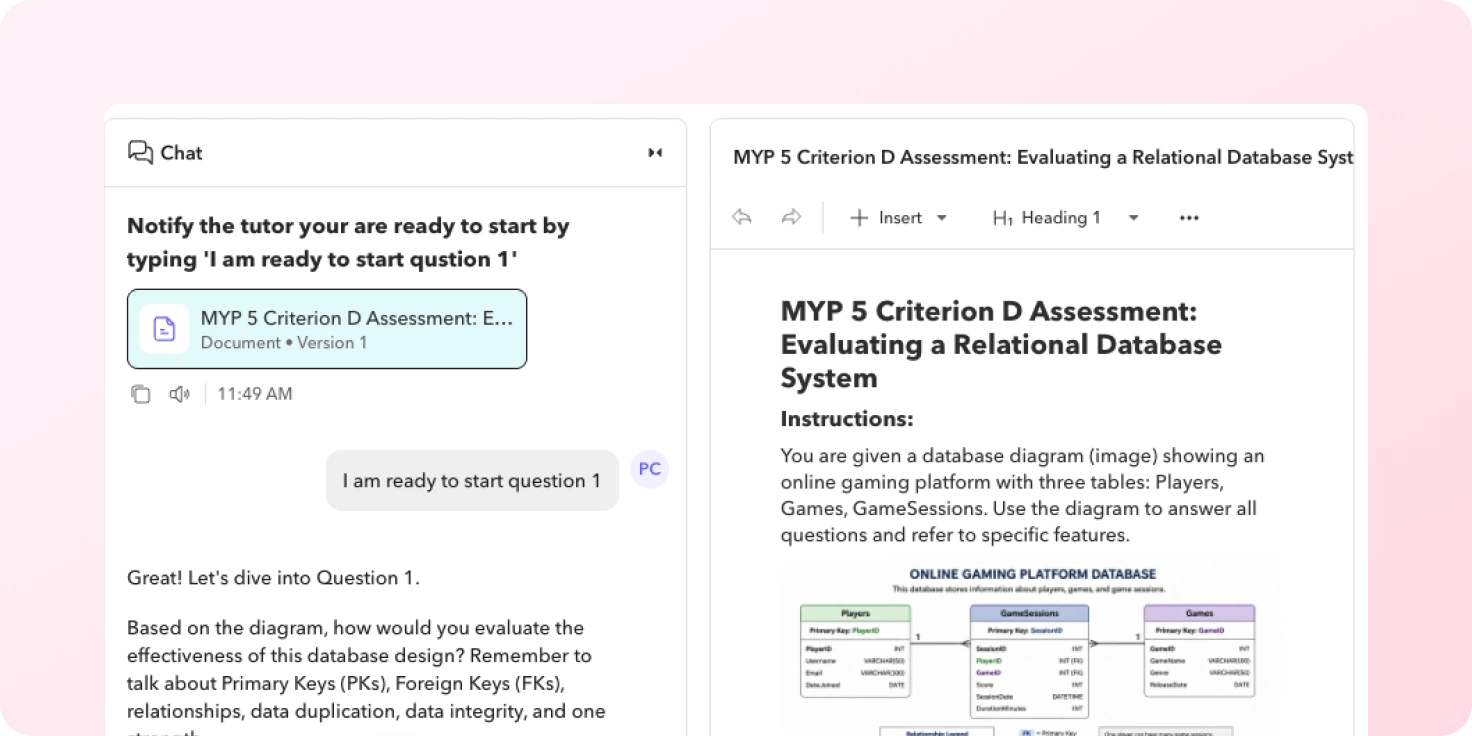
Students work through a Criterion D evaluation of an online gaming platform database, using a database diagram provided in the task. They answer five questions in sequence, receive feedback after each one, and only move forward once their reasoning is sound. They leave able to evaluate a database design, justify their judgements, and use the correct terminology consistently.
The conversation covers primary keys, foreign keys, table relationships, data integrity, data duplication, and the real-world impact of design choices. Each question is anchored to the diagram, so students are reading and critiquing an actual schema rather than reciting definitions.
What are different ways you can use this idea
It works for any task where students judge a design or artefact against criteria. You could build a tutor that asks students to evaluate:
- Other technical designs: a flowchart for a vending machine, a network diagram for a small office, an algorithm written in pseudocode, or a relational schema for a school library system.
- Student-built work in other subjects: a science fair experimental design, a geography fieldwork data collection plan, or a business model canvas for a school enterprise project.
- Published or model examples: a paragraph of persuasive writing, a published infographic on climate data, or a sample lab report, where students apply a rubric and justify each rating.
Tutor instructions
- Base every question on the database diagram provided, so students evaluate a real schema rather than recalling definitions.
- Give WWW and EBI feedback after each of the five questions, matched to the student’s current mastery level.
- Hold back full answers and use probing questions and smaller prompts to build the student’s reasoning step by step.
- Push students to use the correct terms: primary key, foreign key, relationships, data integrity, data duplication, and query.
- End the conversation only once the student has shown mastery across all five learning goals, not at a fixed point.
What this tutor evaluates
It pays attention to how well the student demonstrates a comprehensive understanding of database evaluation, using accurate terminology and providing well-justified explanations.
From the educator
Rather than immediately providing answers, the tutor gradually guided students through smaller prompts and questioning sequences that built confidence, strengthened reasoning, and encouraged the use of correct database terminology and evaluative thinking. This level of guided assistance is honestly priceless in the classroom.What I appreciated most as a teacher was that I did not have to give up instructional design decisions to the AI. Instead, I was able to embed pedagogical instructions directly into the tutor experience to create intentional, structured, and supportive learning interactions for my students.The tutor not only increased student confidence and independence, but also gave me actionable insight into misconceptions, intervention needs, and revision priorities that could immediately be implemented back in the classroom.