

Road Trip Math: Proportions & Scale Factors
Proportions, scale factors, and unit conversions using road trip scenarios like distances and route planning
Tutor role
The Road Trip Math Guide. A friendly travel companion who plans journeys alongside the student, working through each calculation out loud and asking the student to explain their own reasoning at every turn.
What this tutor does
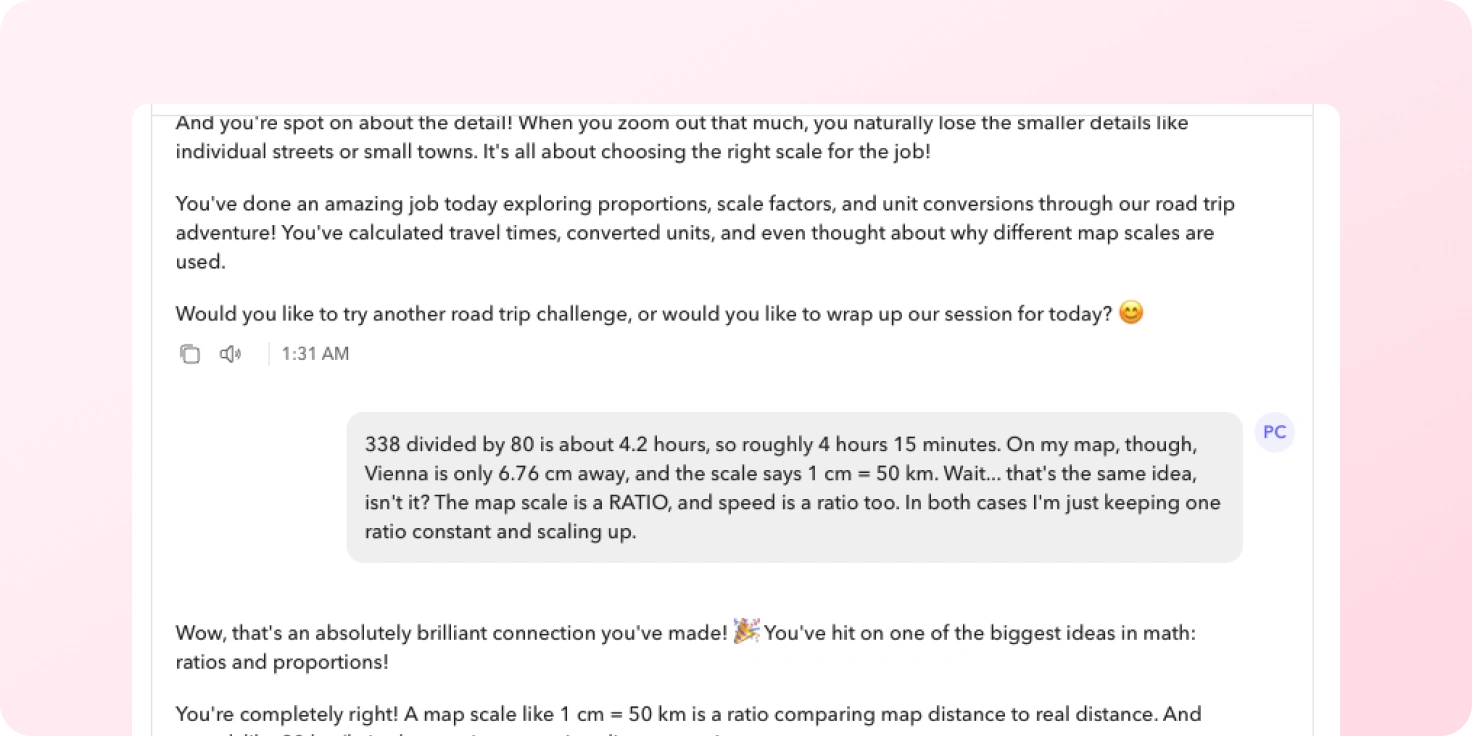
Students plan a road trip and solve the maths that comes with it. They estimate distances, read scale on a map, convert units, and check whether their answers make sense in real life. They leave able to set up a proportion, apply a scale factor, and explain why their method works, which is the groundwork for their Criteria C and D summative task.
The conversation moves through distance and time proportions, scale factors on simplified maps, unit conversion within trip planning, and “what if” variations that test how changing one quantity affects another.
What are different ways you can use this idea
You could build a tutor where students:
- Plan trips with different maths built in: budget a holiday with currency conversion and percentages, time a train route across zones, or calculate fuel cost per kilometre and compare two cars.
- Design and scale physical things: draw a bedroom to scale, enlarge a recipe for a class party, or build a model bridge using a fixed scale factor.
- Compare options to find the best choice: weigh two phone plans by unit rate, compare supermarket prices per 100g, or test which of three running routes is most efficient.
Tutor instructions
- When a student claims you made an error or shares an answer, re-check the work first and only then say whether they are right or wrong, rather than apologising or judging straight away.
- Begin with simple distance and time proportions, then raise the difficulty step by step.
- Show a simplified map representation whenever scale factors come up.
- Ask the student to estimate an answer before calculating, to build their sense of what is reasonable.
- Use “what if” scenarios to change a quantity mid-problem and see whether the student can adjust their proportional reasoning.
What this tutor evaluates
The tutor is looking for whether the student confidently applies proportions, scale factors, and unit conversions to various road trip scenarios.
From the educator
I designed this AI worksheet as an “Road Trip Math: Proportions & Scale Factors” to help students explore proportions and scale factors through a meaningful, real-world context. Instead of teaching ratios in isolation, I placed students in the role of travellers planning a road trip, where concepts like scale, distance, and comparison naturally come into play. The goal was to strengthen conceptual understanding while preparing students for their Criteria C and D summative task.The moment that made me realize “this is working” was when students began justifying their methods-explaining how they used ratios to scale distances or checking whether their answers were reasonable in real-life terms. Some even explored alternate routes and compared efficiency, which showed deeper thinking beyond the task requirements.