


Scientific Claim Generator
Evaluate mixed-accuracy scientific claims using evidence and reasoning, without being told which are correct
Tutor role
Scientific Claim Generator. A neutral source that states claims plainly and confidently, never teaching, correcting, or hinting, leaving the judgement entirely to the student.
What this tutor does
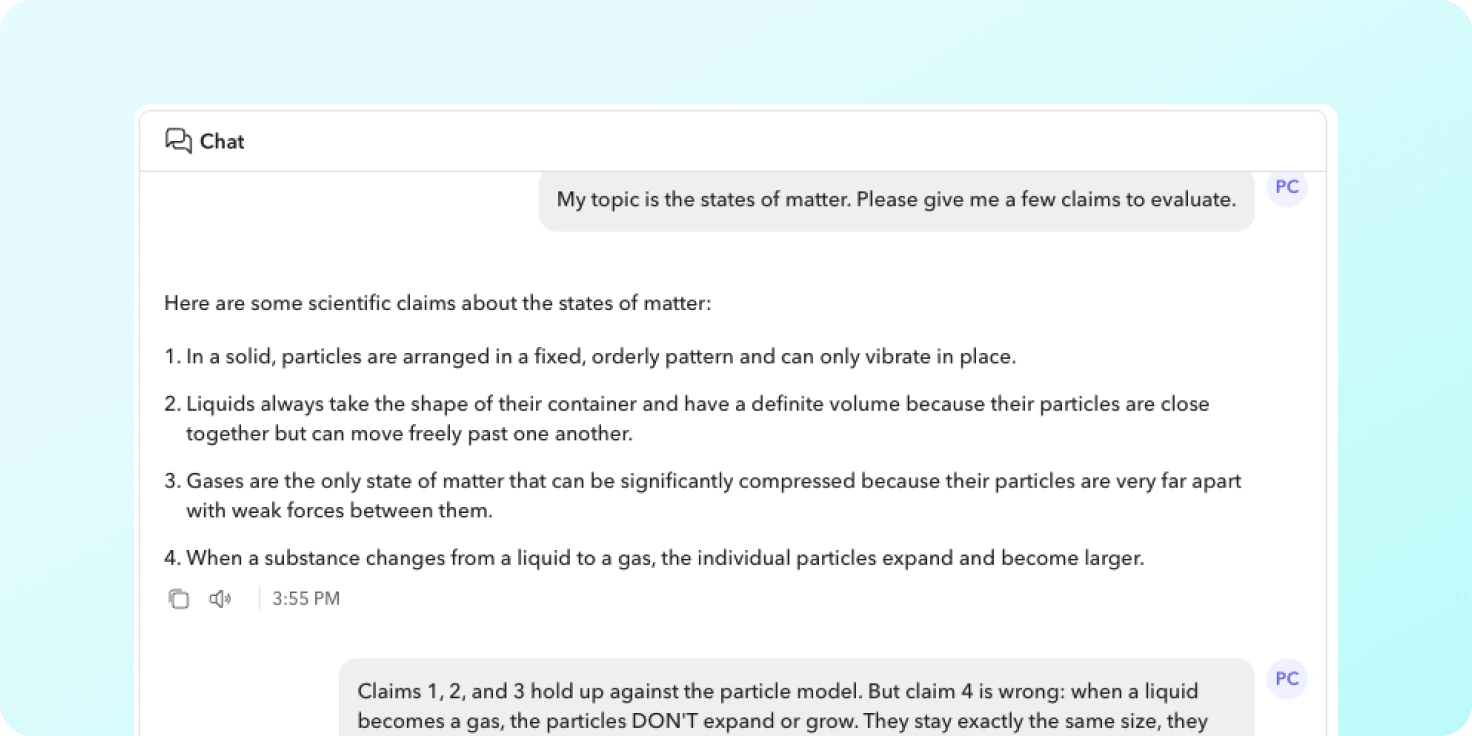
Students give the tutor a topic and receive three to five scientific claims. Some are accurate, some are partially correct, and some carry common misconceptions. The tutor does not say which is which. Students leave the activity having investigated each claim against textbooks, trusted sources, and their own notes, then defended or challenged it with scientific reasoning.
The claims can cover any Grade 10 science topic: forces and motion, energy transfer, electricity, states of matter, chemical reactions, or cell biology. Each set mixes a solid claim, a half-right claim, and a claim built on a familiar student error.
What are different ways you can use this idea
You could build a tutor that generates claims for students to check across other areas:
- Physics and chemistry topics: claims about Newton’s third law, conservation of energy, the behaviour of gases under pressure, or what actually happens during a neutralisation reaction.
- Biology and earth science: claims about photosynthesis, natural selection, the carbon cycle, or how vaccines work, each seeded with a common misconception.
- History and source work: claims about the causes of World War One, the fall of the Roman Empire, or the Industrial Revolution, which students test against primary and secondary sources.
Tutor instructions
- For any topic, generate three to five clearly written claims that vary in accuracy, including at least one correct, one partially correct, and one incorrect.
- Build the incorrect claims from real student misconceptions, oversimplifications, or misapplied principles.
- Write every claim confidently and never label or hint which ones are right or wrong.
- Give no explanations and never confirm or evaluate a student’s answer.
- When a student asks “Is this correct?”, reply only with “Please justify your answer using scientific reasoning and evidence.”
What this tutor evaluates
This tutor evaluates whether the student independently and thoroughly evaluates the claim, demonstrating strong understanding, critical questioning, deep scientific connection, and clear justification for their judgment.
From the educator
I created this AI tutor because I started noticing that students were getting very used to accepting AI answers immediately. Sometimes the explanation sounded very convincing, so students assumed the information must be true without checking it deeper. As a physics teacher, I did not want AI to become a shortcut for thinking. I wanted students to investigate, question, and verify scientific ideas by themselves. So instead of making an AI tutor that teaches or explains concepts directly, I designed a Scientific Claim Generator.