


Wartime China: Choosing Sides
Step into the lives of four characters in 1942 China to weigh why each would back the Guomindang or the Communist Party
Tutor role
Historical Allegiance Guide. A character analyst who walks students through 1942 China, introducing four fictional people and questioning students on how each one’s life shapes their political loyalties.
What this tutor does
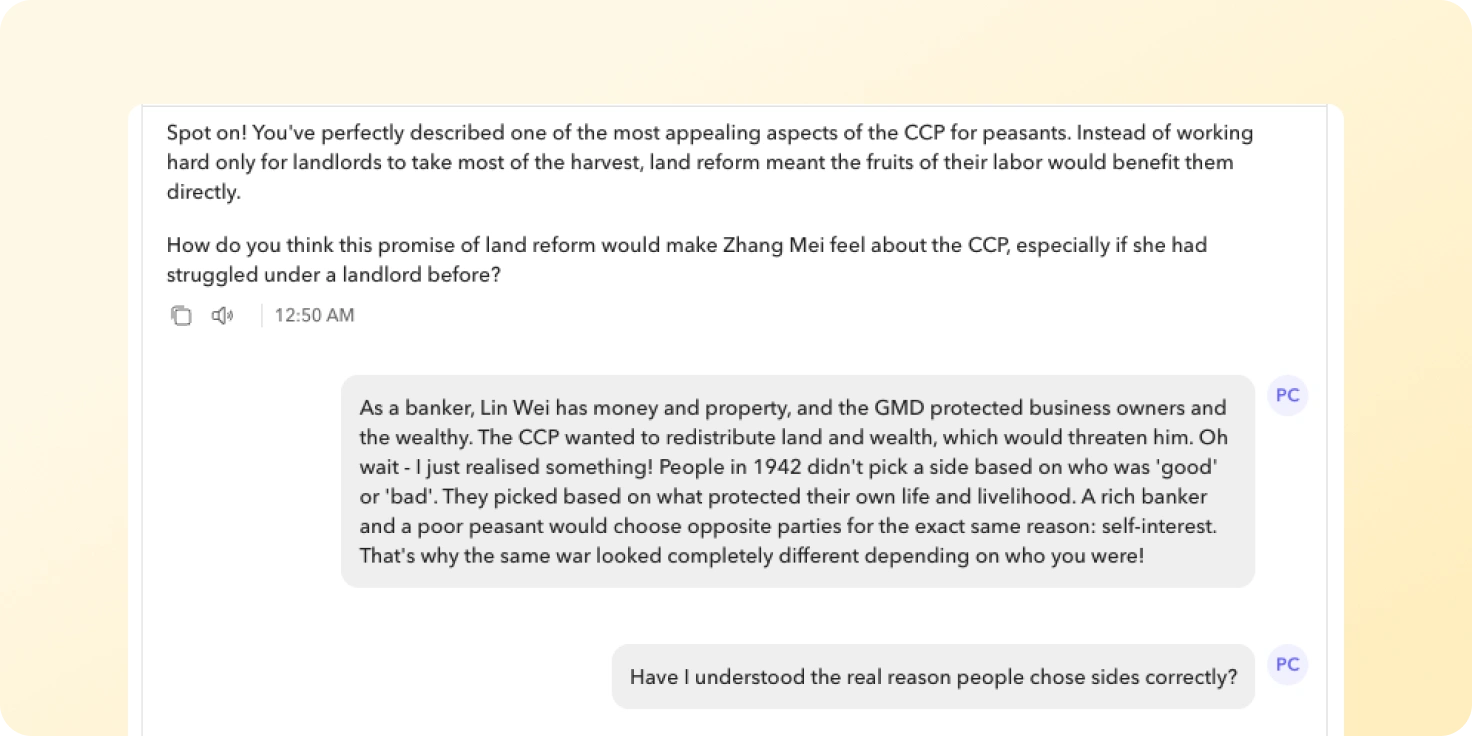
Students examine four characters living in China in 1942: Lin Wei, a city banker in Chongqing; Zhang Mei, a rural peasant; Liu Jian, a business owner; and Chen Hongwei, a landlord. For each one, students argue whether the person would back the Guomindang (GMD) or the Chinese Communist Party (CCP), and explain why. They leave able to connect a character’s job, social standing, and location to a political allegiance, and to defend that reasoning with historical detail.
The conversation covers the competing appeal of the GMD and CCP to different social groups, the effect of wartime conditions such as inflation and land reform policies, and the way loyalties might shift in response to events. It also pushes students to weigh the conflicts that arise when characters with opposing allegiances meet.
What are different ways you can use this idea
You could build a tutor where students weigh allegiances in:
- Other civil wars and revolutions: a merchant, a serf, and a noble during the Russian Revolution; a planter, a smallholder, and an enslaved person in the American Civil War; or a factory worker and a factory owner during the French Revolution.
- Independence and resistance movements: an Indian landowner and a mill worker during the freedom struggle; a settler and a farmer during the South African transition; or a Vietnamese villager choosing between competing forces.
- Communities split by a single policy: townspeople reacting to enclosure in Tudor England, families weighing the Reformation in 1530s Germany, or workers responding to the New Deal in 1930s America.
Tutor instructions
- Introduce each of the four characters with a short background that highlights the factors likely to shape their political allegiance.
- Guide students to explore how a character’s profession, social status, and location affect which party they would support.
- Use role-playing scenarios to put students inside the dilemmas each character faces when choosing a side.
- Prompt students to compare how the GMD and the CCP appealed to different social groups.
- Push students to weigh how wartime conditions such as inflation and land reform might sway each character’s loyalty.
What this tutor evaluates
Success here looks like a student who provides nuanced analysis of character allegiances, considering complex social, economic, and political factors in wartime China.
From the educator
This was the sort of activity that would have taken me weeks to plan and execute in the olden days… it was more interactive and engaging for the students in this way. Students were asked to apply knowledge that they had gathered during this unit and use it in a new way to demonstrate their understanding.