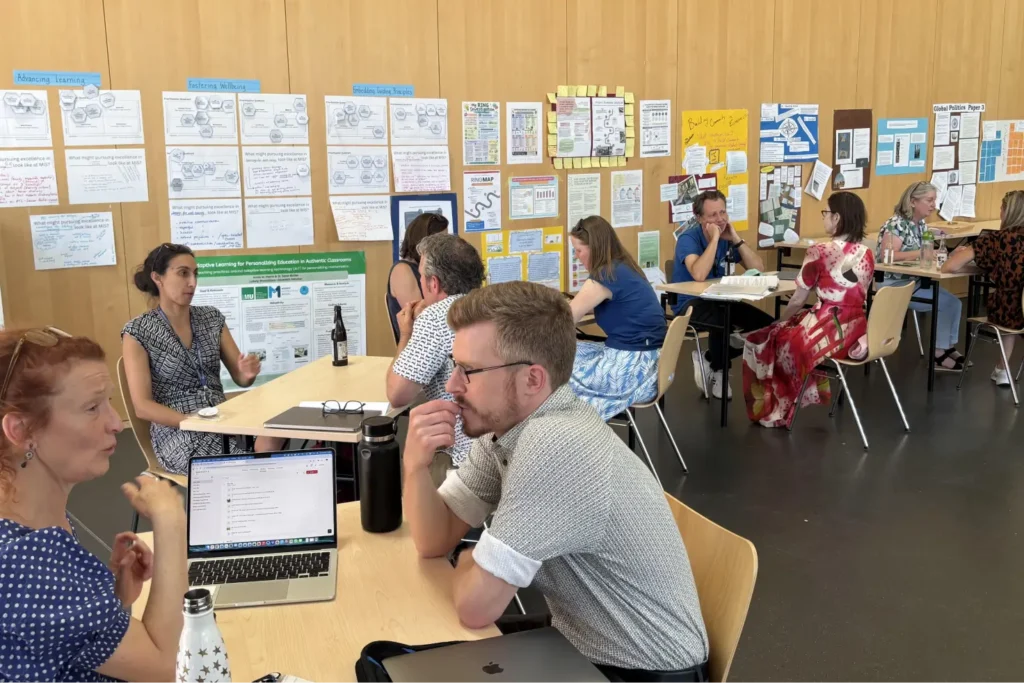
On a Friday afternoon at Munich International School (MIS), teachers meet in RINGs organised around a shared area of practice. One group is working on feedback. Another is looking at student engagement. A third is exploring how co-teaching can reduce barriers for learners. Within each RING, teachers share resources, test ideas, and push one another to get more specific. No one is waiting for an administrator to define the work. The questions belong to the teachers themselves.
This is RING, Munich International School’s teacher-led framework for professional growth. It stands for Reflect, Inquire, Grow, and it gives teachers a structured way to study their own practice, learn with colleagues, and examine the impact of their inquiry on student learning.
The system it replaced
When Mhairi Ziegler arrived at Munich International School in 2022 as a new Science teacher in the upper school, the school already had a professional growth process built around classroom observations, meetings with section principals, and individual goal setting. It provided a strong foundation, but the disruption of the pandemic had made parts of the process harder to sustain consistently. Documentation could become substantial, progress was not always easy to track across a three-year cycle, and continuity could be affected when supervisors changed.
As Mhairi, Elyse, and the team began rethinking the programme, they saw an opportunity to place greater emphasis on teacher ownership, student learning, and professional learning between colleagues. The aim was not to discard classroom observations or leadership feedback, which remain part of the school’s approach, but to add a process that was more collective, easier to follow, and closely connected to what students were experiencing in the classroom.
The team kept returning to a simple idea: professional growth cannot be understood through observations or documents alone. It is also visible in whether teachers are learning, adapting, experimenting, and responding to the students in front of them.
So in 2023, Mhairi and Elyse, as leaders of the school improvement group, led a team of 15–20 teachers in designing RING.
Built by teachers, for teachers
They looked at other models, read widely, and borrowed where it made sense. But one question kept coming back: what would work here, with these teachers, in this school, under these conditions?
Before they designed the mechanics, they agreed on four criteria:
- The framework had to be flexible
- It had to motivate teachers to grow and take pride in their work
- It had to be manageable and transparent
- And it had to work for the whole school community, not just for a few enthusiasts
“What I love about our system,“ Elyse said, “is that we created it ourselves; it was for teachers by teachers.” After the first year, the design group went back to the faculty and asked a straightforward question: was the framework flexible, motivating, manageable, and working for everyone, not just a few enthusiasts? The responses were strongly positive on all four.
Inside the RING cycle
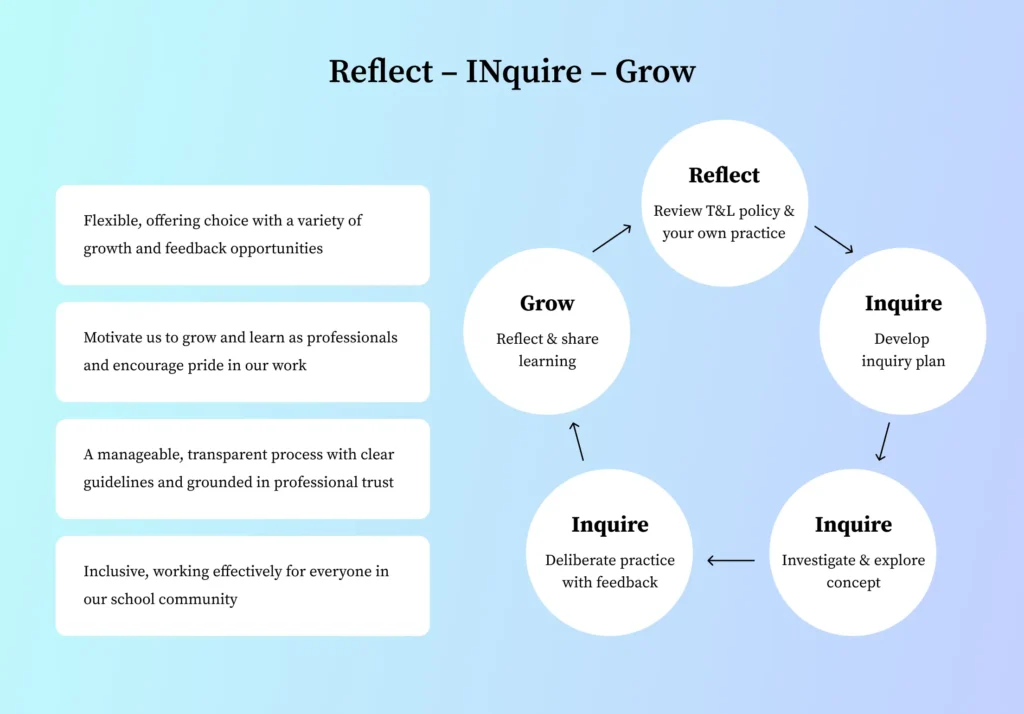
The RING cycle at Munich International School: Reflect, Inquire, Grow, built around flexibility, transparency, and teacher ownership.
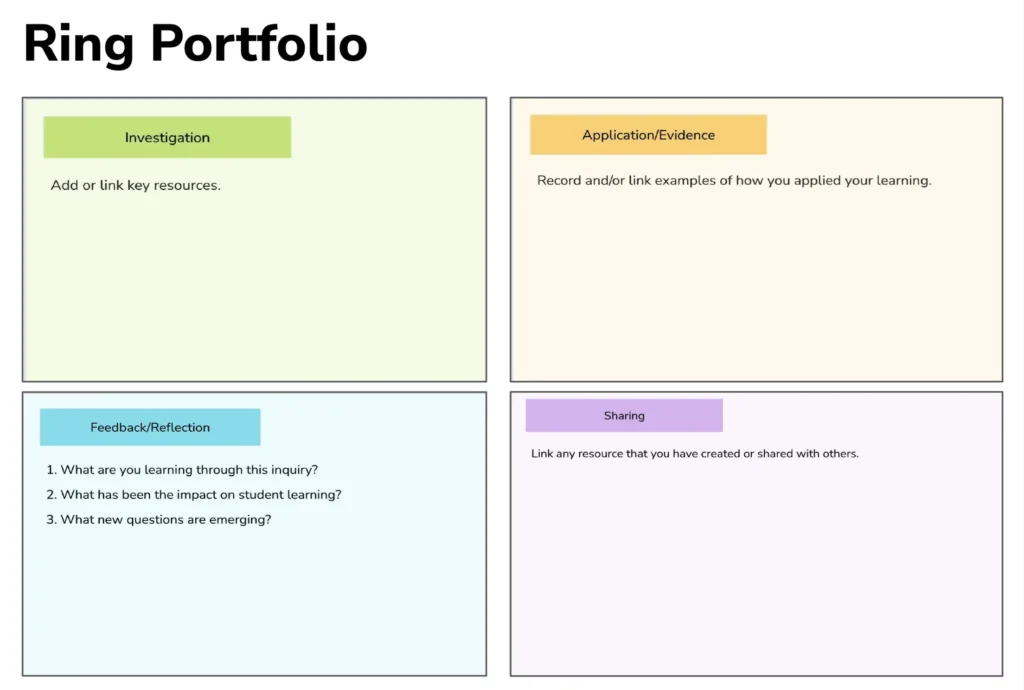
At the start of each school year, teachers engage in the Reflect stage by reviewing MIS’s teaching and learning policy and completing a survey about an area in which they want to grow. The survey provides the data used to form RINGs around shared areas of focus. Teachers then deepen their reflection through different structures, one of which can be a walk and talk with a colleague. The process ends with each teacher arriving at a question they want to investigate for the year. That question, along with the teacher’s plan for investigating it, applying the learning, gathering evidence, and sharing with colleagues, is documented on a RING Inquiry Plan on Toddle, the teaching and learning platform the school already uses.
In the Inquire phase, which makes up the bulk of the year, teachers are grouped into RINGs. Each RING is a small group of eight to twenty teachers organised around a shared theme: feedback, student engagement, learner-centred teaching, AI implementation, or assessment. The theme is what holds the group together. Within it, every teacher works on their own specific question, but they investigate, test, and refine those questions alongside colleagues working on the same broad area. That is what makes the conversations in each session useful. A teacher exploring feedback is sitting with others also thinking about feedback, not in a generic professional development session.
Each RING meets four to six times across the school year, depending on the calendar. Sessions are structured but not rigid. Some are for refining inquiry questions, some for sharing resources, some for feedback, and some are simply protected time to do the work.
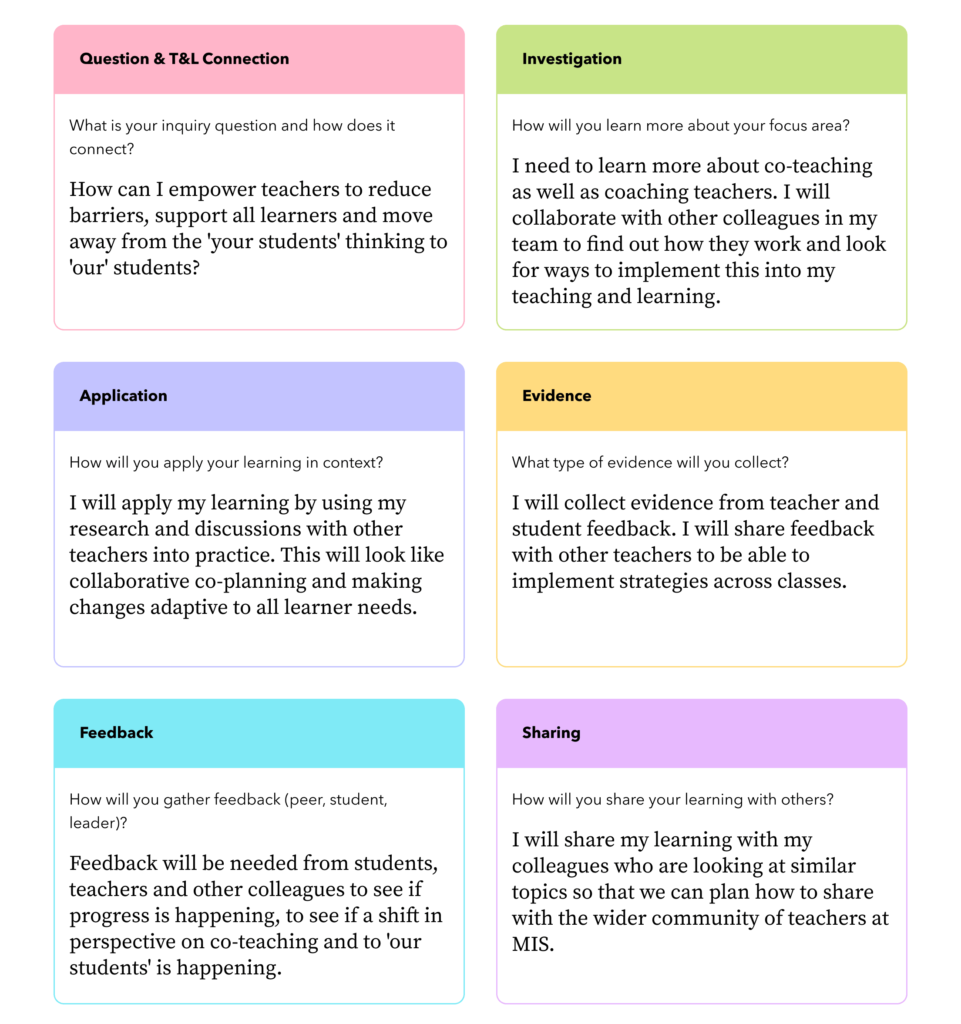
This year, MIS is running ten RINGs across a faculty of about 180. Each group is led by a teacher who volunteers for the role and receives a small stipend. The questions teachers work on are deliberately small and precise. One teacher framed hers this way: “How can I empower co-teachers to reduce barriers, support all learners, and move away from ‘your students’ thinking to ‘our students’?” She mapped out how she would investigate it, what co-planning with colleagues would look like in practice, and what evidence of a shift in perspective she would collect.
At the end of the school year, teachers share what they have learned with the school community at RINGfest. The gathering is shaped around teacher choice, with options including one-to-one speed sharing, roundtable discussions, presentations, posters, and more. Teachers share their inquiry questions, evidence from their classrooms, feedback from students, and what changed in student learning. Leadership engages in RING as well, so school leaders both share their own learning and learn from others. What accumulates is a picture of an entire school learning collectively.

How RING contributes to appraisal
One of the most consequential decisions the design group made was to make RING one part of MIS’s wider professional growth and appraisal framework. RING does not replace classroom observations or leadership feedback. It adds a sustained, teacher-led inquiry and a longer view of how a teacher’s practice develops across the year.
“We talked a lot about what appraisal meant, and what we wanted from teachers,” Leigh said. “Ultimately, the sign of effective teaching is teachers who are genuinely growing, trying new things, and responding to what their students need.”
RING is one prong of a three-pronged framework. The other two are regular classroom observations and feedback from leadership, and professional support plans for teachers who are not meeting expectations.
Every teacher maintains a RING portfolio across the year, built on Toddle. Leigh describes this as “dogfooding,” a product-development term for using the same tools you ask others to use. Teachers experience firsthand the process of documenting, reflecting on, and showcasing learning that their students use on Toddle. The portfolio includes evidence from practice, feedback from students, and examples of the inquiry’s impact on student learning. What leadership looks for is not a finished product. It is evidence of genuine movement: a teacher who is inquiring, trying new things, listening to students, reflecting, and adjusting. That evidence accumulates across twelve months, not in a single observed lesson.
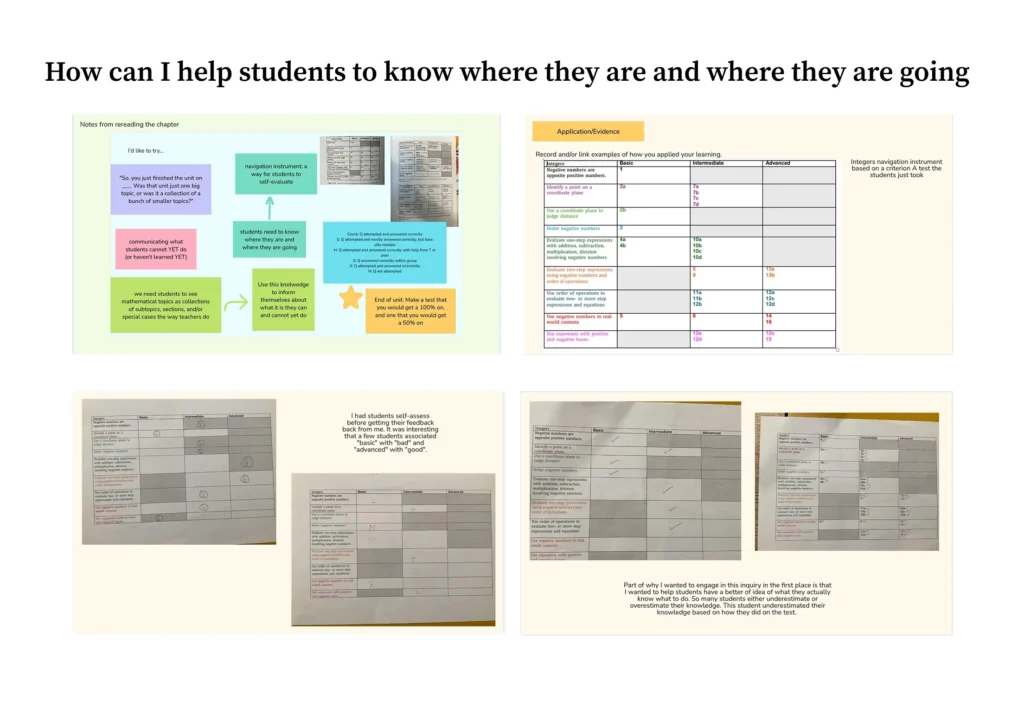
RING does not make appraisal lighter. It adds another layer of evidence to the classroom observations and leadership feedback that remain part of the wider framework. The evidence is broader, the timeframe is longer, and the work is visible to colleagues, not just to a supervisor.
One test of that rigour is whether the work holds up outside the school. Mhairi spent a year working on student engagement through her own RING inquiry. It began as a question on a wall in a Friday afternoon meeting. By the end of the cycle, she had enough to present it as an hour-long workshop at the German Association of International Schools’ By Teachers For Teachers conference. The session drew teachers from across the network, and the framework she had built inside her own classroom became something other schools could borrow from. A line of inquiry that began as one teacher’s question ended up influencing practice well beyond MIS.
Small changes count
One reason RING has taken root is that the school did not define success too narrowly. Teachers are not expected to redesign their entire practice in a year. An inquiry can be ambitious, but it can also be small.
Elyse shared one example: a teacher who started standing at the classroom door at the end of every lesson, asking each student what they had learned that day. “Even a small instructional tweak like that is winning,” she said. If it sharpens student reflection, changes the quality of feedback, and alters how a teacher plans the next lesson, it counts.
Bigger inquiries follow the same pattern. As we discussed earlier, one teacher spent the year investigating co-teaching. Her question was how to reduce barriers for learners and move colleagues from “your students” thinking to “our students” thinking. It was ambitious, but she did not try to overhaul a lesson structure overnight. She started small, with a single co-planning conversation with a colleague about one shared class. From there the question deepened, becoming not just “what does good co-teaching look like?” but “what does it feel like for a student to be in a room where teachers see them as shared?” Each RING meeting sharpened the question further. By the end of the year, she had evidence of a shift, visible in student feedback and in changed conversations with colleagues..
What other schools might consider
If you are wondering whether something like RING could work in your school, the model is more portable than it might look. It does not need external consultants or a significant budget. The main investment is time, plus modest stipends for the teachers who lead each group. What matters far more than resources is how you set the conditions.
Three conditions have made the difference at MIS, and they are worth thinking about before you start.
Hand the design to teachers. It is tempting to draft the framework yourself and then ask teachers for feedback. That can work, but the version of RING that took root at MIS was built by teachers from the start, against criteria they agreed on. Starting with a leadership-designed framework tends to produce something teachers accept. Starting with a teacher-designed one tends to produce something teachers protect. The difference matters when the system has to survive a hard year.
Protect time inside the working day, not on top of it. Professional growth that lives in evenings or weekends rarely survives a busy term. At MIS, RING meetings sit inside professional learning time that already existed. The school is not adding hours, it is reallocating them. It is worth being honest about what can come off teachers’ plates to make room for this, because if the answer is nothing, the model will struggle to hold.
Connect inquiry meaningfully to appraisal. RING works because inquiry is treated as meaningful evidence of professional growth within the school’s wider framework. It does not replace observation, leadership feedback, or support. It adds evidence of how a teacher’s thinking and practice develop over time, and what difference that makes for students.
If those conditions are in place, the rest is mechanics, and the mechanics can be adapted to fit different schools. If they are not yet in place, the more useful starting point is the conditions themselves: who designs, what time is protected, and how much ownership leadership is ready to share. The framework can wait until those answers are clearer.