
Every year, students, staff and the senior leadership team at the Western Academy of Beijing (WAB) enter a dragon boat race. The seventeen leaders share one long, narrow boat and row together. Kevin Crouch, the school’s Director of Educational Technology, describes it as the most honest leadership exercise the school runs. “The boat that wins is not the one where people push the hardest,” he told me. “It’s the one that’s the most synchronised.”
The metaphor is deliberate. WAB is a school of 1,400 families from 58 nationalities, speaking 44 languages, spread across a 99,000-square-metre campus in Beijing. Keeping an institution this large and diverse moving in one direction is not a strategic exercise. It is a cultural one, built through vocabulary, listening, repetition, and foundational beliefs that have held for thirty years.

Thirty years of the same foundation
WAB was founded in 1994 with three philosophical commitments written into its constitution: educating the whole child, championing staff, and building genuine home-school partnerships. Three decades later, those founding statements still sit at the base of every policy the school sets.
From the three commitments came five core values: caring, student-centred, a mosaic of diversity and inclusion, a gung-ho spirit of working hard and together, and China-global coherence — a recognition that WAB is a diverse international community rooted in a Chinese context. Together, these make up the constitution.
The constitution then gives rise to eight board principles, covering education, admissions, finance, compliance, technology, health, and safeguarding. Every school policy must sit under one of those eight. Each policy ties back to a principle, each principle to a value, each value to a founding commitment. Alignment, top to bottom.
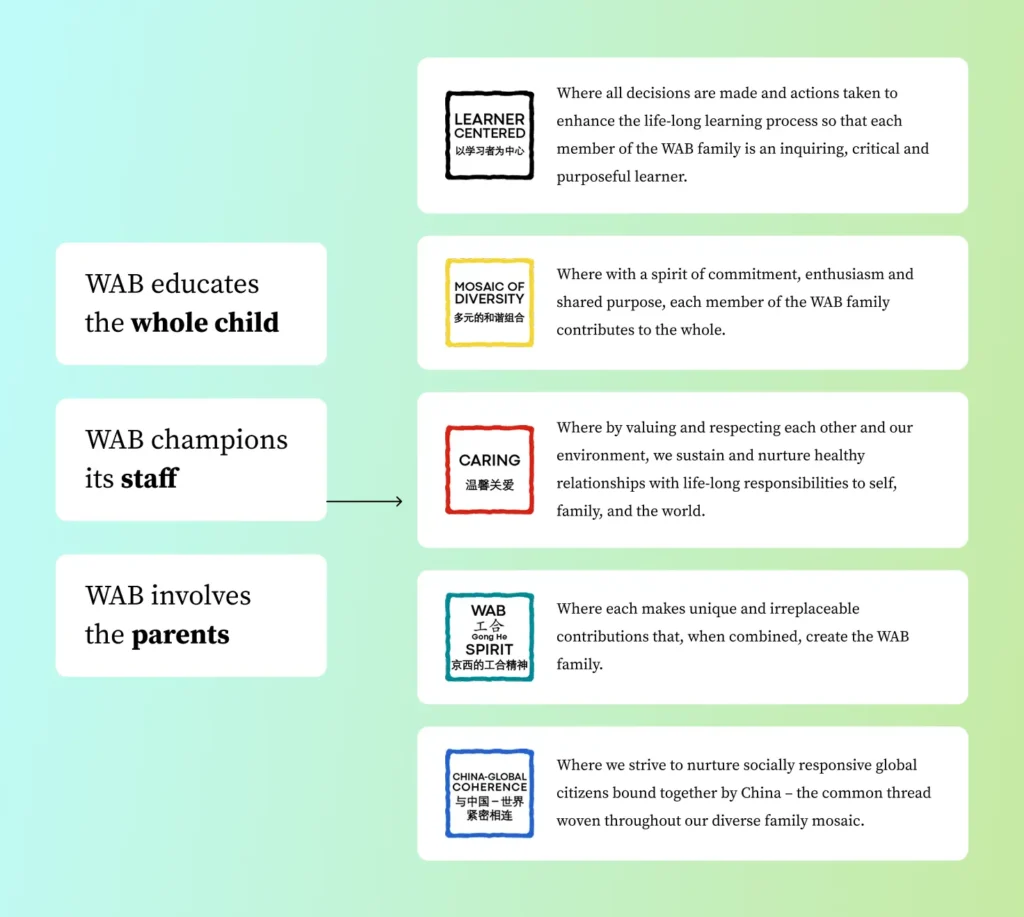
This is the system Marta Medved Krajnovic stepped into when she became Head of School, and the one she now leads from inside. “When a new head of school arrives, they need to look at those principles and ask: what is the key guidance under them? And all their work stems from this,” she told me.
A mission statement tells you what a school believes. A constitutional architecture tells you what a school is designed to do even when the people who wrote it have moved on.
Strategy as a cultural exercise
In 2021, WAB needed a new strategic plan. What it produced was, deliberately, not quite a plan. The process itself was an expression of the school’s values. WAB had spent years telling students they had agency. It would have been strange to then write the school’s future behind a closed boardroom door.
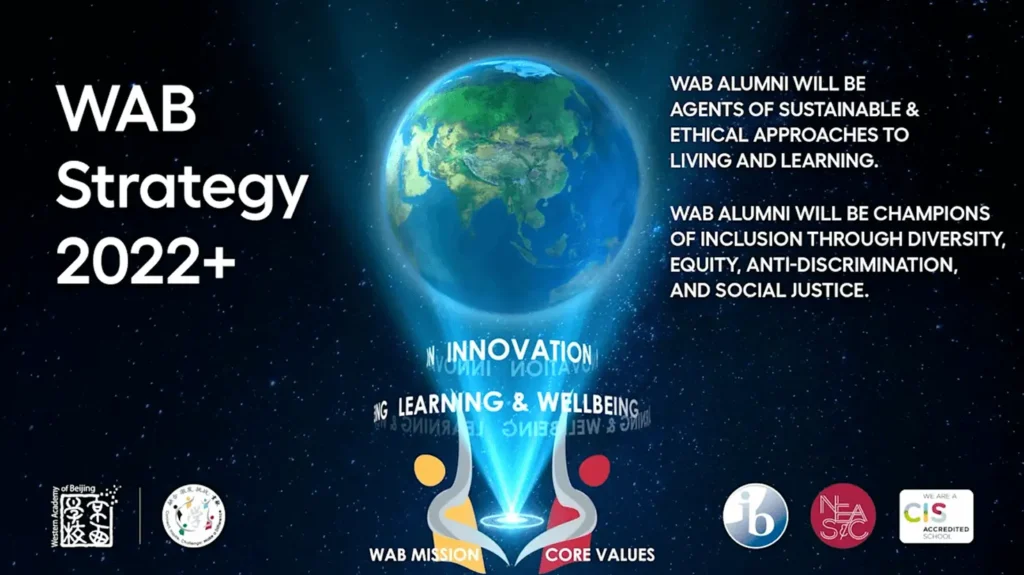
A volunteer group of students was trained to facilitate workshops across the full community including parents, alumni, faculty, staff, and the board. The exercise was framed not “what should WAB do next”, but “what kind of people should WAB alumni become”. They called these workshops “Portraits of WAB Alumni.”
What emerged were two new areas of focus, layered on top of the existing foundation:
- WAB alumni would be agents for sustainable and ethical approaches to living and learning.
- WAB alumni would be champions of inclusion through diversity, equity, anti-discrimination, and social justice.
When the board approved the strategy in 2022, they named it “2022+” with no end date, and no pre-determined KPIs attached.
“We don’t talk about a strategic plan. It’s more of a strategic vision. Our current strategy doesn’t have a timestamp. It says 2022+, meaning we’ll see when we are ready to move on.” — Marta Medved Krajnovic, Head of School
The board rejected the idea of including financial targets or compliance metrics in the strategy itself. Those, Marta explained, are everyday governance responsibilities. They sit in the policies that govern day-to-day operations, not in a vision document. By stripping out the corporate machinery, the strategy became something the community could internalise rather than merely track.
This emphasis on alignment, on making sure the how of a decision matches the what, is something you see again and again in how WAB operates.
The patience test: AI as a case study
If WAB’s strategic planning process shows how the school builds shared direction, its approach to artificial intelligence shows how alignment functions under pressure. When ChatGPT launched in late 2022, WAB was simultaneously navigating the tail end of China’s COVID restrictions. The school community was fragmented and culture needed rebuilding.
Stephen Taylor, the Director of Innovation, published an early guidance document with a deliberately open title: “If You Use Me.” It was not a mandate and it was not forced on anyone, it was an invitation to think about a set of considerations for educators who were starting to explore generative AI. “It wasn’t something that was put on the walls and said this is the way,” Stephen recalled. “It was just a thinking frame for where we go.”
Over the following year, the school ran a series of sessions where faculty could speak openly about their relationship with AI. Kevin described the design: “We put scenarios up there and let everybody speak their mind without judgement. The early adopter could say what they wanted. The late adopter could share their worries and fears.” The sessions ran multiple times over eighteen months with a single message: it is acceptable to be uncertain, but it is not acceptable to ignore the implications for students.
In parallel, Kevin built the ALT team, Advancing Learning with Technology: a group of early adopters given space to experiment and then present back to the wider faculty. The pattern is consistent across WAB: prototype with willing participants, let others see it working, then scale. “There is a safe place for people to experiment,” Irina Mach, the Director of Marketing Communications, explained, “and then it slowly trickles through to the rest of the organisation.”
Three years in, WAB’s faculty owns its understanding of the technology.
The power of saying the same thing again and again
Walk into any meeting with WAB’s leadership team, on Zoom or in person, and the school’s core values are on display behind them. The repetition is intentional. Every presentation to parents, every faculty meeting, every new employee onboarding uses the same vocabulary.

“Repetition might feel really repetitive to the person who’s saying it,” Irina observed, “but it’s not actually the way most people experience it.”
Communication at WAB is structurally transparent. Unusually, Irina, Director of Marketing and Communications, sits on the educational leadership team. Her role is not marketing. It is ensuring the language used internally matches what is communicated externally, and that both reflect what actually happens in classrooms.
The school’s senior leadership team of 17 people meets every two weeks. These gatherings are where shared language gets refreshed and extended into whatever the school is currently working through.
The cumulative effect of these small moments – the biweekly meetings, the mission on the Zoom wall, the communication policies – is that the shared language does not just exist on paper. It lives in how people talk to each other every day.
Alignment begins at the gate
Alignment at WAB starts during admissions, where the school is transparent about what it does and does not do.
Homework is optional in elementary. There are no traditional grades. “Dissatisfaction happens when expectations aren’t met,” Irina explained. If a parent is looking for mandatory homework graded and returned every Friday, the admissions team will tell them WAB is not that school. WAB would rather lose an applicant than gain a misaligned family.

Hiring follows the same logic. A new teacher does not just meet a principal. They meet heads of department and coordinators. For leadership roles, they also meet students. “We look at the candidate from different directions, with different points of view,” Marta said.
The multi-layered approach does two things at once. It gives candidates repeated exposure to WAB’s values, so they can decide whether the school is a fit for them. And it gives the school multiple perspectives on whether the candidate will thrive.
When alignment fractures
The system is not infallible. When Marta arrived at WAB eight years ago, she found a school that was, in her words, split roughly fifty-fifty. The previous strategic plan had generated significant innovation but also significant friction. Half the staff felt energised by the direction, while the other half felt alienated.
What Marta found, on closer inspection, was not a disagreement about values. It was a drift in vocabulary. The same aspirations were being described in language that felt foreign to long-serving teachers. The foundation had not moved. The words on top of it had.
She spent her first months listening. She invited people from both camps into her office and tried to understand the school’s history. One move proved especially effective: bringing founding teachers back to speak about the school’s earliest years. What emerged surprised everyone. The new strategic direction was more aligned with the original founding principles than anyone had realised. The vocabulary had changed. The values had not.
“The best thing I could do in those first few months was spend time understanding where the school came from,” Marta reflected. “Creating my own picture out of many very different perspectives.”
Marta’s role was not to bring alignment to WAB. It was to restore the language that made the existing alignment visible again.

Culture tools vs strategy tools
Near the end of our conversation, Kevin said: “We use a lot more culture tools than we do strategic tools.”
Most school leaders, when facing alignment problems, reach first for strategy tools like KPIs, implementation timelines, accountability structures. These work because they surface problems and force decisions. But they do not, on their own, change what people believe or how they behave when no one is watching.
Culture tools work differently: shared language that everyone uses everyday, an admissions process that tells families what the school can and cannot do, open forums where skeptics and early adopters speak in the same room, a seventeen-person leadership meeting that happens every two weeks, strategic plans with no end dates.
WAB’s approach is not a template. But the question it raises applies to every school: when you face a decision that requires alignment, which lever do you reach for first? And is it the one that actually changes how people think?
What other school leaders can take from this
Few schools share WAB’s specific conditions, but four principles are universal.
- Define your values clearly, and structure them. Three founding commitments at WAB give rise to five core values, which give rise to eight board principles, under which every policy must sit. Values are not a poster on the wall. They are the architecture every decision passes through.
- Repeat the core message past the point of comfort. WAB’s leadership says the same things in every meeting, every presentation, every Zoom call. The mission sits behind leaders on screen. Onboarding, parent communication, and faculty meetings use the same vocabulary. It feels repetitious to the people saying it. That is the point.
- Build decisions with the community, not for it. WAB’s last strategic plan was shaped in workshops facilitated by students, with parents, alumni, faculty, staff, and the board. Its AI guidance emerged from forums where skeptics and early adopters spoke in the same room. Decisions stick when the people who have to live with them help shape them.
- Be patient. WAB’s AI rollout took three years. Kevin’s response to those who would call that slow: “If you want to go fast, go alone. If you want to go far, go together.”