
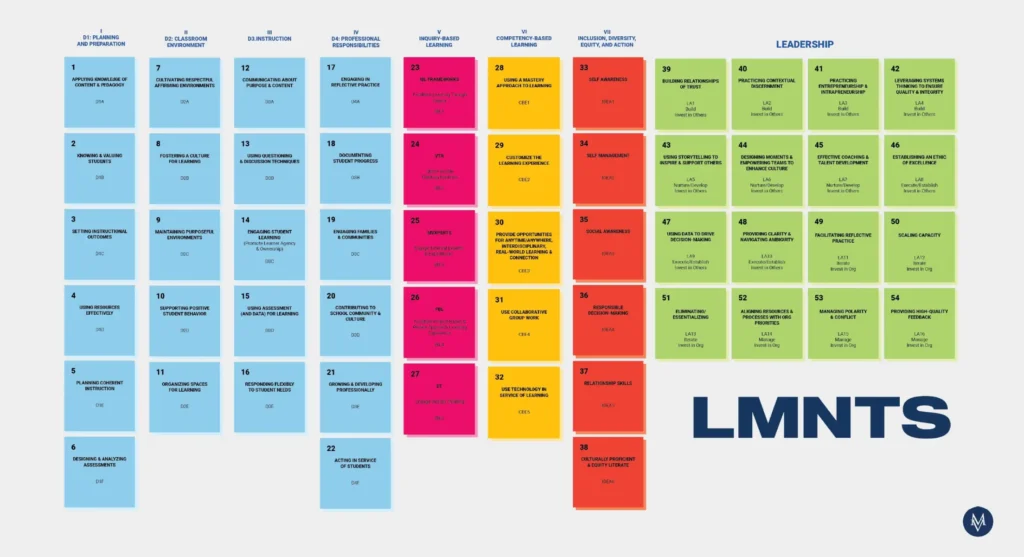
In September, every teacher at The Mount Vernon School in Atlanta sits down with their supervisor and opens something that looks, at first glance, like a periodic table. Not of chemical elements, but of professional competencies. Teachers choose the “elements” they want to grow in, and over the course of the year, they build living portfolios that document how those competencies evolve in practice.
In most schools, teacher evaluation and professional development run on parallel tracks that rarely intersect. A supervisor observes a lesson, completes a rubric, and writes a report. The teacher reviews it, may or may not find it actionable, and moves on. Meanwhile, professional development happens separately – through workshops, guest speakers, or the occasional conference – often disconnected from the evaluation in timing, language, and purpose. The result is a system that struggles to drive meaningful growth.
“All schools suffer with the same problem when it comes to teacher evaluation,” Jennifer Santi told me. “We hover somewhere between compliance and the idea of getting better. We were trying to solve for what does it truly mean to be an effective teacher and the answer is not a compliance checklist.”
Mount Vernon set out to replace this entirely. Now, administrators do not write evaluations about teachers. Teachers write their own. They choose their focus, curate their evidence, and build the case for their own growth. Administrators only respond.

One map for everything
Mount Vernon began this work by asking a simple question: could a single competency framework serve as the common language for hiring, professional development, evaluation, and compensation, all at once? Most schools have four separate answers to that question. Mount Vernon wanted one.
The answer they built is called LMNTS. It draws on the Danielson Framework’s four domains – Planning and Preparation, Classroom Environment, Instruction, and Professional Responsibilities – and pairs them with three domains native to Mount Vernon’s own identity: Inquiry-Based Learning, Competency-Based Education, and IDEA (Inclusion, Diversity, Equity, and Action). Together, these seven domains form a competency map that teachers and administrators navigate using the same language.
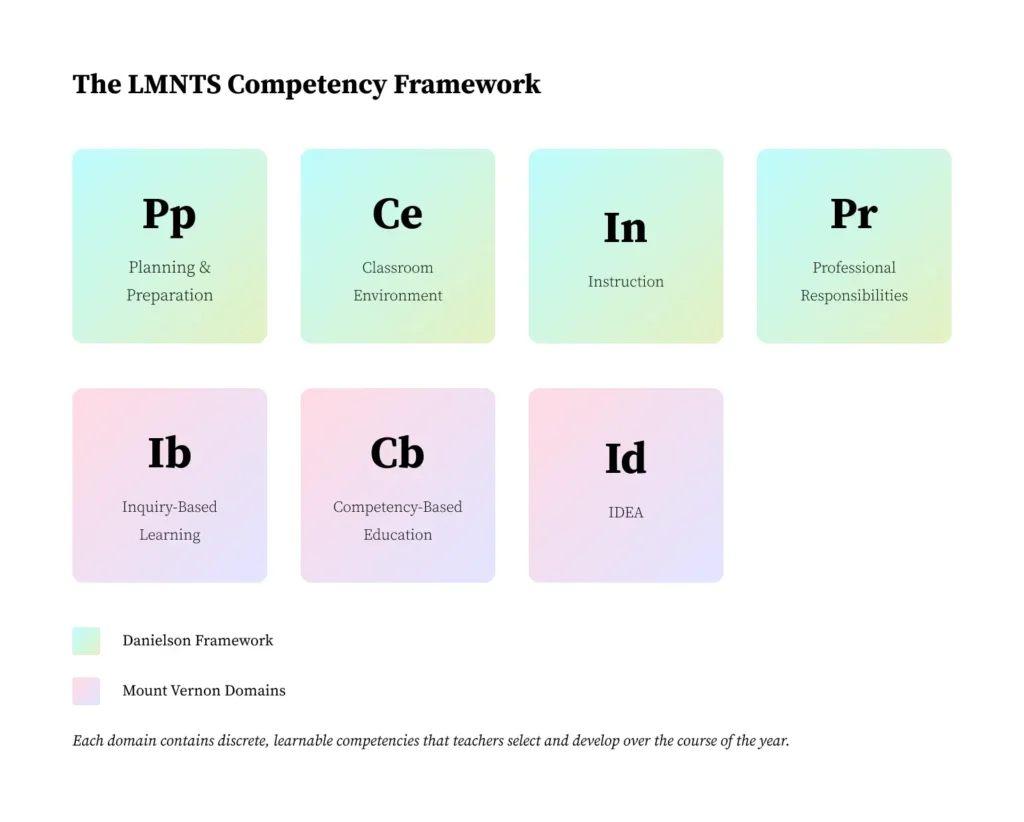
“We wanted to give employees a map of competencies to show them what matters in our organization,” Jennifer said, “and then let them choose their own adventure when it comes to developing those skills.”
What makes the map significant is what it does organizationally. The same language that appears in a job posting is the language used when a teacher sets goals, the language a supervisor uses in a mid-year check-in and the language a portfolio reviewer uses to assess distinction. Most schools carry multiple disconnected frameworks – one for hiring, another for observation, another for PD, another for evaluation – each with its own vocabulary. At Mount Vernon, there is one map.

A year inside LMNTS
The annual cycle begins in September, when teachers sit down with their supervisor and select a few competencies to focus on, not all seven, just the ones that matter most that year. Mount Vernon calls it “superpowers and kryptonite”: two areas where you’re strong, and two where you want to grow.
From there, teachers build living portfolios. Teachers submit artifact reflections: a unit plan showing how their curriculum evolved toward inquiry-based design, a video clip from a lesson demonstrating a new questioning technique, a slide deck from a conference presentation, student survey data showing shifts in how learners describe their own experience.

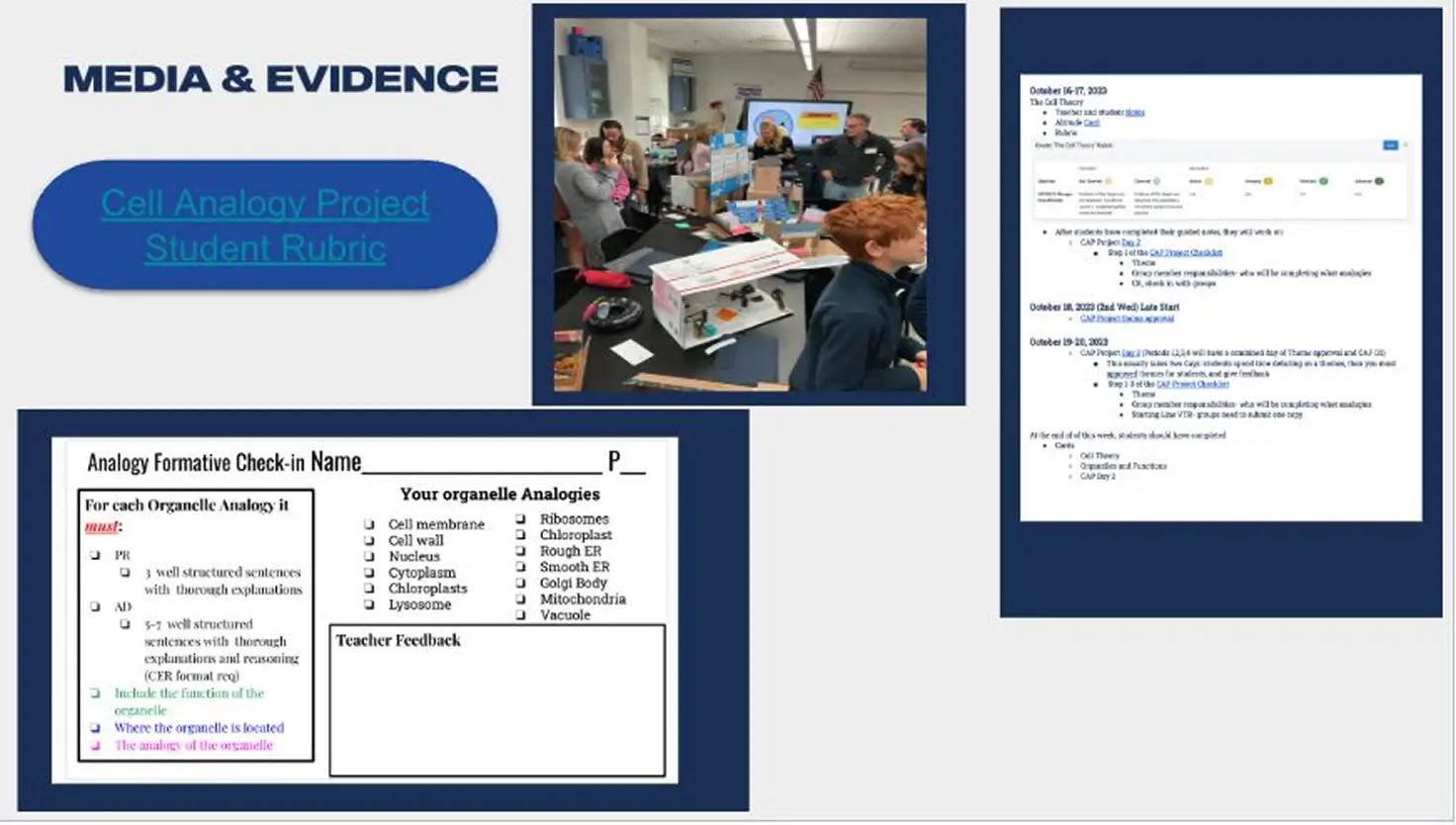
Three times a year, teachers have formal check-ins with their supervisors. The mid-year conversation is structured around evidence: teacher and supervisor review linked artifacts together and discuss where development actually stands. The teacher arrives having already self-assessed; the supervisor responds. It’s a collaboration, not an audit.
“I changed my conversations drastically,” Jennifer said. “We were able to really get into some finer elements of teaching and learning.” The competency map gave both sides a vocabulary precise enough to make feedback specific. Not just “keep growing” but which element, what evidence and where next.
Evidence without blame
Running alongside these formal conversations are two non-evaluative practices: Learning Walks and Instructional Rounds. In a Learning Walk, a teacher visits colleagues’ classrooms and writes reflections – it’s an individual act of noticing and learning from others. Instructional Rounds are collaborative: a teacher identifies a specific challenge they’re working through and invites a group of peers to observe with that lens. The group then provides collective feedback focused entirely on what the teacher asked them to look for. Critically, none of this data is routed to formal evaluation. It goes to the teacher – as material for reflection and portfolio development. This distinction matters. When observation data feeds evaluation, teachers have every incentive to hide difficulty. When it feeds learning instead, they surface struggle and document the process of working through it.
“It’s a different audience, and so there’s a different level of safety,” Jennifer explained. “With a peer, you might be more open to saying, ‘Hey, I just totally messed this up and I don’t know what I’m doing.'”
Teachers also participate in RDI (Research, Development, and Iteration) teams – small groups that tackle school-wide strategic priorities by researching a problem, prototyping solutions, and refining them over time. A teacher’s RDI project can become a portfolio artifact, meaning institutional goals and individual growth reinforce each other rather than competing for the same time.
Formalising growth

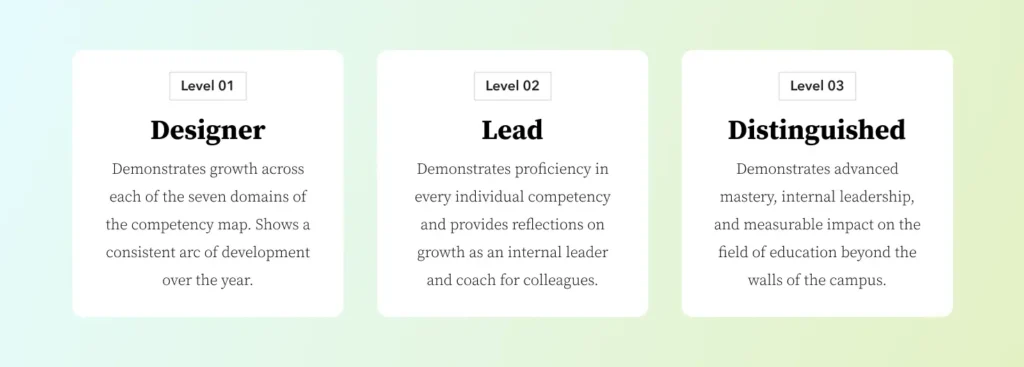
The living portfolio sits at the core of how teachers grow at Mount Vernon. From their third year onward, teachers can choose to take that growth further through MOVEE (Mount Vernon Employee Excellence), an optional distinction program where they formally submit their portfolio for review by an eight-member Portfolio Review Committee and two Faculty Advisors.
MOVEE has three levels of distinction. A Designer demonstrates growth across each of the seven domains and shows a consistent arc of development over the year. A Lead demonstrates proficiency in every competency and reflects on their growth as an internal leader and coach. A Distinguished instructor demonstrates advanced mastery, internal leadership, and measurable impact on education beyond the campus.
Each level carries a monetary incentive, and Distinguished instructors earn a three-week sabbatical with a professional learning stipend.
The connection to pay was introduced only after running the portfolio system without it for several years. Mount Vernon had studied performance-based and merit-based pay programs and found that when compensation is tied to evaluation too early, the process becomes an exercise in checking boxes. By keeping the focus on professional development first and introducing monetary incentives later, they ensured that the system stayed rooted in learning rather than reward.
The sequencing here was important. MOVEE did not create the culture of portfolio reflection – it recognized it. By the time compensation entered the picture, teachers already understood the value of the process. And when Distinguished instructors are celebrated at an annual distinction ceremony, it marks growth that has genuinely happened, not performance calibrated for a reward.
In the first year, forty-six employees voluntarily submitted portfolios – nearly half of all eligible staff. No mandate drove that number. The rest weren’t opting out of growth; many had new children, family commitments, or were directing their energy toward coaching sports or directing plays. They remain eligible whenever they’re ready.
Jennifer told me that the most telling signal for her was when she heard a teacher say, “When I go up for MOVEE again in three years…” It means teachers are not completing a requirement. They are planning a professional trajectory inside the institution.

The design choice
The LMNTS model was designed to mirror the choice-based, inquiry-based approach that Mount Vernon uses with its students, extending it to faculty and staff. In the same way that student learning focuses on levels of proficiency, their model emphasizes the development of skills rather than simply assigning a score. It reflects a specific institutional belief: that teachers are capable of more self-direction than most schools grant them.
The risk of this approach is real: some teachers may choose the comfortable path. But the risk of the alternative – a mandatory, supervisor-authored evaluation cycle – is less visible but arguably greater. Teachers can spend entire careers in systems that have no shared language for good teaching, no coherent path for developing it, and no connection between individual growth and the direction of the school.
Jennifer told me about a teacher she hired a few years ago to teach math. He did not have a math background. “That one was just a gut hire on my part,” she said. Through LMNTS, he had specific competencies to work toward and a way to measure his own growth. Three years later, he submitted for MOVEE and went up a whole level. She told me about another teacher, “my curmudgeon,” she called him, “my grumpy guy,” skeptical of institutional initiatives and hard to please. Through LMNTS, he grew into a leadership role he probably never saw coming. “All he needed,” Jennifer said, “was somebody to see him and hear him and give him the confidence he needed.“
Each September, teachers open the map and choose their elements. Over the course of a year, they build the evidence. Some submit for distinction. Many more carry the practice forward regardless.
What other schools can take from this
Few schools will replicate Mount Vernon’s model in full. A dedicated R&D team, five years of iteration, and a 54-competency periodic table are not where most schools can start. But the design questions Mount Vernon answered are ones every school faces: Does your school use the same language for hiring and professional development? Do teachers have any authorship over their own growth narrative? Does observation data feed evaluation or learning?
For a system like this to work, three foundational conditions need to be in place:
- The first is culture: teachers and administrators need to trust that evidence is for learning and that surfacing struggle won’t be held against them.
- The second is time: Mount Vernon guarantees every teacher a planning period each day, professional learning every Tuesday, and dedicated RDI sessions every other month, A system built on reflection requires actual space to reflect.
- The third is resources: Budget must follow intent. PD requests are tracked, conference attendance is distributed equitably, and division heads make deliberate decisions about where funds go.
Without all three, the portfolio system would be a set of forms with no life in them.
The lowest-cost change is also the most powerful: separating observation feedback from formal evaluation. When teachers know that a classroom visit is designed to help them, not rate them, the quality of what observers see changes- and so does what teachers are willing to try.
The broader question for school leaders is not whether to build a periodic table of competencies. It is whether the way teachers are currently evaluated reflects the kind of growth the school claims to believe in.
PS: Mount Vernon built this system over five years with a dedicated R&D team – something most schools don’t have. If you’re interested in exploring a similar approach, their consulting arm, Mount Vernon Ventures, works with schools around the world to help design these systems. You can reach them at mvventures.org.