Every morning, a teacher at UWC South East Asia puts out fewer tricycles than there are children.
Six-year-olds at UWCSEA have to queue. They have to wait while another child rides. “They have to understand,” Nick Alchin, the school’s Head of College, told me, “someone else deserves their turn just as much as I do.”
It would be easy to read this as a lesson in patience or sharing. UWCSEA reads it as the first lesson in service.
At most international schools, service arrives in the secondary years: a CAS requirement, a charity drive, a volunteering trip abroad. At UWCSEA, it is a subject in the full sense, with a K-12 curriculum for service, sustainability and peace that maps conceptual progressions, skills and knowledge outcomes year by year. The range runs from the child learning to wait for a trike to the Grade 12 student learning to facilitate dialogue between young people divided by conflict.
From service to service learning
UWCSEA has run some form of service since it opened in Singapore in 1971. What it has spent recent years doing is something more precise: building a curriculum for learning how to serve. And it starts with a distinction between doing service and service learning.
“If you’re doing service, you’re finding someone to serve, and you’re going to serve them, whether they want it or not,” Nick Alchin said. Even with good intentions, the student who arrives at an old people’s home with a prepared list of activities has already decided what is needed before listening to anyone.
Service learning starts differently. “You’ve got to find a client,” Nick said, “and don’t tell them what you’re going to sell them. See what they want to buy. You go in trying to understand the person in front of you, not to fix their problem, but to find out what they actually want, and what role, if any, you can play in it.”
Three stages of service
UWCSEA has built its service progression from kindergarten to Grade 12, with conceptual outcomes at each stage and a framework that is reviewed every few years.
The framework runs three stages.
In the primary years: noticing. A six-year-old is not ready to investigate systemic inequality. But she can begin to register that other people have perspectives and needs unlike her own, and that those perspectives carry equal weight. In our daughter’s Kindergarten class, a Grade 12 student from another school who used a wheelchair spent a week learning alongside the children. The service learning was in the small acts of attention: noticing that the furniture needed to move, working out how to communicate with him, building a relationship on his terms.
In the middle years: action. Students begin to develop agency. They find organisations to work with, fundraise, visit service partners regularly, connect a cause they care about to concrete work.
In the senior years: systems thinking. Students begin to examine the larger conditions surrounding a need, including their own position within those systems. “You want them to say: I am part of this system. What role does that give me to change it?” Nick said.
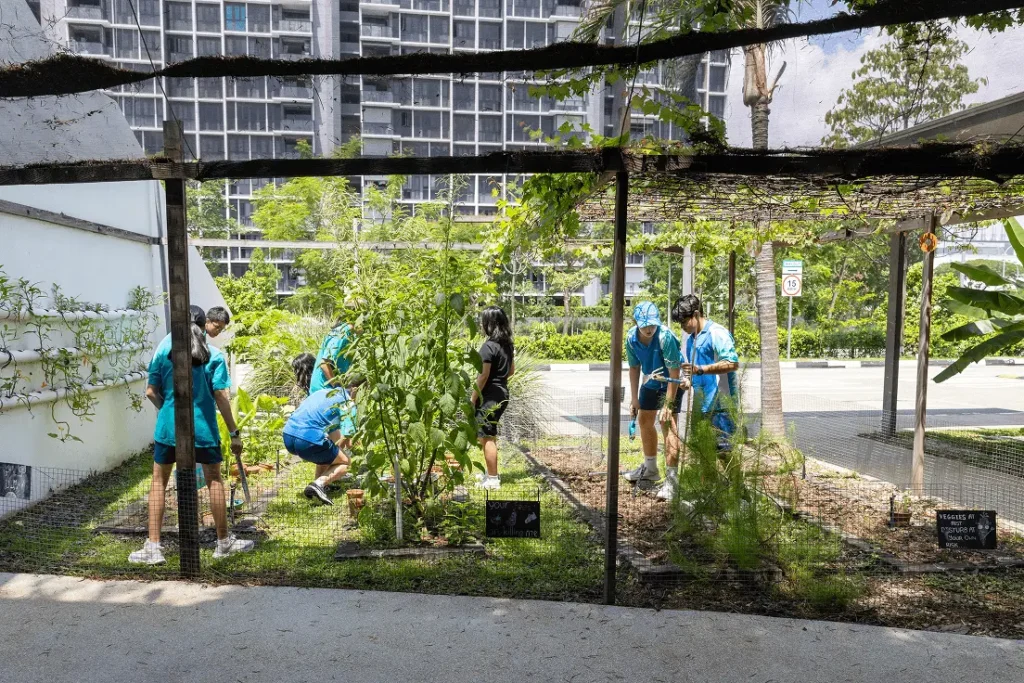
Grade 2: Sustainable food choices
One example of how this works in practice: the Grade 2 Sustainable Food Choices unit.
Students begin with cards representing 30 everyday items and narrow them to the 12 they consider essential human needs. They evaluate their own packed snacks and trace the decisions behind them. They visit a local supermarket with a $4 budget. They turn their classroom into a Hawker Centre. They visit the campus garden across the year and care for UWCSEA’s chickens: feeding them, collecting eggs, maintaining the enclosure.
The unit culminates in research groups investigating popular Singaporean dishes, rating their sustainability, and publishing a collective Sustainable Food Guide to the campus digital library. Anyone in the community can access it and use it.
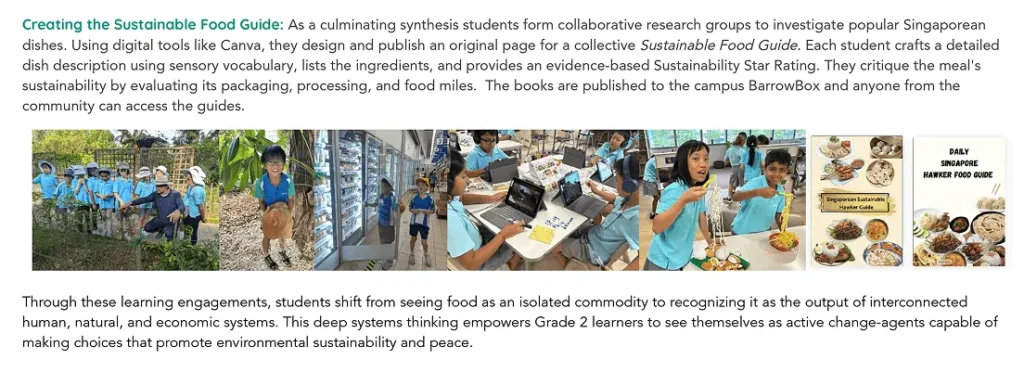
The unit sits in the Humanities block. But the conceptual understanding it builds, that parts of a system depend on each other and that people can make choices that support sustainable outcomes, runs directly from UWCSEA’s service, sustainability and peace curriculum.
A seven-year-old who understands the supply chain behind her school canteen lunch is not yet a systems thinker. But she is starting to see herself as someone with a position inside a system, and a choice about what to do with it.
Project Fuxi
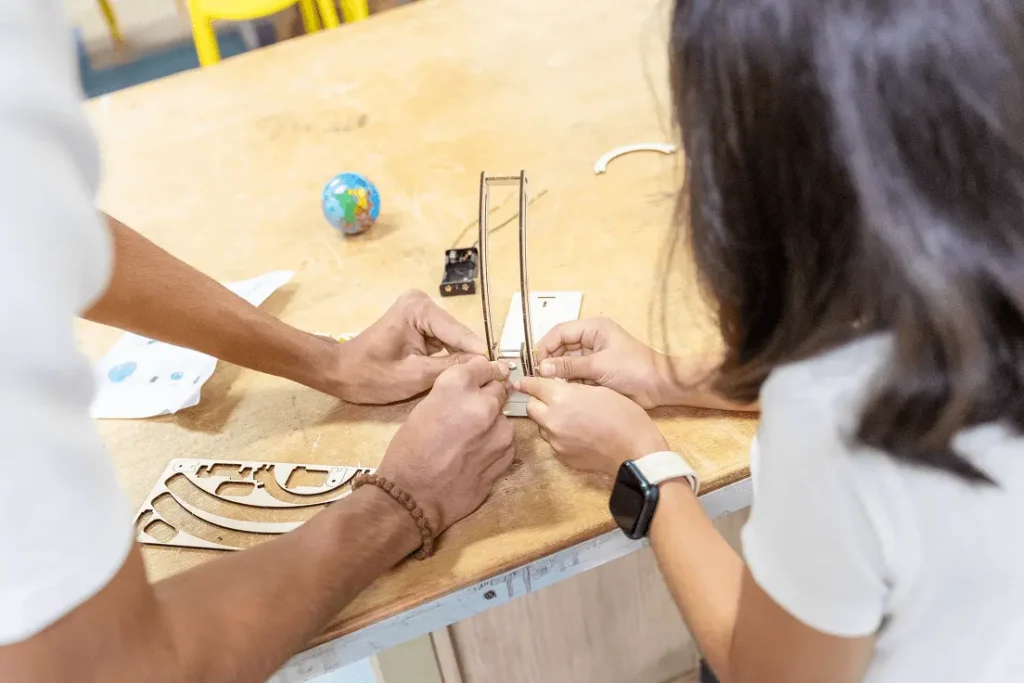
In the senior programme, service takes a different shape.
A group of UWCSEA students started visiting Apex Harmony Lodge, a dementia care facility in Singapore. They played music for patients. Some patients with advanced dementia could not respond to conversation. Music sometimes reached them, but only the right music. Contemporary pop was unlikely to connect with an elderly Chinese patient whose memories were tied to a different time and musical tradition.
So students started researching.They needed to work out which music belonged to which patient’s life, and then get hold of it legally. They contacted Spotify about playlists. They hit copyright issues and worked with lawyers to navigate them. They built a system for playing patient-appropriate music and monitoring responses. Then they noticed that not all patients could respond externally, and started exploring how to detect internal responses. Were patients reacting to music even when they could not show it?
They partnered with the National University of Singapore and explored EEG technology that could identify which music a patient responded to, even when the patient could not communicate it outwardly. The project combined music, coding, AI, data analysis, and links to existing music libraries. It became known as Project Fuxi and earned a President’s Award.
Nick does not point to this as an exceptional outcome. He points to it as an illustration of how service is supposed to develop. “They started by showing up. They noticed a need within a need. They drew on what they knew, engineering, neuroscience, design, and found people who knew more. The service kept expanding because they kept asking what else was possible.”
The Initiative for Peace
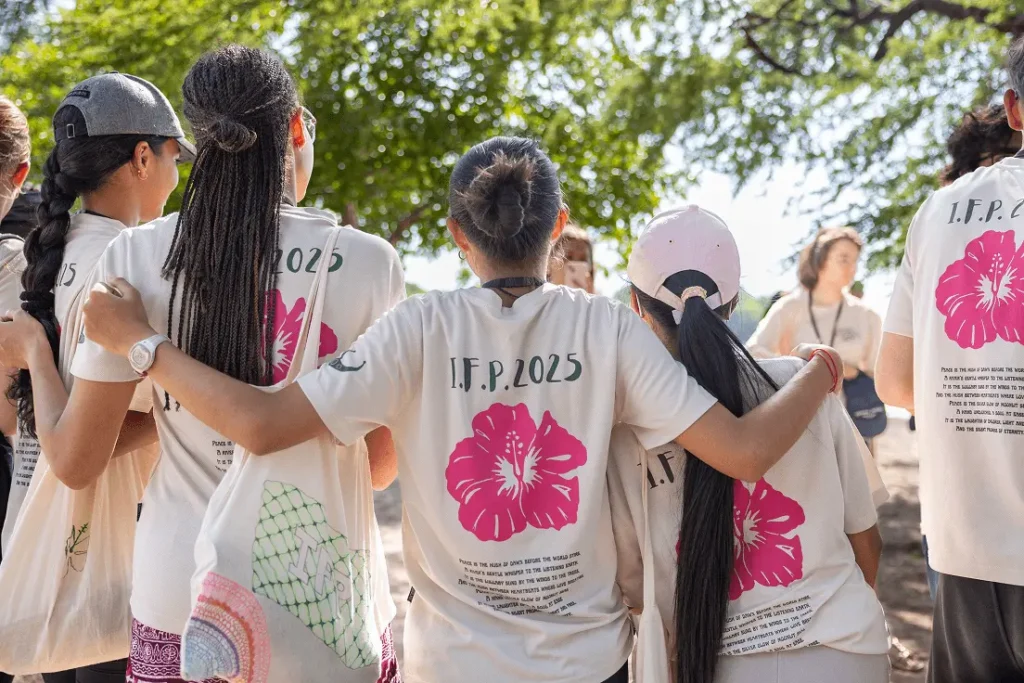
The Initiative for Peace shows the same progression in a different setting.
Founded by UWCSEA students and teachers in 2001, the programme trains students in the theory and practice of peacebuilding before asking them to design and facilitate dialogue themselves.They study peace, conflict and violence, learn how to hold difficult conversations, and then build a week-long programme for young people from communities divided by active conflict. The aim is not to resolve the conflict for them. It is to create the conditions in which they can meet one another as full human beings with perspectives worth understanding.
Since 2001, the programme has engaged young people from Kashmir, Pakistan, Timor-Leste, Sri Lanka, Cambodia and Thailand. In one session in Thailand, UWCSEA students worked with refugees, former child soldiers and local youth: three groups in active conflict, forty people sharing one room for a week. The students had to do more than host an event. They had to prepare the dialogue, read the tensions in the room, and help participants stay in conversation when it became difficult.
Students who learn to facilitate the programme sometimes carry it elsewhere. One alumnus is now running the Initiative for Peace in Sudan, in the middle of active tribal conflict. “His ambition is to bring peace to Sudan,” Nick told me.
What makes it last
UWCSEA’s greatest design tension is whether to mandate service or leave it open. Mandate too much, and service becomes an obligation. Leave it too open, and the programme lives or dies on individual students’ enthusiasm, and disappears when they graduate.
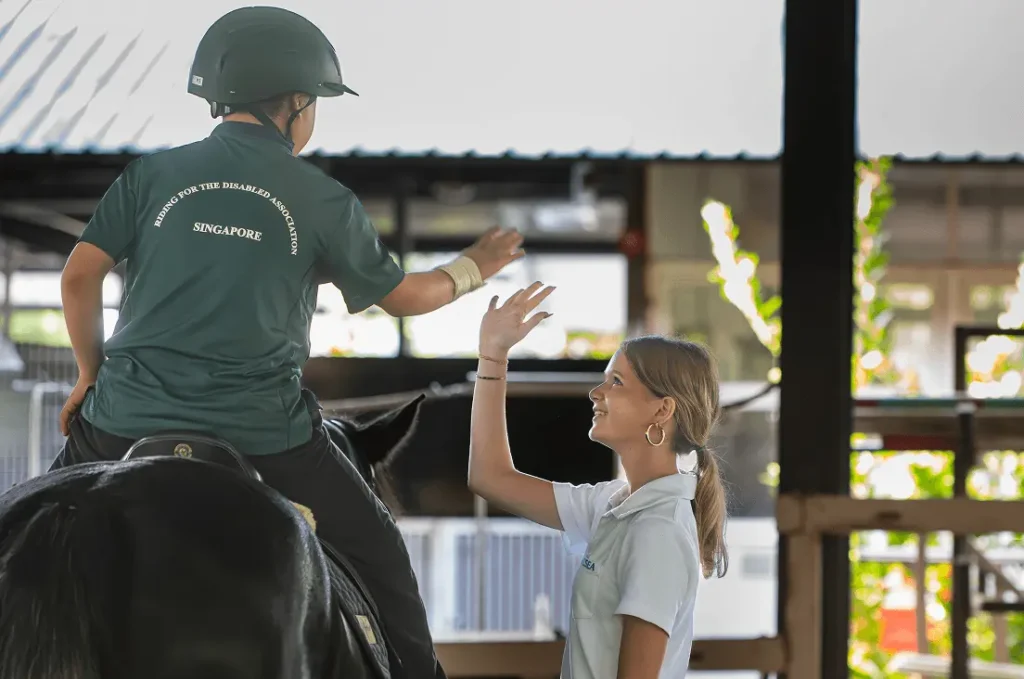
Their answer is to build the conditions for students to lead service well. UWCSEA runs two campuses in Singapore, Dover and East. Each has four or five staff dedicated solely to coordinating service, and service responsibilities are written into every teacher’s contract. Dozens of student groups meet each week, each connected to a real partner organisation. Students decide what to do and own the work, but they do not have to conjure it from nothing each year. Before a student leader graduates, they work with a member of staff to identify the next one, and to pass the baton on. By making a good handover, continuity is assured.
UWCSEA’s partnership with Lamdon School in Ladakh, India shows what continuity looks like in practice. Lamdon combines formal education with a deep commitment to Ladakhi culture, and each year a UWCSEA cohort travels there to meet and learn alongside Lamdon students. Each cohort arrives not to invent a new project, but to inherit a relationship built by those before it and carry it forward.
Students lead the work. The institution makes it last.
The school currently has 6,030 students across two Singapore campuses, Dover and East, from 117 countries. Keeping service alive, at that scale, across 13 years of schooling, is less a programme management challenge than a culture one.
Three questions for school leaders
The design of UWCSEA’s service programme will not transfer as is into your context. What transfers is the set of questions underneath it, and each one is worth asking of your own service programme.
Are students learning to listen before they act? Service learning begins with understanding the people in front of them before deciding how to respond. If students arrive with solutions, the work has not started.
Does the learning deepen with age? If you cannot say what a 12-year-old should understand about service that a seven-year-old does not, you have activities rather than a curriculum.
What keeps the work alive when its leaders leave? If a partnership ends when the student running it graduates, the programme is resting on individuals. Protect time, maintain partnerships, and distribute responsibility so the work does not depend on a handful of committed people.
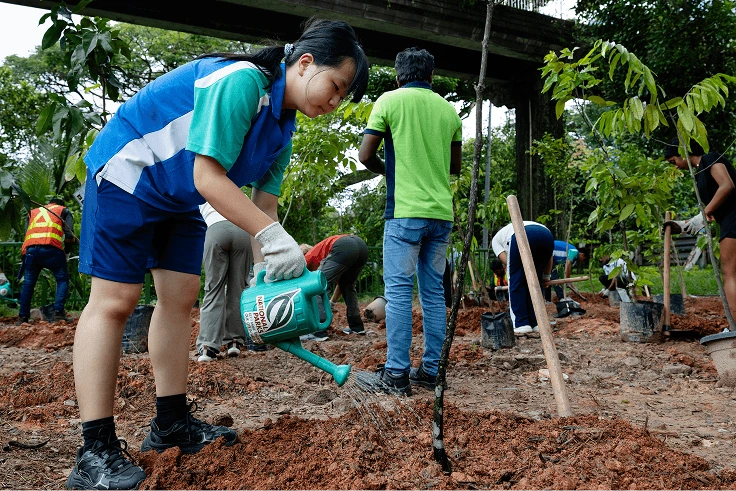
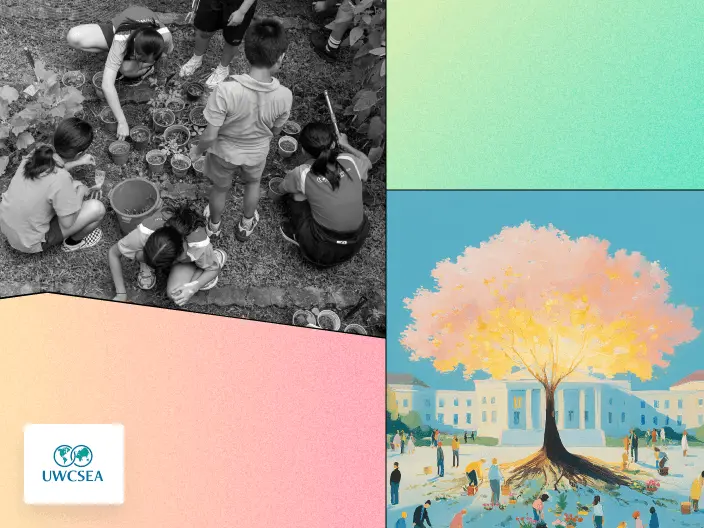
“I believe the meaning of life is to plant seeds of trees under whose shade you will never sit,” Nick told me.
The real measure of the service learning curriculum lies beyond the years the school can observe directly. Nick will never know the outcomes for most of the students that UWCSEA shapes. But the ones he does know about are telling: the alumnus now running peace programmes in Sudan, the former student teaching underprivileged children, the one greening Mumbai through eco-lodges. All of them, he says, are making it happen somewhere.
At UWCSEA, it all begins with a trike in the playground.