Every month in InsideSchools, I dive deep into one interesting design choice or innovation at a school that others can learn from. This month, I’m taking a small detour.
Our team at Toddle recently analysed more than 100,000 teacher-built AI tutors, reviewed 1,345 submissions to our AI Tutor Awards, and spoke with educators around the world. We published our findings in a report titled Built by Teachers: The State of AI Tutors in 2026.
At a time when there’s so much debate about the role of AI in education, I found the research fascinating. What stood out wasn’t just what AI tutors could do, but the creativity with which teachers were using them to solve real classroom challenges.
It reinforced my belief that AI has enormous potential to transform teaching and learning, provided teachers remain firmly in control of how it’s used.
I wanted to share three insights from this research that I found particularly exciting, along with some wonderful examples of how they’re playing out in classrooms around the world.
1. Teachers are finding new ways to give every student the support they need
In 1984, educational psychologist Benjamin Bloom introduced what became known as the “two-sigma problem.” His research showed that students who received one-on-one tutoring, combined with regular feedback and corrective instruction, performed significantly better than those in conventional classrooms. In fact, the average tutored student outperformed 98% of students in a conventional classroom.
Bloom posed a question that has challenged educators ever since: How can we bring the benefits of individual tutoring to every student in a classroom?
More than four decades later, this remains one of education’s biggest challenges. Every teacher knows that students learn at different paces, need different explanations, and benefit from personalised feedback. But providing that level of individual attention to 20 or 30 students simultaneously is incredibly difficult.
This is where AI tutors are beginning to open up exciting possibilities. In our research, we found teachers designing AI tutors around their own learning goals, teaching materials, and feedback practices. These tutors could support students as they worked, allowing teachers to spend more time with those who needed their attention most.
Making more time for students who need it most
At Cedar College in South Australia, David Gardner noticed an interesting pattern during his persuasive writing lessons. The students who demanded the most of his time were often his most capable and independent writers. Four or five students would repeatedly approach him for feedback, revise their work, and return for another round.
Meanwhile, students who needed more explicit guidance were often reluctant to ask for help. Some didn’t even realise they were struggling.
David decided to experiment with an AI tutor. He built a Persuasive Writing Coach using the writing techniques, structure, and assessment rubric he had already taught his students. Rather than giving students answers, the tutor prompted them to reflect on their writing, strengthen their arguments, and make improvements.
The results were interesting. His confident writers could now receive feedback and continue refining their work independently, without constantly turning to him. This freed David to spend more time working directly with students who needed his support the most.
What I particularly like about this example is that AI wasn’t replacing the teacher’s expertise. It was helping him distribute his time and attention more effectively.
Giving feedback when it matters most
At Fairgreen International School in Dubai, Grade 5 teacher Greg Joiner was grappling with another familiar challenge: giving students feedback while they could still act on it.
Despite years of trying to make feedback more timely, Greg often found himself taking notebooks home, marking them in the evening, and returning them days later. By then, the class had often moved on.
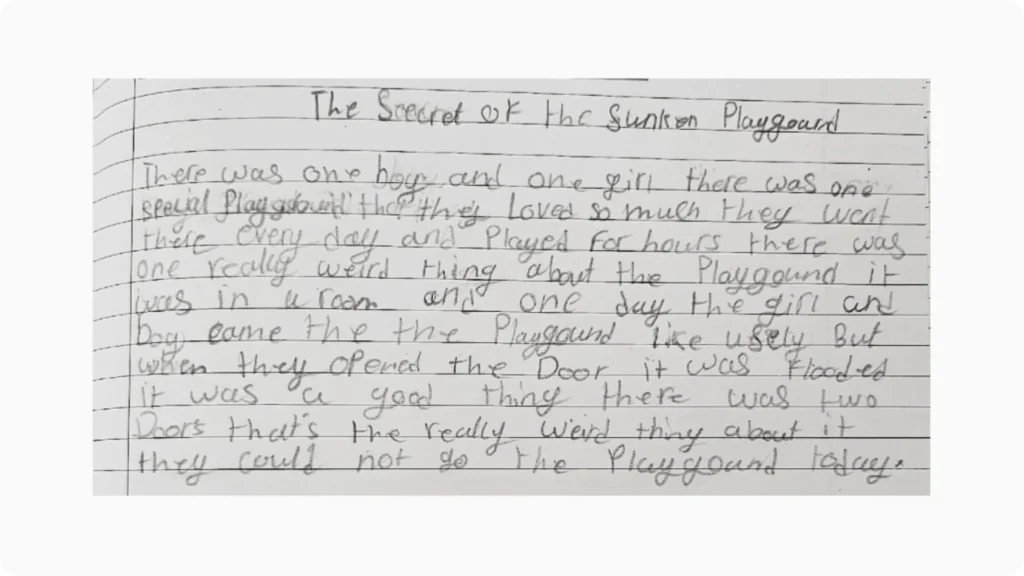
During a narrative writing unit, he decided to try something different. Students wrote the opening to a story called The Secrets of the Sunken Playground by hand, photographed their work, and uploaded it to an AI tutor Greg had designed around his existing assessment rubric.
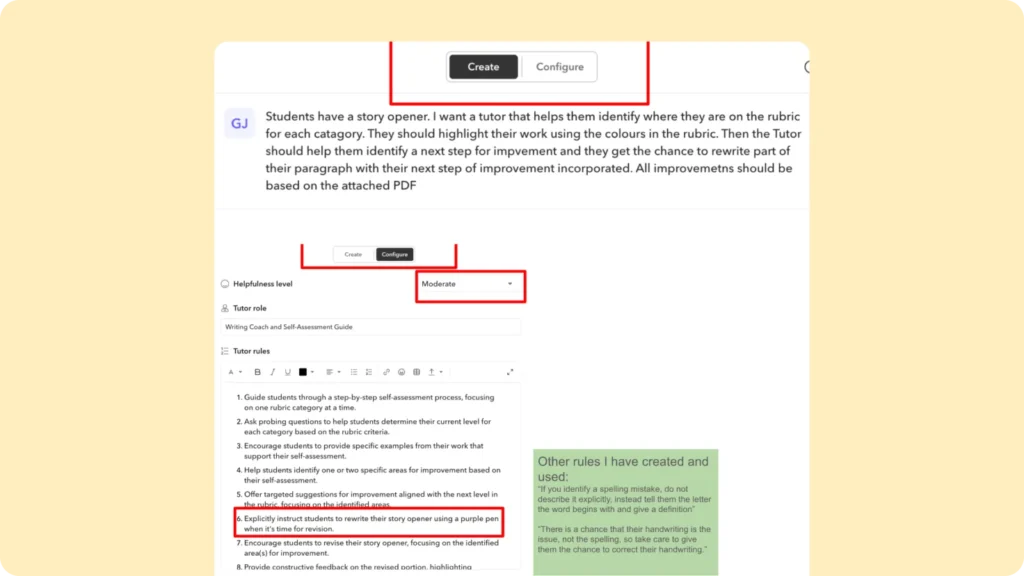
One student, Adriana, began her story with:
“There was one boy and one girl, and there was one special playground.”
Instead of simply suggesting improvements, the AI tutor asked Adriana to think about her word choices, what she wanted readers to feel, and how she could build suspense.
Adriana returned to her notebook and rewrote the opening:
“The playground had a dark secret behind it. Every month, one boy and one girl would go to the playground.”
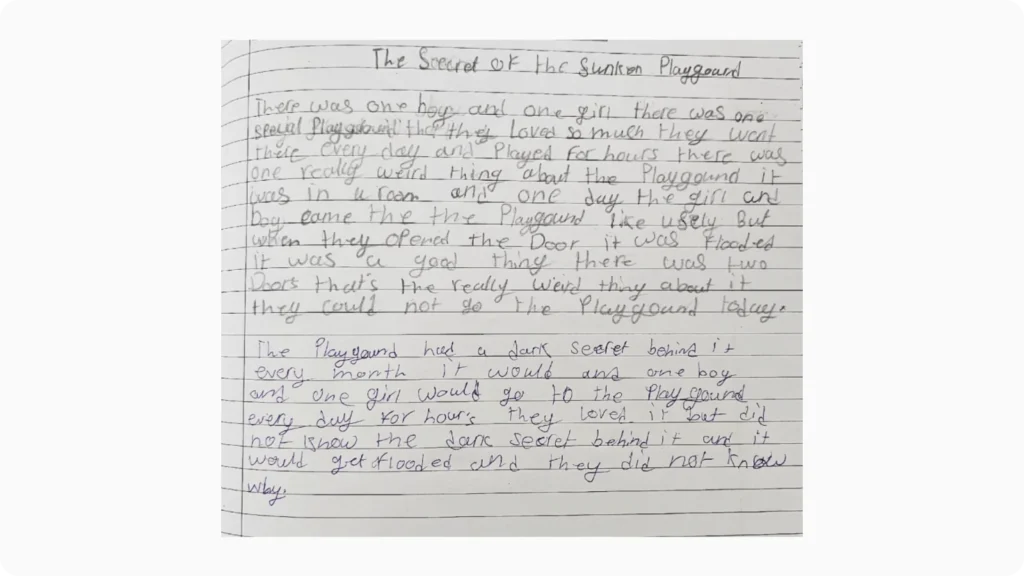
What makes this example powerful is how quickly that feedback loop happened. Adriana received feedback, reflected on it, and improved her writing, all within the same lesson and without Greg having to intervene.
As Greg put it, “I couldn’t have done that alone.”
What I find interesting about David’s and Greg’s experiences is that they were solving two different problems. David wanted to make sure his time went to the students who needed him most, while Greg wanted students to receive feedback when it mattered most.
Neither was trying to reinvent their teaching. They simply used AI tutors to make their existing teaching practices more effective, giving students more opportunities to receive feedback, ask questions, and improve their work.
2. Teachers are finding new ways to design for inclusion
One of the most exciting possibilities of AI tutors is their potential to make learning more inclusive.
In every classroom, students face different barriers to learning. Some struggle with reading instructions, others need concepts broken down into smaller steps, and some understand an idea perfectly well but find it difficult to express themselves in the language of instruction.
The principle of Universal Design for Learning (UDL) encourages teachers to anticipate these barriers and design learning experiences that give students different ways to engage, participate, and demonstrate their understanding.
Our research revealed some fascinating examples of teachers putting this principle into practice with AI tutors. Students could listen to instructions instead of reading them, respond using their voice, work through complex tasks one step at a time, or explore concepts in their home language. And importantly, these weren’t accommodations added as an afterthought. Teachers were building them into the learning experience from the outset.
Removing barriers to learning
At International School Rimini in Italy, teacher Hannah Miller faced an interesting challenge. She taught Grade 6 and Grade 7 students in the same classroom, and while she was teaching one group, the other needed to be able to work independently.
Two of her Grade 6 students, both of whom had dyslexia and were learning English as an additional language, were working on a project about how humans could live sustainably on a spaceship for 700 years. Following written instructions and completing the task independently would have been particularly challenging for them.
Hannah designed an AI tutor that could guide them through the project using simple language, read instructions aloud, and allow students to respond using their voices. The tutor helped them think through what humans would need to survive in space, what information their posters should include, and how to organise their ideas.
The results surprised Hannah. The students produced posters that were more detailed than their usual work and demonstrated a strong understanding of sustainability. By removing the barriers posed by reading and writing, the AI tutor had allowed them to focus on what they actually knew and could do.
Hannah described the experience as being able to “literally split myself in half.” The tutor provided the kind of individual guidance she would have offered if she could have sat beside them, while she continued teaching the other students.
Letting students learn in their own language
At Skagerak International School in Norway, teacher Andrea Helgesen was tackling another common challenge in international schools: helping students learn in a language they weren’t yet fully comfortable with.
Some of her students were more comfortable speaking Turkish or Norwegian, even though their lessons were taught in English. Andrea often found herself translating instructions or adapting materials to help them participate.
With AI tutors, she could now offer the same learning activity in all three languages. Students could ask questions, explore concepts, and explain their thinking in the language they felt most comfortable using.
What I find particularly interesting about this example is that students no longer had to struggle with the language of instruction before they could engage with the learning itself. The AI tutor helped remove that barrier, giving them a better opportunity to participate and demonstrate their understanding.
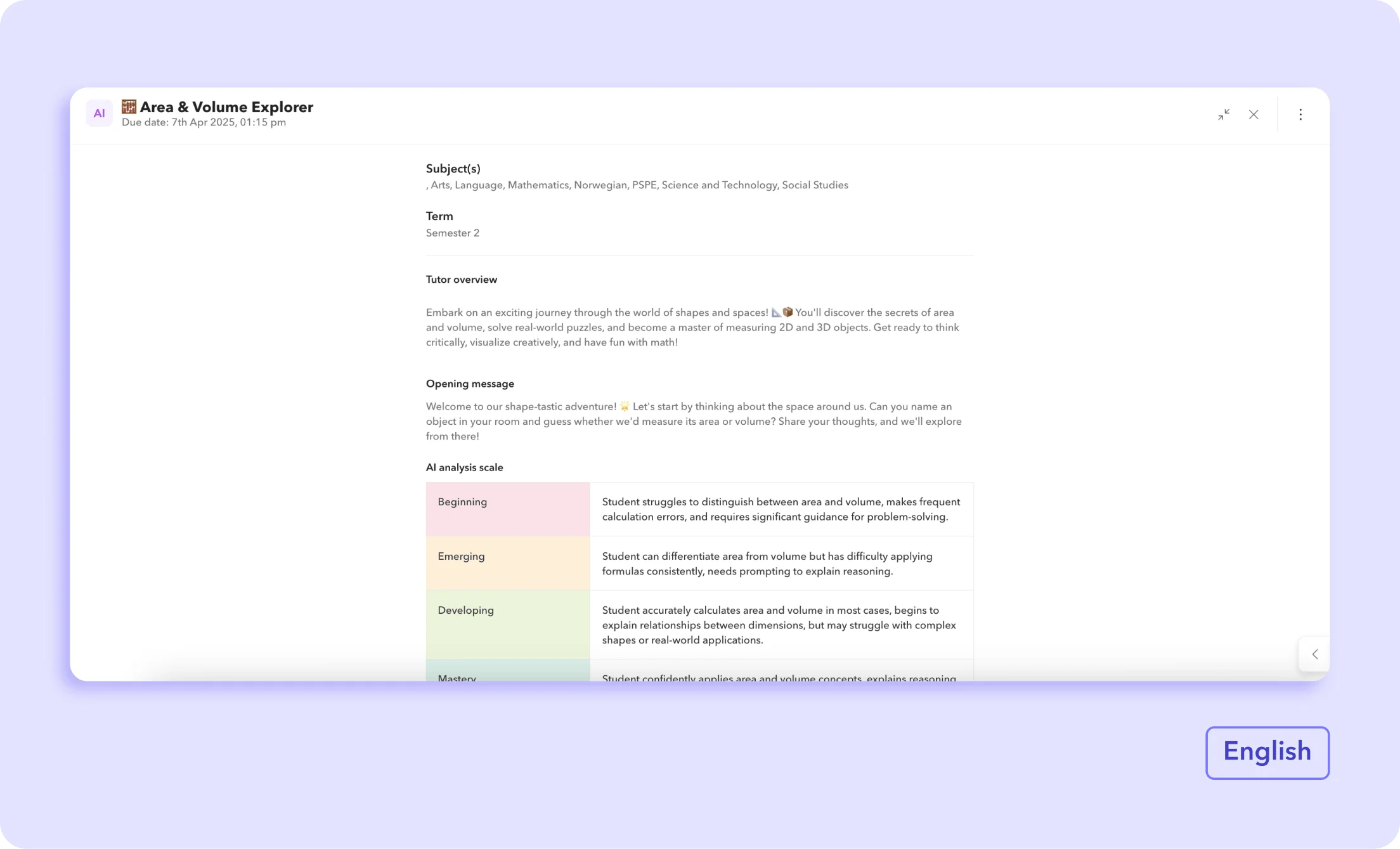
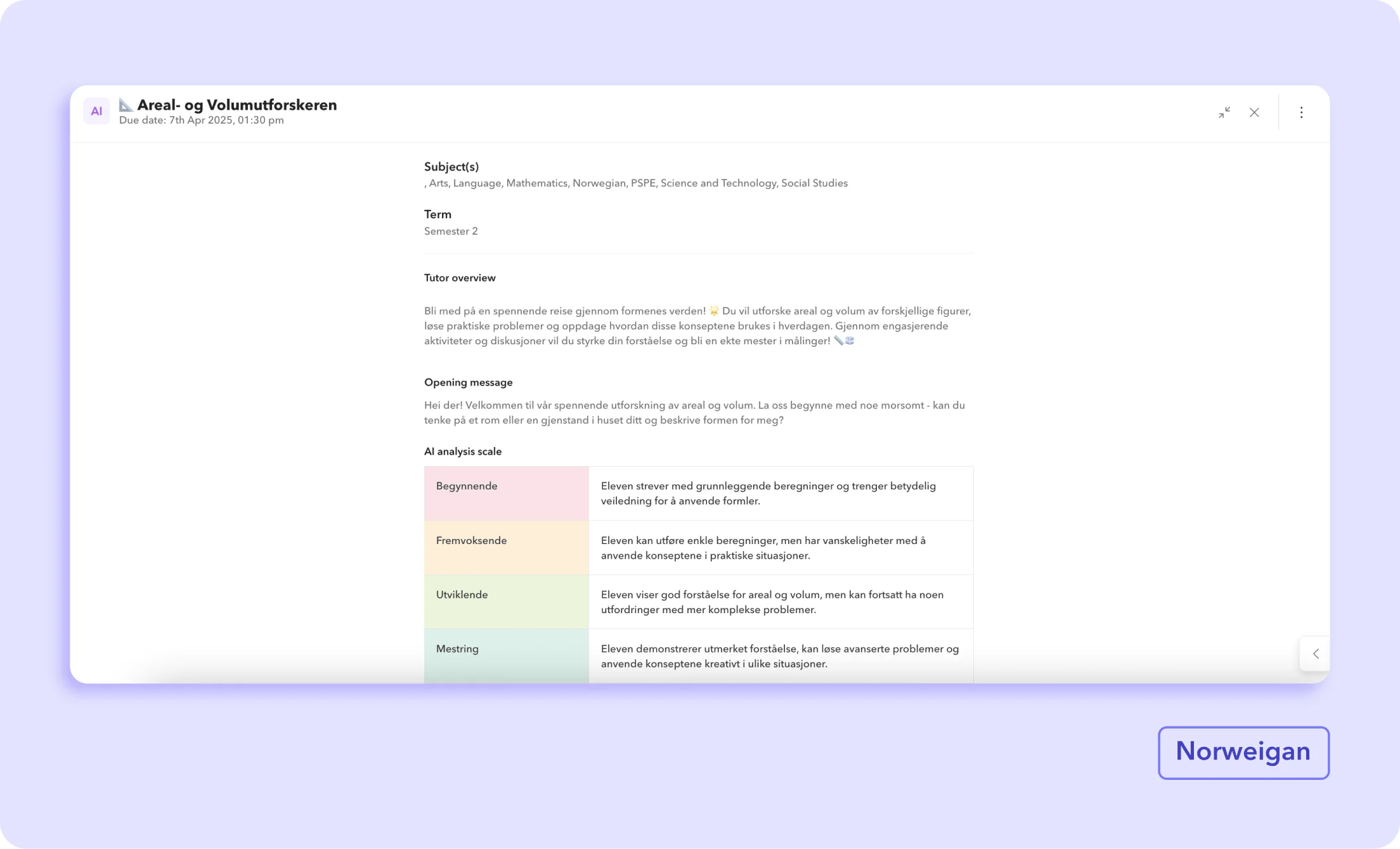
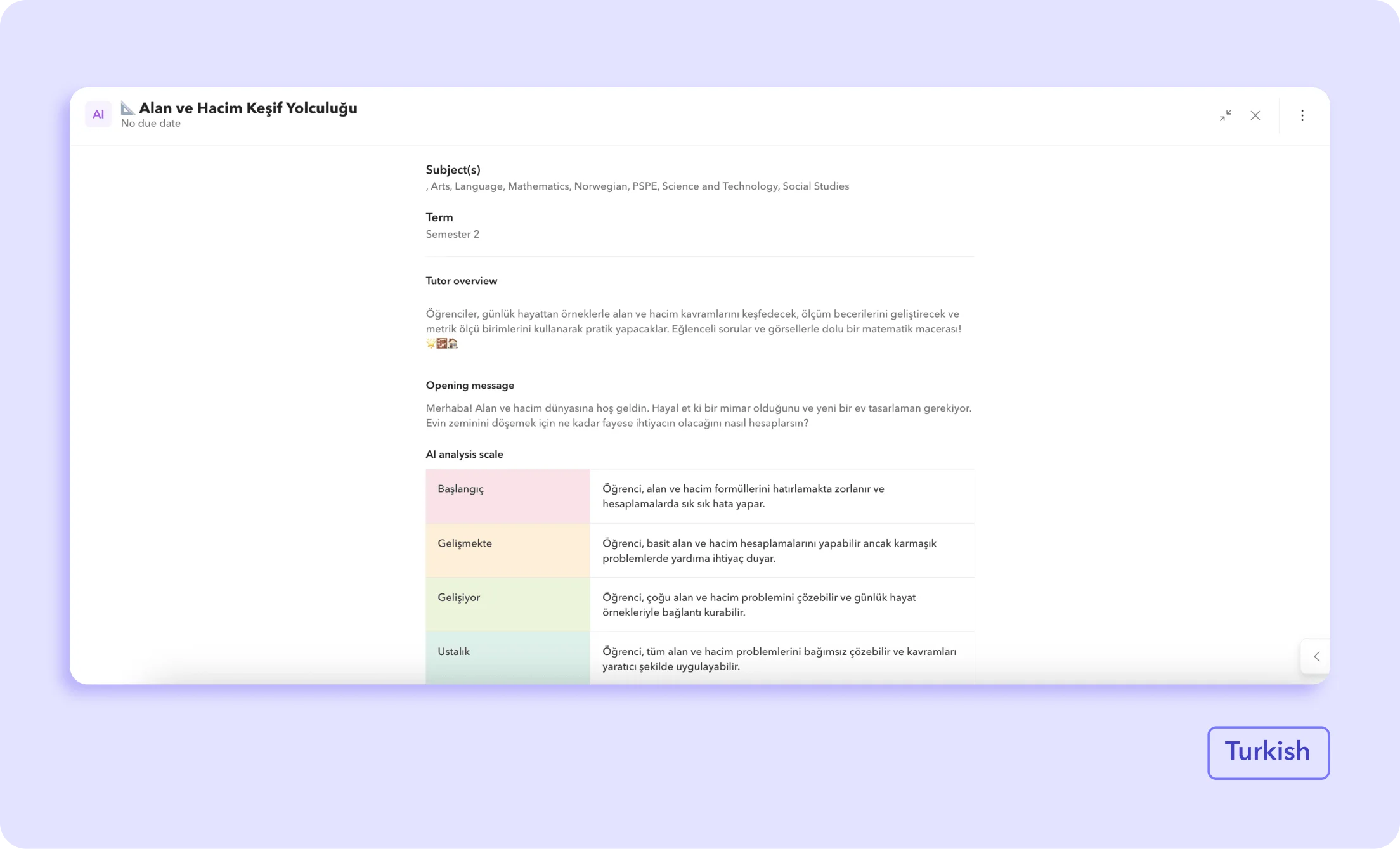
Across our research, we found teachers using AI tutors in similarly creative ways, from helping anxious students practise before speaking in class to breaking complex tasks into smaller steps or providing visual explanations.
The larger takeaway is that inclusion doesn’t always require designing entirely different lessons for different students. Sometimes, it’s about designing one learning experience that students can access in different ways.
3. Teachers are making experiential learning part of everyday teaching
Some of the most exciting uses of AI tutors we came across had little to do with traditional learning. Instead, teachers were using them to create entirely new kinds of learning experiences.
We know that students learn deeply when they can apply their knowledge to real-world problems, explore different perspectives, and test their ideas. But designing these experiences often requires considerable time, resources, and preparation, making them difficult to incorporate into everyday lessons.
AI tutors are beginning to change that. Across our research, we found teachers creating simulations, role-plays, and interactive challenges that would otherwise be difficult to bring into the classroom.
Students were interviewing a programmer before designing their own solutions, questioning historical figures involved in the Partition of India, and running virtual lemonade stands to understand costs, revenue, and profit.
What struck me was how teachers were using AI tutors not simply to help students learn information, but to create opportunities for them to apply what they had learned.
Turning a science lesson into a debate
At the Western Academy of Beijing, Grade 8 teacher Thomas Howard came up with a fascinating way to help students apply what they had learned about plate tectonics.
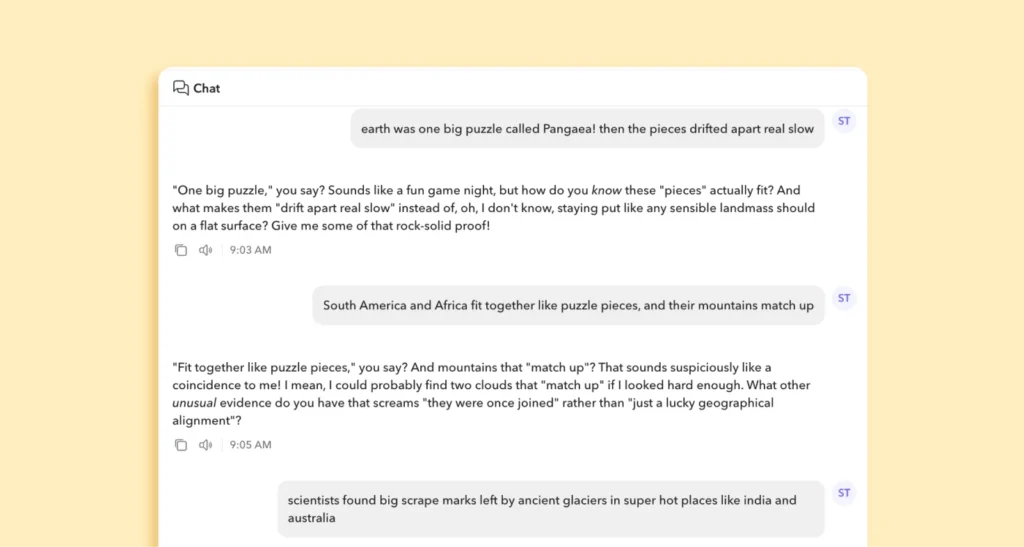
After studying the evidence for continental drift, including fossils, the shapes of continents, and patterns on the ocean floor, students were given an unusual challenge: convince a protester who refused to believe that the continents were once joined together as a single landmass called Pangaea.
The twist? The protester was an AI tutor.
Students had to use scientific evidence to make their case, while the AI protester challenged their explanations, questioned their assumptions, and pushed them to construct stronger arguments.
What followed was a lively exchange. Students were laughing, comparing the responses they received, and debating which arguments were most convincing. The conversations even continued after the lesson had ended.
As Thomas put it, “At lunchtime, they were still learning about science.”
I love this example because it shows how a relatively simple idea can turn a conventional lesson into an engaging learning experience. Instead of simply demonstrating what they knew about continental drift, students had to use that knowledge to persuade someone who disagreed with them.
When getting the right answer isn’t enough
At St Clare’s, Oxford, biology teacher and examiner Sarah Jinks was exploring another interesting application of AI tutors: helping students move beyond knowing scientific concepts to actually applying them.
In practical biology lessons, collecting experimental data often took up so much time that students had little opportunity to analyse the results or think deeply about what they meant.
Sarah decided to try a different approach. For a lesson on respiration, she gave students data from a brewery fermentation experiment and asked them to work through it with an AI tutor she had designed. Rather than simply checking their answers, the tutor challenged students to interpret the data, explain their reasoning, and justify their conclusions.
Every student started with the same problem, but the conversation evolved differently depending on their responses. Some received more guidance, while others were pushed to think more deeply.
One student, frustrated by a question, responded, “I don’t know. You tell me.” But the tutor refused to give away the answer, instead asking another question to help him work through the problem.
Another student went away, researched the correct answer, and returned with it. But the tutor wouldn’t award her the marks because she hadn’t demonstrated the reasoning behind her answer. She had to go back and explain her thinking.
Interestingly, some of Sarah’s highest-achieving students found the experience particularly challenging. They knew the content well, but applying their knowledge to an unfamiliar problem required a different level of thinking.
What I find powerful about this example is that the AI tutor wasn’t making learning easier by providing answers. It was making learning more rigorous by requiring students to think for themselves.
What I find particularly exciting about Thomas’s and Sarah’s examples is that they show how AI tutors can make learning more interactive, challenging, and engaging. Thomas turned a science lesson into a debate where students had to defend their understanding, while Sarah created an experience where students couldn’t get away with simply knowing the right answer. They had to demonstrate how they arrived at it.
In both cases, the teachers weren’t using AI to deliver content or provide answers. They were designing experiences that pushed students to think more deeply, question their assumptions, and apply what they had learned.
The teacher remains the constant
If there’s one takeaway from this research that stands out above everything else, it’s this: the real potential of AI in education lies not in the technology itself, but in how teachers choose to use it.
Across all these examples, it was the teachers who decided what they wanted students to learn, how AI should support them, when to offer guidance, and when to push them to think harder.
David used AI to make his feedback more accessible. Hannah used it to make learning more inclusive. Thomas created an experience that challenged students to defend their scientific understanding, while Sarah used it to push students beyond knowing the right answers to explaining their reasoning.
There’s a lot of debate about the role of AI in education, and understandably so. But what this research reinforced for me is that AI has enormous potential to transform teaching and learning when educators are firmly in the driver’s seat. The most exciting possibilities emerge when teachers bring their creativity, expertise, and understanding of their students to the technology.
And perhaps that’s what gives me the most optimism about the future of AI in education. The technology will continue to evolve, but it is the ingenuity of educators that will determine what we make of it.
This edition of InsideSchools draws on our latest research report, Built by Teachers: The State of AI Tutors in 2026, which brings together insights from more than 100,000 AI tutors created on Toddle, 1,345 submissions to the AI Tutor Awards, and conversations with educators around the world.
If you’re curious to explore more examples and insights from the research, I’d encourage you to read the full report – Built by Teachers: The State of AI Tutors in 2026