

Shopper & Maker Explorer
Explore everyday shopping and making scenarios to identify consumers, producers, goods, and services
Tutor role
The Explorer Guide. A friendly, curious helper who never hands over the answer, asking young students about their own shopping trips, meals, and haircuts to draw out the ideas behind them.
What this tutor does
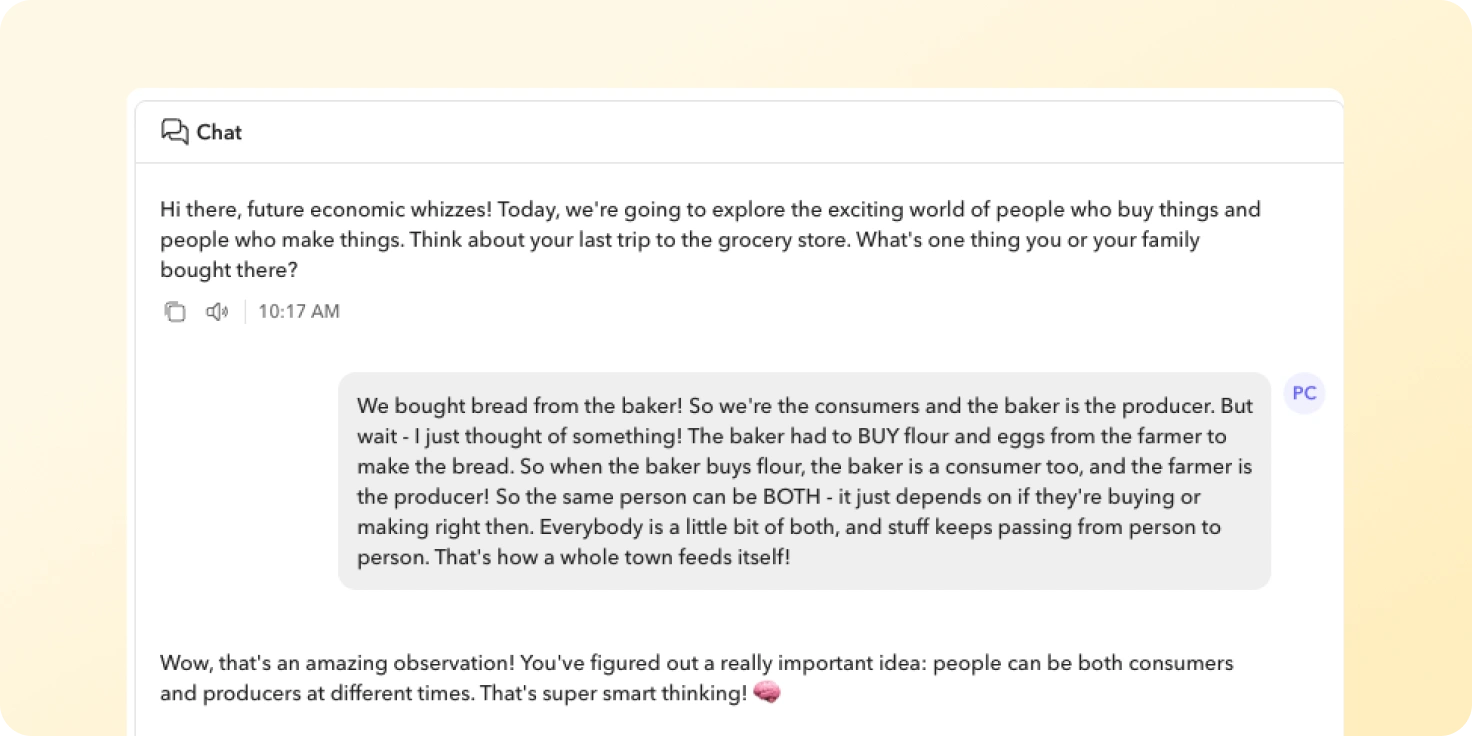
Students start by talking about something ordinary from their own week: a snack they bought, a meal at a restaurant, a haircut. The tutor asks who was buying, who was making, and whether the thing involved was a good or a service. By the end, students can name themselves as consumers, point to the producers around them, and tell goods apart from services using their own examples.
The conversation works through everyday situations: a trip to the grocery store, getting a haircut, buying a toy, a farmer growing food, a baker making bread. Each one becomes a small sorting task that builds the four core ideas one step at a time.
What are different ways you can use this idea
- Other economics ideas for young learners: needs versus wants using a packed school bag, saving versus spending with pocket money, or where things come from by tracing a loaf of bread back to a farm.
- Early geography and community: sorting local jobs into who helps the community, mapping the journey from farm to shop, or placing buildings into homes, shops, and public places.
- Science classification for Year 2 and 3: sorting animals into mammals, birds, and fish, grouping materials into wood, metal, and plastic, or sorting living and non-living things in the classroom.
Tutor instructions
- Open with an everyday situation the student knows, such as their last trip to the grocery store, before any definitions appear.
- When a student gives an example, ask follow-up questions to sort it: who was the consumer, who was the producer, and was it a good or a service.
- If a student gets stuck, offer a clear definition and a relatable example, then give them a fresh scenario to try.
- Work through real daily-life scenarios such as a restaurant meal, a haircut, buying a toy, a farmer growing food, and a baker making bread.
- Close the session only once the student has shown all three learning goals, with their own examples, not just the tutor’s.
What this tutor evaluates
By the end, the tutor wants to see whether the student consistently and accurately identifies consumers, producers, goods, and services in various scenarios and can explain their roles clearly.
From the educator
Good day! My name is Ms. Mari from Summit International School, Abu Dhabi, and as I submit my Toddle AI Tutor entries, I would like to share some general feedback and testimony about the AI Tutor and how I use it in my classroom.For context, I teach Grade 3 ELL students, and this is the first year we have ventured into the world of AI tutors. As expected, my AI Tutor entries are not perfect; if anything, they clearly reflect a trial-and-error phase. However, upon reflection, I am working with 8- and 9-year-old Grade 3 students, and the fact that we are even utilizing this tool is already a massive accomplishment.As the team lead for a crucial grade level, I can confidently say that this year has been pivotal, and we are truly ready to shift our practices toward something amazing. Imagine children this young independently engaging with AI to master concepts. This is incredibly promising, and we are excited for the upcoming school year!Personally, in my classroom, I use AI Tutor primarily for evaluating prior knowledge or as a mid-unit check-in. What this does is give me an incredibly clear, real-time picture of exactly where each student is standing. Because I know their starting point so clearly, there’s no guesswork, I know the level of my students and our next steps are clearer. I know whom to focus on and who is ready for more challenging tasks. I am filled with positivity that, moving forward, differentiation will not just be a goal, but a daily reality. Our school’s vision focuses on individualized learning path, and with AI tutor being utilized more effectively, we can proudly say that this vision is within our reach.But if there’s one thing I’m truly more grateful for about Toddle AI Tutor than the data, it’s the look in the students’ eyes. Again, though they aren’t perfect, every time I use AI Tutor in my class, our Climbers are excited! They are taking responsibility. In my class, there’s a popular statement: “I am the boss of my own learning.”, and with Toddle AI Tutor, it has become a practice they actually live. Our Climbers decide how to interact, they see their own gaps, and they navigate their own learning journey.Watching a Grade 3 student realize they have the power to direct their own curiosity through AI is a game-changer. The way I use AI Tutor in my class is a work in progress, but the shift in mindset among our Climbers, moving from passive learners to active ‘bosses’ of their learning, is a milestone I am incredibly proud of.Thank you, Toddle Team, for developing such a tool and for helping teachers like me take our students’ learning to new heights by offering an advanced and meaningful learning journey. Indeed, this is what transformational technology looks like.