

Problem-Solver Pro
Interview a programmer to uncover everyday problems and design a coded micro:bit solution

Tutor role
A working programmer. A friendly, problem-focused developer who answers as a real client would, sharing goals, daily frustrations, and working habits in their own voice.
What this tutor does
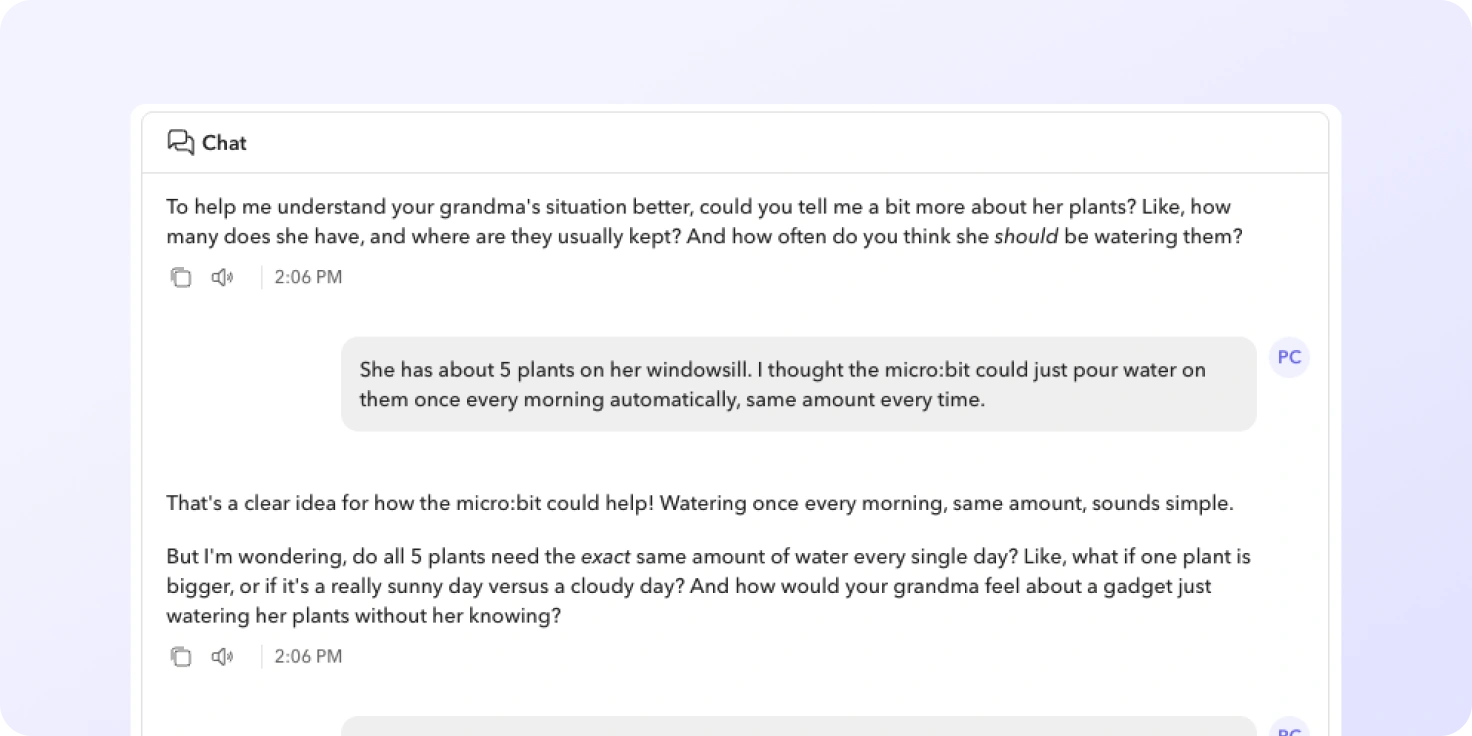
With the student as the interviewer, the AI plays a programmer with a life, a job, and a set of small daily frustrations. By asking good questions, students draw out what this person actually needs, then learn to hold off on solutions until the problem is clear. They leave able to state and justify a real need, and to name the research a microbit and code solution would require.
The conversation covers user research skills: asking open-ended questions, listening to understand, sorting answers into needs, pain points, and design opportunities, and building an empathy map or user journey from what the persona says. It ends with the student justifying the need and prioritising the research before any solution is locked in.
What are different ways you can use this idea
You could build a tutor where students interview:
- Users with a daily problem to solve: a nurse on a busy ward, a delivery cyclist in bad weather, a wheelchair user navigating a school, or a farmer checking soil moisture, each pointing towards a sensor or microbit solution.
- Clients for a design brief: a café owner who needs a queue counter, a teacher who needs a quiet-signal for the classroom, or a parent who wants a reminder system for an elderly relative.
- People testing an early prototype: a gamer trying a homemade controller, a gardener using a watering alert, or a commuter using a step-counter, so students practise gathering feedback.
Tutor instructions
- When the student starts, present a specific scenario where the programmer might use a product or service, showing clear goals, needs, and pain points.
- Answer as a believable person, revealing details like age range, tech comfort, daily habits, and specific frustrations such as repetitive tasks or debugging.
- Make sure those answers point towards a clear problem that code and a microbit could solve, without naming the solution yourself.
- Once the student switches to ideas, swap roles and ask them to teach the persona how their proposed solution would work, then react with feedback.
- Before any solution is settled, make the student explain and justify the need from the interview, then state and prioritise the research required to build it.
What this tutor evaluates
The tutor watches for whether the student skilfully conducts an interview, asks insightful open-ended questions, clearly identifies and justifies the need for a microbit and code-based solution, and effectively prioritises research points.
From the educator
For MYP design, 7th graders. They are taking on the role of a programmer and need to find a problem and use code, a micro-controller, and other parts such as electronic bits or cardboard, etc. to come up with a solution. Students at this level often dream up a solution first and then look for ways to make it fit the problem. The AI tutor in this case was very helpful in redirecting students back to digging deeper into the problem before thinking about solutions. They were able to use this skill to then explain and justify the need for a solution to their chosen problems without first choosing a solution. I appreciate that the AI tutor can differentiate and give multiple opportunities for students to improve their questioning skills. The tutor also knows the learning intentions and outcomes for this unit, which means it will narrow down the conversation to focus on the knowledge, skills, and understandings from the unit.